Showing posts with label Forest Hills Gardens. Show all posts

Thursday, July 2, 2020

Patriotism Forest Hills Style, July 5, 1920

By Michael Perlman

Forest Hills Gardens town crier
Back in 1914, the annual Independence Day festival was launched in the Forest Hills Gardens. This set off a tradition where committees, residents, and friends participated in a day-long program for all generations and interests in an exquisitely decorated and uniquely illuminated Station Square, as well as the Forest Hills Inn and Tea Garden, Olivia Park, and along Greenway Terrace. A most historical Forest Hills event was on July 4, 1917, when Colonel Theodore Roosevelt delivered his “One Hundred Percent American” unification speech at the LIRR Station to address WWI. Today, patriotism and tradition continue to echo in a modified form through Children’s Day at Flagpole Green in June. Let’s turn back the clock to July 5, 1920, which marked the 144th anniversary of America’s independence.

The ceremony on Village Green now Flagpole Green
Keeping in mind that the 1919 celebration cost $3,057.90, Dr. Thompson Tyler Sweeny, who served as the Chair of the 1920 celebration, requested that every Gardens family contribute an average of $10. It was anticipated as the greatest of Independence Day celebrations yet! The Forest Hills Gardens Bulletin published, “Not only were the birds singing cheerily to arouse the villagers from morning slumbers, but through the streets early on July 5 came the Town Crier calling lustily to all to come to the Green for the Flag-raising at 9:30.” The ceremony featured members of American Legion Post 630 and Boy Scouts Troop 2 under the direction of Harvey Warren, who served as Post president and scoutmaster. Uniformed servicemen and Boy Scouts assembled in Station Square and began marching to Village Green. After Warren played the part of a Colonial Town Crier, he changed into military garb. The flag was raised and a patriotic prayer was made. A chorus sang patriotic tunes under guidance of the famed Glee Clubs leader Bruno Huhn, with piano accompaniment by Mrs. Charles H. Scammell, who was considered “the foster mother of all good singing of Forest Hills Gardens.”

Children were ready to play games in Station Square at 10 AM, thanks to the direction of Dr. W. F. Seybolt.. The publication read, “There are between fifty and sixty very happy boys and girls who are wearing bronze and silver badges, won at the children’s games in canvas-covered Station Square between 10 and 12 o’clock.” It continued, “With kiddie car races, pillow fights, sack and relay races, a whole program of fun, speed, and skill was carried out.” The lineup also included games for adults such as a baby carriage race, football kicking and ball tossing, tilting matches, tug-of-war between easterners and westerners.

 
At 2 PM, Hawthorn Park became a baseball field where the “Inn Warriors” (the Inns) clashed with the “Station Square Cohorts” (the Outs). An umpire appeared in armor, while a batter wore petticoats. The Daily Star reported, “There will be no tennis this year, the committee having decided that tennis is so integral a part of the life of the community as to make a baseball game a greater diversion.” The Forest Hills Gardens Bulletin stated, “The Outs came nobly from the rear and put the winning run over the plate to the accompaniment of the deafening plaudits of the assembled throng.” It later read, “It was a dashing game, and the narrow margin of one run by which the Outs won their victory shows how closely it was played.” The Inns’ captain was Ray Bell whereas Edmund O’Shea led the Outs. 


By 4 PM, attendees were in tune for opera at Olivia Park, a natural amphitheatre. Milton Aborn directed a company which performed “Pagliacci” by Ruggero Leoncavallo (1892) and “Cavalleria Rusticana” by Pietro Mascagni (1889). The Metropolitan chorus featured 24 vocalists and the Metropolitan orchestra featured 17 members. Scenery was minimal to maximize on the park’s charming ambiance.

Between 5 and 7 PM, festivities included a home-cooked supper by the Women’s Guild of the Church-in-the-Gardens social room for $1, where the proceeds would benefit the Community House fund.

At 7:30 PM, they made their way back to Station Square for a band concert and the community Choral Club that performed several patriotic airs comprised of nearly 75 vocalists. Another highlight was music at twilight by the Regiment Band of the 22nd Corps of Engineers, a 40-piece band under Master George Briegel. The evening continued with dancing in Station Square at 9 PM, lasting until midnight. The Forest Hills Gardens Bulletin read, “The dance on Station Square, lighted by myriads of red, white, and blue incandescents, will fittingly close a happy family and community patriotic day – the Independence Day of 1920, long to be remembered”… “The decorations will consist of myriads of American flags interspersed with those of the Allies, all placed to produce the best effect.” It also stated, “All the lads and lassies, maids and matrons and escorts danced on the canvas covering until – well, why tell the hour – for the music was the best and the night balmy.” Over 3,000 people were in the audience and among the dancers, and Chairman Henry W. Hirschberg was commended for this final feature.

The festival offered a humanitarian aspect. Proceeds from the refreshment booth, which served ice cream cones, lemonade, iced tea, sandwiches, and cake, benefited the Big Sisters of Queens Borough. Based on the prior year’s partnership, the Big Sisters received over $200 and assisted seven children who would have traditionally ended up in institutions, and ultimately helped them find suitable homes. 

Reflecting on the festival’s success, the publication stated, “Our friends and relatives were here in such numbers that it was apparent that our village is growing, and that everyone likes ‘our party,’ as Dr. Sweeny, the chairman, called it.” It continued, “The most impressive and appropriate part of the program, in the humble opinion of the editor, was in the Flag raising and the singing of the newly christened Choral Club.”

A similar version was featured in Michael Perlman's Forest Hills Times column: http://foresthillstimes.com/view/full_story/27760129/article-1920s-patriotism--Forest-Hills-style


Monday, November 11, 2019

11/16 "Reflections of Historic Forest Hills" Art Show at Jade


The community is invited to historian & artist Michael Perlman's art show opening on November 16 from 6 PM to 8 PM. His exhibit, "Reflections of Historic Forest Hills" features his local architectural photography, often embraced by nature, as well as his restored vintage community images.

Jade Eatery is located at 1 Station Square, Forest Hills Gardens. Admission is FREE & a Happy Hour special will begin at 6 PM.

All prints are for sale, & his exhibit will be on display through 12/15. Please invite your friends.

Michael Perlman will explain his perspective on photography & the restoration process, as well as showcase local historic sites. A toast to an enjoyable evening & community spirit!

Facebook event page:
https://www.facebook.com/events/2679335875459647

Wednesday, September 18, 2019

The 6 Koi Art Show & Fundraiser, Jade Eatery & Lounge, 9/21 opening show & Event through 11/1


For Immediate Release

Rego-Forest Preservation Council Chairman Michael Perlman
unlockthevault@hotmail.com  (917) 446-7775
http://regoforestpreservation.blogspot.com

Artist & Gallery Owner David Chatowsky
davidchatowsky@hotmail.com  (401) 835-4623

“The 6 Koi” from Rhode Island to Forest Hills: Art Exhibition To Benefit New York Police & Fire Widow's & Children’s Benefit Fund
     
NEW YORK, NY & NEWPORT, RI (Sept 16, 2019) – “The 6 Koi” exhibit, sale, & fundraiser is running from September 15 to November 1, 2019 at Jade Eatery & Lounge at 1 Station Square, Forest Hills Gardens, NY, which offers a popular gallery where artists gather. 

All are invited to an art show, sale, & fundraiser on September 21 from 5 PM to 10 PM. The exhibit is being organized by artist, humanitarian, and multiple gallery owner David Chatowsky, a Rhode Island resident who is returning to NY for another artistic and humanitarian opportunity.
   
Ten percent of all sales will benefit the New York Police and Fire Widow's and Children’s Benefit Fund, which provides financial assistance and support to the families of NYC police officers, firefighters, Port Authority police, and EMS personnel who have been killed in the line of duty. This initiative is in partnership with Chatowsky’s friend Lyle Carey, who is running in the NYC Marathon to raise 4k for the charitable cause.
   
Local historian Michael Perlman said, “On a trip to Newport, RI last fall, I am proud to have met a very talented and unique artist and humanitarian, David Chatowsky, and bring him to Forest Hills, NY on two occasions for highly beneficial causes. The arts are universal and can serve as a platform for committing good deeds.”  All works of art are for sale and will be presented to the buyer by Jade Eatery & Lounge on the day of purchase.   

Patrons enter Jade Eatery & Lounge, which offers a rare koi pond, home to 6 beautiful koi fish. Chatowsky said, “These 6 Koi are the inspiration for my art show. I am very familiar with koi and aquatic plants, since I worked on an aquatic farm in Palm City, Florida in my early twenties, and helped raise koi. I also grew many water plants such as water lilies and lotuses.” 
    
Acrylic paintings that are on display include “The Jonah Koi,” “The Samurai Koi,” “Koi with Water Lilies,” and “Red and Green Koi with Lotus Flowers.” “I hope my paintings’ variation in sizes and the fact that some are in color and black and white will stimulate the creative process in patrons,” said Chatowsky. 


The exhibition bears the potential to positively impact Forest Hills and the world. Chatowsky explained, “Animals make our lives more interesting. Their colors enrich our landscapes. All animals are here for our enjoyment, and we are their stewards. Therefore, it is our responsibility to create areas within the urban environment for animals, so future generations can be graced by their presence.  It is very important to use the gifts we have been given to bring peace and harmony into this world.”   
  
Chatowsky feels a bit like Jonah after he exited the giant fish. He said, “Unlike Jonah, I am selling the giant koi fish, which took me back to NYC. My message is not that of repentance, but environmental stewardship.”  


The collaboration between a Rhode Island artist and Jade “signifies the willingness of people working together to create a better future,” according to Chatowsky, who opened his first D. Chatowsky Art Gallery in Portsmouth, RI in 2016, followed by a second in Newport last year. His third gallery recently opened on Block Island. His diverse accomplishments also include permanent mural installations at the Florida Museum of Natural History, owning art galleries in Florida and New York, and coordinating humanitarian art exhibits in Los Angeles and Boston.

For a sneak peek of David Chatowsky’s “The 6 Koi” paintings, visit: https://www.flickr.com/photos/8095451@N08/albums/72157710893585847

Event page:

###

Thursday, August 22, 2019

A Forest Hills Mystery... "Celebrity Walk"

By Michael Perlman


Every community has forgotten relics which either survive or have been concealed, demolished, or carted away and awaiting rediscovery. The latter is the case with “Celebrity Walk,” a collection of handprints and signatures in cement slabs which existed in the 1960s and 1970s along the perimeters of the lawns in front of one of Forest Hills Gardens’ most historic and storied buildings, the Forest Hills Inn. It evoked the ambiance of Grauman’s Chinese Theatre’s forecourt’s footprints and handprints feature.

“I loved coming up with press-generating ideas, including the creation of a Celebrity Walk in front of the hotel’s sidewalk cafe. Marketing seemed to come easily to me,” said Mark H. Fleischman, former owner of the famed Studio 54 nightclub and author of “Inside Studio 54” which features a memoir of his life. From 1965 to 1968, he co-owned the Forest Hills Inn and served as executive director, although he retained stock in the company that sold to the co-op and rented the restaurants.

Fleischman explained, “It was a real coup when we got Frank Sinatra to put his handprints into a block of wet cement when he headlined the Forest Hills Music Festival at the nearby tennis stadium. As soon as other celebrities heard about Sinatra’s handprints and signature, they agreed to be included in our Celebrity Walk when they performed.”

Other celebrities who followed included Barbra Streisand, Trini Lopez, Woody Allen, and Buddy Hackett. On August 17, 1965, locals picked up the Long Island Star-Journal and read, “The Forest Hills Inn has Frank Sinatra’s and Barbra Streisand’s handprints imbedded on their sidewalk pavement, but it had to get them the hard way. Both stars agreed to make the imprint, but refused to do it at the sidewalk. So wet cement was sent to both stars, the imprints made, and the hardened blocks were then inserted in the pavement.”

The same publication read that on July 8, 1966, Sammy Davis, Jr. was expected at the Forest Hills Inn to place his handprints in the hotel’s “celebrity sidewalk.” Fleischman reminisced, “I was also able to get tennis stars playing for the U.S. Championship to participate in our Celebrity Walk, including Rod Laver, Arthur Ashe, John Newcombe, and my hero from Spain where I attended summer courses at the University of Madrid, Manuel ‘Manolo’ Santana.”

In May 1965, the 300-room Forest Hills Inn and the adjoining apartments were sold for over $1 million to Martin Fleischman, who owned the Skyway Hotels at Kennedy Airport, and his son Mark Fleischman, a 1962 graduate of Cornell University’s School of Hotel Administration. At the time, it offered an English pub, cocktail lounges, a formal dining room known as the Windsor Room, a sidewalk cafe, what was originally named “The Tea Garden,” and four social function rooms accommodating 400 guests. “The Inn was a venerable hotel that looked like an English country manor,” explained Mark Fleischman. A draw was also its location in an upscale community and the proximity to Forest Hills Stadium, but yet it was in foreclosure. “I focused my energies with absolute determination and belief in my ability to revive the Forest Hills Inn, while also still committed to my duties as a Naval officer,” he reminisced.

Fleischman said, “Reviving the Inn involved more than just upgrading the food in the formal restaurant, the Windsor Room, and bringing in a new maĆ®tre d’. I had to change the stuffy attitude of the staff as well and went head to head with the Hotel/Restaurant Workers’ Union.” He hired some new personnel and transformed the Tournament Grill into the Three Swans, an authentic English pub that became a neighborhood success. At the grand opening, local VIPs and politicians attended, including Mayor John Lindsay.

Some local residents recall the existence of a tunnel with a series of catacombs, which may have connected the inn’s basement to the Clubhouse of the West Side Tennis Club. Rumor has it that a sidewalk construction project led to the relocation of the handprints, which may have been placed in the inn’s basement in a potentially concealed tunnel for safekeeping, possibly in the mid to late 1970s.

“I am unsure what happened to the slabs of cement, and my partner in charge of construction passed away many years ago, so I wouldn't know who to ask,” lamented Fleischman. In 2015 and 2017, a search began to rediscover and potentially resurrect the handprints at a secure location to be determined, to educate the public and commemorate diverse celebrities while celebrating Forest Hills history. A small but ambitious committee ventured into the Forest Hills Inn’s basement with flashlights and camera equipment, but on both occasions, the search yielded no results.

George Hoban, president of the board of the Station Square Inn Apartments Corporation is a member of the committee that began searching for the handprints. “I’ve personally looked through the bowels of the Forest Hills Inn for the infamous handprints and came up empty every time. I’ve never found photographic proof that they actually existed.” At one point, he said, “I’m beginning to think that the handprints may be an urban legend like ‘Bigfoot’ or the ‘Loch Ness Monster.’”

“It was an honor to be invited by this columnist, Michael Perlman, to explore the basement of the Forest Hills Inn to look for the signature and handprint slabs,” said Bea Hunt, co-chair of West Side Tennis Club Archives Council. “We searched every nook of the basement and learned much of the Inn's rich history. Unfortunately, we did not find any slabs, but I am confident that the search will continue. The West Side Tennis Club is extremely fortunate to have one slab in our archive.” It features the signatures and handprints of three famous tennis players from various decades, Jack Kramer, Bill Talbert, and Manolo Santana.

Upon viewing a photo of the sole cement slab that turned up in the West Side Tennis Club’s archives in more recent times, Hoban said, “The fact that Celebrity Walk existed is a testament to the rich history of the Forest Hills Inn, and we proudly honor that history as we continue to restore the Inn.” He is in favor of resurrecting Celebrity Walk in some form, if many slabs resurface. “We would need the approval and support of the Forest Hills Gardens Corporation and Friends of Station Square.” 

An alternate form of this article has been published in Michael Perlman's Forest Hills Times column:  http://foresthillstimes.com/view/full_story/27660871/article-A-Forest-Hills-Mystery--Celebrity-Walk

Tuesday, December 18, 2018

Long-Awaited Station Square Restoration Progresses


By Michael Perlman


Station Square is continuing to undergo restoration, brick by brick, after construction began in April and sections were fenced off to vehicular traffic. Last week, local residents and LIRR commuters observed workers reinstalling the historic brick surface along Continental Avenue, which many considered a breath of fresh air. In a time when many buildings citywide that merit preservation fall victim to the wrecking ball, Station Square’s restoration is a rare sight, and marks one of the largest restoration projects in Forest Hills history.

Station Square is the gateway to Forest Hills Gardens, America’s earliest planned garden community, founded in 1909. Inspired by Sir Ebenezer Howard’s Garden City Movement, the model residential development was designed by principal architect Grosvenor Atterbury and landscape architect Frederick Law Olmsted, Jr. Station Square accommodated a classy social life, particularly at the Forest Hills Inn, which opened in 1912 and offered 150 rooms, adjoining the Raleigh apartments on the east and the Marlboro apartments on the west. The LIRR Station, once accessible from the Inn through arcades and bridges sheltering residents and visitors from the weather, enabled a 13-minute commute to Manhattan. The Tudor village ambiance gave birth to historic events including annual 4th of July celebrations, Col. Theodore Roosevelt’s “100 Percent American” speech on July 4, 1917, and Helen Keller’s address to over 1,200 soldiers of the Rainbow Division that same year. 


Tony Barsamian, a member of the Board of Directors of the Forest Hills Gardens Corporation provided an in-depth view of the restoration. In order to upgrade utilities to meet 21st century standards, the overwhelming majority of original bricks were carefully salvaged and stored in Station Square and FHGC facilities. “We have cleaned and replaced every brick with either the original brick or custom-tailored bricks 100 percent to match the originals. We’ve padded them with the same sand in terms of how we lay them down. We don’t use mortar, since it cracks when it is icy or snowy, or water gets into it and then it freezes. We have gone out of our way to maintain it to hopefully last another hundred years.” 


In addition to addressing the roadway’s sinking elevation, Barsamian said, “We made improvements in the center island in terms of bringing it back to its original form.” He continued, “When you dug underneath Station Square, you saw that some of the lines and infrastructure elements were dated. Between National Grid and Con Edison and some other service providers, they came in and upgraded their connections to the homes and our community at large.” Water lines were also repaired. The plans will reportedly include the illumination of Station Square’s arcades.

Routine maintenance has been conducted annually, but not a restoration to this level, according to Barsamian. “This is a unique project that should garner great support from historians, since it will bring to life something that could have disappeared. We will probably be finished in February, but a ribbon-cutting ceremony or party may take place in March to welcome everyone to the beautifully restored Station Square.”

“When I watch bricks being put down in 2018, I imagine what it must have been like in the early 1900s,” said Barsamian. “I ask myself, ‘What were the original construction workers and masons thinking? Did it occur to them that they were involved in something so monumental that it has become a model throughout the country and the world, and when someone wants to create a planned historic village? Did the workers have any concept that the brick that they put down would still be walked and driven on?’ This is a throwback to an earlier time, and yet it was futuristic while designing from the past.” 


Barsamian owes much of the success to restrictive covenants. He explained, “A major reason that the community has been maintained for 100+ years is that homes are required by a covenant in their deed that they keep the integrity and structural soundness of the founding fathers’ established code. You cannot walk in and say I’m going to put in a checkerboard look or paint my bricks green and orange. People buy into the neighborhood knowing that there are restrictions on what can be done, and they need to seek our approval based on the community’s original design. That is why it is a timepiece, where you might as well be in an 1800s European Tudor village.”

Station Square’s restoration is not only marked by the most recent roadway project, but is witnessed along its Tudor facades. George Hoban, president of Station Square Inn Apartments Corporation, explained, “Over the past 10 years, our corporation has spent over 7 million dollars restoring our three buildings, and I don’t think people realize that it was funded entirely by less than 100 owners through assessments. People may also not realize that out of the hundreds of brick patterns throughout the buildings, each and every brick pattern is unique.”

Hoban also extended compliments to the Forest Hills Gardens Corporation and Friends of Station Square for their commitment to restoring and beautifying Station Square over the years, and said “The planning and logistics behind this project were obviously challenging, but they have come through flawlessly.” As a 21-year resident, he added, “I still feel a sense of joy each and every time I come home and see the beauty of the Square. I would see the surprised faces of New Yorkers coming off the LIRR into the Square for Forest Hills Stadium concerts and sensed that many were unaware such a beautiful and unique place existed in NYC.”

For another resident Dan Ziegler, who is the owner of Station Square Fight Fit at the Forest Hills Inn, he is also very pleased with the restoration of a town center with many paths. “When I come home, I almost feel like I'm in Europe. Famous people used to stay in my building, and I love how we can go for a stroll in the Gardens and look at mansions, or walk to Queens Boulevard for more of a city vibe. It's almost like ‘The Wizard of Oz,’ where you go through a door, and each door has something special.”

“Visitors may not realize that when you get an aerial view of Station Square with its bricks, it looks like a map of England,” said Gigmy Bista, manager of Jade Eatery & Lounge. “I cannot wait for the restoration to be complete. We would always have locals, commuters, and tourists taking pictures and hanging out, and it was really good for businesses.” Station Square is symbolic of his first time settling in America. “When I attended Queens College, I started working at Jade as a server and remember admiring the Square so much, having my meals on the Square’s bench, and feeling special. I always think of Jade and the Square as my second hometown.” 


A similar version of this feature has been published in Michael Perlman's Forest Hills Times column: http://www.foresthillstimes.com/view/full_story/27618913/article-Station-Square-restoration-moving-forward


Tuesday, July 3, 2018

A Forest Hills Tribute To July 4, 1918

By Michael Perlman

Chairman Eckman of 4th of July Celebration introducing Senator Calder, Station Square, 1918

Originating in 1914, the Forest Hills Gardens coordinated annual Independence Day festivals in exquisitely decorated Station Square with activities at the Forest Hills Inn and Tea Garden, Olivia Park, and along Greenway Terrace. One of the most communicated events was on July 4, 1917, when Colonel Theodore Roosevelt, the 26th U.S. president, delivered his “One Hundred Percent American” unification speech at the LIRR Station, pleading for a single standard of patriotism and loyalty to the America of George Washington and Abraham Lincoln, to address WWI.

Now it is time to turn back the clock to the 1918 festivities, which were also meaningful, but yet, long-forgotten. Today, patriotism and tradition continue to echo locally in a modified form, particularly through Children’s Day at Flagpole Green in early June, although a century ago large-scale Independence Day celebrations were held on the actual day. 


Flag raising ceremony on Village Green, July 4, 1918

A flag raising ceremony proceeded on Village Green (now Flagpole Green), and Reverend Joseph McLaughlin of Our Lady Queen of Martyrs delivered an address. H.E. Conway read excerpts of Secretary Franklin Lane’s address and patriotic songs were recited. Tennis matches were played on courts that once occupied the site of The Inn Apartments, and the Obstacle Race was an attraction among the popular children’s games feature in Station Square. In Olivia Park, students of the noted Louis H. Chalif dance school at 165 West 57th Street performed the Twilight Symphony, an interpretative dance. 


Samuel W. Eckman, who served as Chairman of the Fourth of July Celebration, introduced Senator William M. Calder, who delivered an eloquent address resulting in rounds of applause by several hundred attendees throughout Station Square. His speech consisted of “The country owes a debt of gratitude to General Leonard Wood and Colonel Theodore Roosevelt for their work in stirring up the sentiment on every hand,” and “We are a long way from success, but we mean to fight it out to the last man, and we must all be ready to answer the call and to stand behind the government.” As a native Long Islander, he felt that Forest Hills was especially delightful, and he praised our community spirit.

Senator Calder felt that one of our most important achievements was passing the draft. He explained that “it put all men, the rich and poor alike, on terms of equality.” He established confidence for our future, based on the success of achievers including Harold Davies (WWI veteran) and Charles Schwab, the famed steel magnate.

Senator Calder discussed America’s conditions in its early days such as the Civil War, and pointed out our fight to free a portion of the human race. “We are now as never before a united people,” he said. “This is a war for justice to nations and to men, and when it is over, the treaties of peace must have a clause in then which should assure to all nations a just and complete peace. We must never forget our obligations to France in the time of the Revolution – how they helped us then and how we should help them now.”

He continued, “While America welcomes the oppressed of every nation to her shores, they must when they come join heartily in building up the honor and glory of the United States. We should here today consecrate ourselves anew to the cause of America and to the just war that she is engaged in.”

The agenda continued with “The Spirit of Play,” a masque presented by children, and character and patriotic dancing followed. Evening festivities consisted of dancing in Station Square, in addition to Camp Upton soldiers performing musical numbers. At the Church-In-The-Gardens, wounded soldiers and sailors of WWI were guests of honor at a dinner.

A great success resulted from the collaboration of various committees such as “Soldiers and Sailors” chaired by L.M. Burt, “Printing” by the prolific American type designer and printer Frederic W. Goudy, “Posters” by famed artist Herman Rountree, “Red Cross” by Mrs. Leon D’Emo, “Entertainment and Program” by John M. Demarest of the Sage Foundation Homes Company, and “Dances and Music” by W. Leslie Harriss.

A similar version has been published in Michael Perlman's Forest Hills Times column:
www.foresthillstimes.com/view/full_story/27581231/article-A-Forest-Hills-Tribute-on-July-4--1918?

Wednesday, April 18, 2018

Station Square: Restoring The Gateway To Forest Hills Gardens

By Michael Perlman

The talk of the town is the much-anticipated Station Square Restoration Project, announced last week by the Forest Hills Gardens Corporation, which maintains the character of Forest Hills Gardens, an earliest planned garden community in America, originating in 1909.

The Forest Hills Inn triumphs over the stately Station Square, Photo by Michael Perlman, November 2015


Station Square, November 2015 photo by Michael Perlman
A statement read, “This will be a multi-faceted project with many phases, and involving more than just the restoration of the historic road surface. All the public utilities will also be upgraded, including their infrastructure, once the roadway is opened.” The project will commence this week and continue through 2018. While vehicular traffic will be off limits east of Continental Avenue, emergency vehicles will be permitted. 

Station Square circa 1916 to 1920 postcard, Courtesy of Rego-Forest Preservation Council
Local residents began to discuss Station Square’s history and their hopes for a community anchor. Sir Leonard Lombard, a director of the Station Square Inn Apartments Corp said, “What makes its ambiance unique is the whimsical Arts & Crafts style that the architects employed, combined with the fantasy-like Neuschwanstein romantic road castle. The architectural and cultural history, which was in vogue at that time, is unlikely to be duplicated with today's technology and state-of-the-art construction methods.” He hopes the restoration will continue with the facades. “I hope to see a more unified commercial look and more upscale shops along Station Square.” 
Inspired by Sir Ebenezer Howard’s Garden City Movement, this model residential development was designed by principal architect Grosvenor Atterbury and landscape architect Frederick Law Olmsted, Jr. Station Square accommodated a classy social life, particularly at the spire-adorned Forest Hills Inn, which opened in 1912 and offered 150 rooms, adjoining the Raleigh apartments on the east and the Marlboro apartments on the west. The LIRR Station, accessible from the Inn through arcades and bridges sheltering residents and visitors from the weather, enabled a 13-minute commute to Manhattan. Historic events transpired, including annual 4th of July celebrations, and at the Station, where Col. Theodore Roosevelt delivered his “100 Percent American” speech on July 4, 1917, and Helen Keller greeted over 1,200 soldiers of the Rainbow Division that same year. 

LIRR Station with original fountain as the centerpiece circa1915, Courtesy of Susanna & Robert Hof
When guests and prospective residents of the Forest Hills Gardens picked up a copy of “Forest Hills Inn,” an early 20th century illustrated pamphlet by philanthropic organization Russell Sage Foundation’s subsidiary, Sage Foundation Homes Company, they learned about the Gardens’ benefits of location, education, and business, as evident by the planning of parks and open spaces alongside homes with architectural treatment. It read, “Grouped around the arcade, through whose arches may be seen the Common, the groves, and the homes of Forest Hills Gardens, are attractive stores and shops that supply every normal want. In the center of the Square, the play of a fountain adds to the vivacity and charm of the scene. The architecture and plan of Station Square have been designed to provide an attractive spot for the common use and pleasure of residents. Beauty, harmony, and utility are here combined in a unique way.” 

Grosvenor Atterbury's sketch of Station Square, circa 1909 - 1910, Courtesy of Susanna & Robert Hof
One couple who builds upon the history of their families living in the Gardens since its origins is Susanna and Robert Hof, owners and managing brokers of Terrace Sotheby’s International Realty, which occupies three Station Square storefronts. Since pedestrians will be channeled onto the sidewalks, he said, “We see it as a net neutral or even positive aspect for businesses.”

The project will preserve and utilize the roadway’s authentic bricks, which will be stored in a loading area along Greenway Terrace. Robert H. explained, “The distance between the roadbed and the sidewalk has deepened. The brickwork, in the pattern of a Union Jack is sacred, and where there are gaps, they will be filled in with proper vintage bricks of the same type and acquired potentially from Upstate New York.”

Susanna H. provided further insight. “As part of the plan, the Forest Hills Gardens Corp. is trying to work out the details to restore the large decorative lanterns that hang from the facades.” The center island is also expected to be repaired, which is where a fountain once provided water for horses, and then around 1916, two kiosks were added and would function as police and taxi outposts. “It is wonderful how it evolved into a sitting area,” she said.

In a joint statement, they explained, “We are very enthused over the restoration plans, and thank Assemblyman Andrew Hevesi, who was instrumental in arranging a grant which helps all of us.”

Wendy Bachman, president of Friends of Station Square admires how Station Square was described as "one of the finest public spaces in America" by Robert A.M. Stern, former dean of the Yale School of Architecture and founder of architectural firm RAMSA. “The LIRR, Forest Hills Gardens Corporation, and Friends of Station Square collaborated for over 25 years to raise funds and seek guidance in maintaining this American architectural jewel,” she said.

Past restoration success stories include the center island in 1995, the LIRR Station in 1999 after being deemed “National Register - Eligible,” and landscaping as the result of the Millennium Appeal from 2000 to 2001. She continued, “The guts of the square need a complete overhaul. After the restoration is complete, my hope is that it will take another 100 years before any work of this magnitude.” 

The Sage Foundation’s 1912 ad read, “Endowed by nature with every beauty, the country is disfigured by towns, cities, and suburban developments which make a sorry and hideous spectacle. Our rapid growth may be a reason for our having neglected to take some thought of how we were planning and what we were building, but the time has come for more forethought, and this excuse should no longer be tolerated.”

This precise planning lives up to its testament. “I feel truly blessed to live in Station Square and love looking out my window, seeing the clock and life in Forest Hills Gardens passing by, changing with seasons,” said Mr. James, who embraces the turn-of-the-century ambiance. He continued, “One observation is the expression on people's faces when they step off the LIRR for the first time, wondering where they are, and amazed with what they are seeing in Queens.” 

Forest Hills Inn & Station Square with ivy, 1966 postcard courtesy of Rego-Forest Preservation Council

A similar version appeared in Michael Perlman's Forest Hills Times column: www.foresthillstimes.com/view/full_story/27562259/article-Restoring-the-Gateway-to-Forest-Hills-Gardens-

For updates on the Station Square Restoration Project, email the Forest Hills Gardens Corporation at info@fhgc.org  

Monday, December 21, 2015

Dec 27: FREE Forest Hills Gardens Tour!


FREE Forest Hills Gardens Holiday Tour on Sun, Dec 27 from 2 PM - 4 PM. 


Please add your friends to the event page & share over social media.

We will visit historic sites including the storied Forest Hills Inn & Tea Garden, PS 101, The Leslie, Adolph Weinman's WWI Soldiers & Sailors Memorial, Church-in-the-Gardens, & the Christian Science Church. Also to be explored is the Gardens' celebrity culture with names i.e. Burt Bacharach, Fred Hart, & Alrick Man, Jr.

We will meet at Station Square outside the LIRR Station at Continental Ave & Burns St. Please join Jeff Gottlieb (Central Queens Historical Association, President), Michael Perlman (Rego-Forest Preservation Council, Chair, & Legendary Locals of Forest Hills and Rego Park, Author), & Cheryl Cuddeback (longtime resident, author, & real estate salesperson).

The forecast is predicted to be mild. Questions? Email jeffgottlieb@hotmail.com & unlockthevault@hotmail.com  


Friday, December 4, 2015

Dec 6: FREE Historic Forest Hills Tour!


FREE Historic Forest Hills Tour on Sun, Dec 6 from 2 PM - 4 PM.
We will explore stately residential buildings, the business district, & the Forest Hills Gardens. We will meet at La Boulangerie at 109-01 72nd Rd. Please join Jeff Gottlieb (Central Queens Historical Association, President), Michael Perlman (Rego-Forest Preservation Council, Chair & Legendary Locals of Forest Hills and Rego Park, Author), & Susanna Hof (Terrace Sotheby's Realty, Principal).


Questions? Email jeffgottlieb@hotmail.com & unlockthevault@hotmail.com

RSVP on Facebook: www.facebook.com/events/1513120738986003


Saturday, November 21, 2015

Help Solve Forest Hills Gardens Mysteries & Rediscover Relics


Copyright Michael Perlman
Forgotten Past of The Forest Hills Gardens by Michael Perlman

- Why did the handprint & footprint concrete slabs featuring celebrities outside the Forest Hills Inn, once known as "Celebrity Walk" vanish?
- Why are the 2 concrete eagles at the base pedestals of the Forest Hills Tennis Stadium nowhere to be seen?
- Why is the only remnant of the Sun Dial on Village Green a 4-hole pedestal?
- Why & when did the historic Fountain of Piping Pan in Olivia Park vanish?
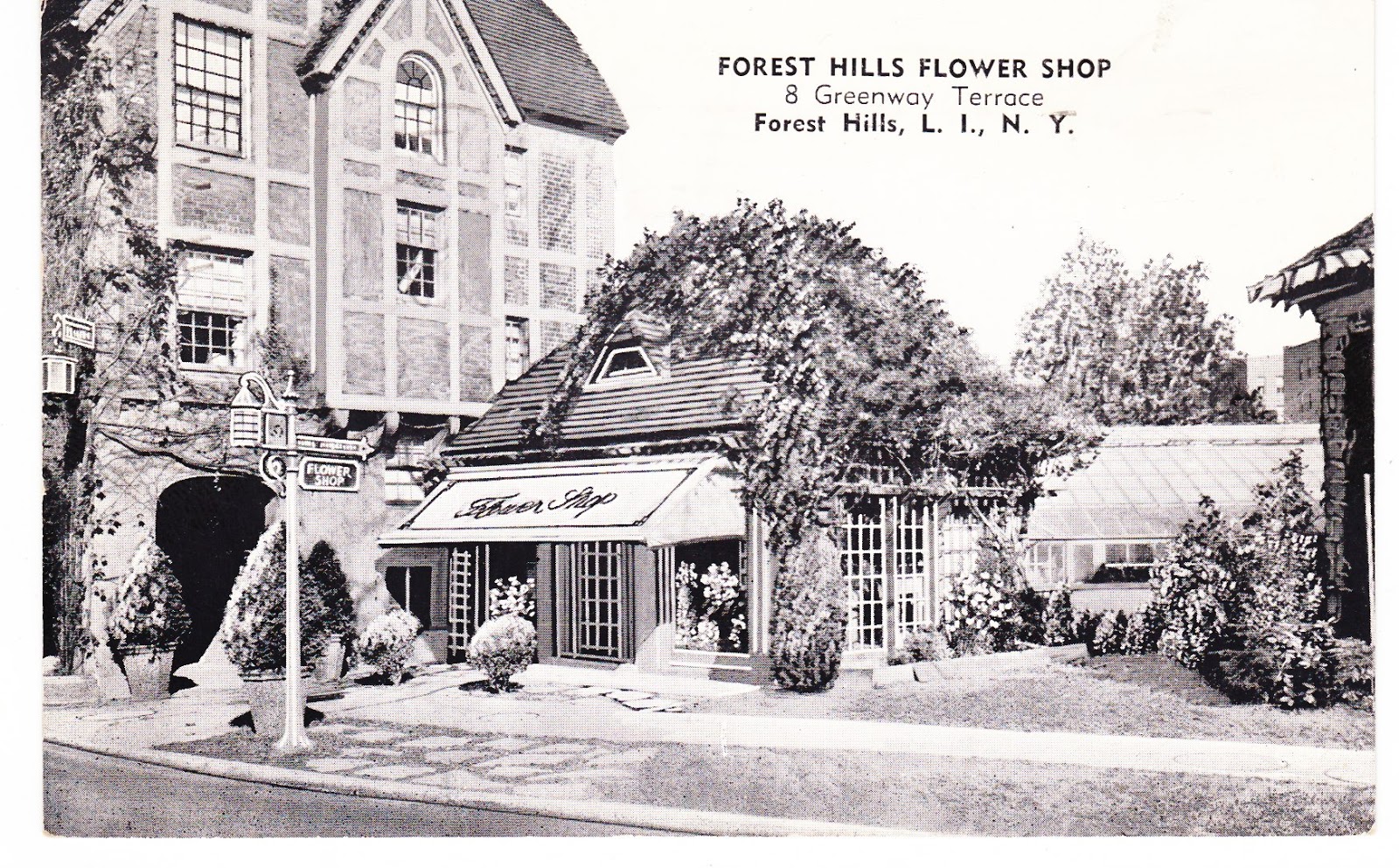
- Why is 8 Greenway Terrace, which  contains a greenhouse that once belonged to the popular Forest Hills Flower Shop left vacant in the exclusive Forest Hills Gardens for approximately 15 years?
- Will the Tea Garden see new light?
- Is the Forest Hills Gardens' standalone stone mailbox post the last of its kind locally?

Forgotten relics and some mysteries are very much alive in our backyard, and such is the case in the Forest Hills Gardens.

Established in 1909 as America's earliest planned garden community, Tudor and Arts & Crafts homes on winding streets featuring lush landscapes add up to a predominant preservation success story, thanks to restrictive covenants administered by the Forest Hills Gardens Corporation.

Principal architect Grosvenor Atterbury and urban planner Frederick Law Olmsted, Jr. would generally be content, despite the few features that have vanished.
Copyright Michael Perlman, 2015
On Village Green, situated along Greenway Terrace, one comes upon a pea gravel pedestal with four holes. Affixed to the top was once the “Sun Dial.” The pathways which extend from the pedestal are symbolic of the sun’s rays providing contrast from the lawn.

Back in 1915, it was boasted by The Newtown Register as “a very attractive feature which was depended upon as giving the correct time when the sun shines.”

Copyright Michael Perlman, 2015
Olivia Park offers a most intimate setting, but a tranquil and functional feature once known as the Fountain of Piping Pan has long vanished. In 1915, The Sun published, “The presiding genius of the fountain is a small nude boy in plaster playing a pipe and the water tumbles over the stones at his feet down into a miniature lake, where the birds may disport themselves as in one of nature’s own sylvan retreats.”

On July 4, 1915, with a local branch of the Audubon Society on scene, the fountain, designed by Beatrix Forbes-Robinson Hale, was dedicated to Margaret Olivia Slocum Sage, who was kindly regarded for her passion to birds.

Also part of her acclaim was her establishment of the Russell Sage Foundation, which sought to improve the social and living conditions in the United States.

Her vision was realized as this park often served as a natural amphitheater, where Irmgard, Baroness von Rottenthal performed interpretative dances at the ceremony to the sounds of Grieg and Tchaikovsky.

Copyright Michael Perlman, 2015
At 8 Greenway Terrace stands an Old English single-story Forest Hills Flower Shop with an adjoining greenhouse that opened in the 1920s as florist and landscape contractors, but shuttered around 1998.

“The florist John J. Loguercio ran the shop for many years, and would employ some of the local teens as delivery boys, including one that became an M.D. Andre, who now owns Forest Hills Flowers & Blossoms on Metropolitan Avenue, began working for John,” recalled Forest Hills native Maria Swanson.

“It was a beautiful spot with climbing roses and window displays,” added Kew Gardens resident Eileen Mahoney, who was raised at 14 Greenway Terrace. “Everyone in the neighborhood had him provide flowers for their weddings. Neighborhood Christmas trees and wreathes were purchased there.”

Copyright Michael Perlman
“It saddens me that some of these unique features have disappeared,” said Swanson, who recalled concrete slabs in front of the Forest Hills Inn, which consisted of Forest Hills’ Celebrity Walk.

On site were entertainers’ handprints and footprints. They included Frank Sinatra, Barbra Streisand, Sammy Davis, Jr. and likely Buddy Hackett, The Beatles, The Marx Bros, Betty Davis, Charlie Chaplin and John Wayne.

“They were possibly removed in the late 1970s,” she continued.

Former Forest Hills resident Steven Grimando was on scene at the time the slabs were salvaged during a construction project.

“They were framed in wood and placed on dollies, two at a time,” he said. “Under the Forest Hills Inn, there’s a ramp with doors, and the slabs were then placed deep within a series of catacombs.”


Copyright Michael Perlman
As the Inn was a center of a classy social life prior to its residential conversion in 1967, the Tea Garden, nestled behind the Inn was in full swing. Opened in 1912, it was once the site of afternoon teas, weddings, dances, and productions by The Gardens Players that took inspiration from the natural setting.

Guests would dine to the Inn Trio’s performance of Nevin’s “A Day in Venice” and Dvorak’s “Humoresque.” Today, behind an ornate gate on Greenway Terrace stands majestic trees and a defunct central brick fountain, but the cascading wall fountain has vanished. Now plans are underway to restore the Tea Garden.
Copyright Michael Perlman
On a stroll among forgotten spots, locals can stop at presumably the last pea gravel mailbox post on Ascan Avenue and Greenway South, which bears a 1938 inscription. The mounted miniature mailbox is long gone, but to its right is a more familiar 1950s-era blue mailbox.
The long gone eagle & Bill Tilden in 1937 at Forest Hills Tennis Stadium
And a couple of concrete eagles have mysteriously gone missing from the Forest Hills Tennis Stadium, which was designed as America’s first tennis stadium in 1923 by architect Kenneth Murchison and built by The Foundation Company.

Bea Hunt, former vice president of the West Side Tennis Club, noticed the pair in photos through the 1950s, but then examined a Rolling Stones concert photo marked July 2, 1966, where the eagles were missing.

“Today there are 11 concrete eagles at the upper faƧade overlooking the amphitheater, but originally an eagle stood on each pedestal at the lower ends of the horseshoe,” she said.


Source: Queens Ledger - Forgotten Past of The Forest Hills Gardens 


Thursday, June 19, 2014

Touring Forest Close & the Forest Hills Gardens with Architectural Historian Barry Lewis

By Michael Perlman, Rego-Forest Preservation Council Chair & Forest Hills Times Columnist


On a warm Saturday morning, nearly 40 residents of Forest Hills and other communities gathered in Station Square, to begin their weekend with a tour of the Forest Hills Gardens and Forest Close. Many anticipated their first encounter with notable architectural historian Barry Lewis, who conducted historic NYC tours, televised on Channel Thirteen, and wrote the book, “Kew Gardens: Urban Village in the Big City.”

This tour was made possible by the Historic Districts Council, NYC’s largest citywide preservation advocate. It is part of the non-profit’s “Six To Celebrate,” where the HDC will offer tours of the neighborhoods which encompass the six preservation-worthy selections of 2014 between June and October. HDC Preservation Associate Barbara Zay explained, “These tours serve to highlight neighborhoods that many New Yorkers are unaware of, and in places that are more heavily trodden, to shine a light on unknown aspect of their history or built environment.”


The Forest Close Association nominated Forest Close, an assemblage of rowhouses designed in 1927 by Robert Tappan, a client of Cord Meyer Development Company. It is bounded by 75th Road, 76th Avenue, and Austin Street. Zay explained, “The HDC seeks to raise awareness of this delightful neo-Tudor enclave and explore opportunities to further protect it for future generations. The Association is concerned about new developments and real estate projects in its surrounding neighborhood that could threaten the Close’s sense of place.”


“Town home living in Forest Close and nearby Arbor Close allows for gardening, outdoor dining, or winter reading by the fireplace,” said Forest Close resident Elisa Barsoum Losada. “Each home has a private patio overlooking a shared common green space and has doorbells on the patio and front doors. These features encourage a sense of community, and allow neighbors to live and work together throughout the seasons.”

“Contemporary architects and developers can take a lesson from the design of Forest Close,” said Joanne Wasti, who opened her home and served fine cookies and lemonade. She explained, “As people become more aware of their carbon footprint and green design, Forest Close is an example of a design emphasizing community and away from the car culture. The shared garden area also helps with run-off and cools our homes in the summer.”

The Association maintains a covenant which regulates changes to its architecture and open space, similar to the Forest Hills Gardens Corporation, which upholds restrictive covenants governing the Forest Hills Gardens.


Established in 1909, the Gardens is America’s earliest planned garden community. It originated when the Russell Sage Foundation purchased land from the Cord Meyer Development Company, and Principal Architect Grosvenor Atterbury and Landscape Architect Frederick Law Olmsted, Jr. developed what would become an internationally recognized model of urban planning. Tudor and Arts & Crafts mansions, a few apartment houses, the Forest Hills Inn, religious institutions, and outdoor and indoor recreational features can be found.

Barry Lewis highlighted the community’s history and clever design principles. Station Square was conceived as a town center, which merges residential space with an inn, shops, and the LIRR station. Lewis explained, “Atterbury’s walkway system around Station Square is brilliant. He figured, ‘Why should people staying at the Inn have to schlep their luggage outside?’ He created over the street bridges and a walkway system that goes through the buildings.” He continued, “This is urban thinking. Not suburban thinking. It’s about civilizing the city’s way to live in the industrial era.”


Lewis glanced across the way at The Inn Apartments (separate from the Inn) and pointed at the oversized casement windows. He said, “These architects understood that modern people wanted light and air in their apartments. The waffling allows for a multiple exposure.” He continued, “There was a feeling of security and coziness using distressed brick over fieldstone, which gives a rugged feeling of civility.”

Addressing front lawns of homes, Lewis pointed out that most are not fenced in, which can be attributed to covenants. “You would get off the train from NY, where everything follows a grid street system and felt claustrophobic, but here you would have a feeling of openness,” he said.

Every community faces some controversy over development. Lewis addressed the last lot to be developed, which is where The Leslie apartments stands. The site was formerly the Russell Sage Foundation’s sales office and the Austin Hanks house, where the lone surviving family member refused to sell for redevelopment’s sake. Not long after she died, The Leslie was completed in 1942.

The Leslie’s advantages were sunken living rooms, artist studio windows, social rooms, and indoor and outdoor play areas. Additionally, he stated, “An entire city block is completely surrounded by gardens. This was a template for some white brick apartment buildings of the post-war period such as the Manhattan House.”

The Community House
Another stop was Atterbury’s 1926 Community House, which contains a theater, a social hall, and basketball courts. Lewis said, “There was room for everybody. It was very common in a quality community development to have a clubhouse.” He related it to garden communities of Jackson Heights and Kew Gardens. Other historic sites that Lewis featured were the West Side Tennis Club, the Church-in-the-Gardens, the Tea Garden, Hawthorne Park, PS 101, and the Holland House just beyond the Forest Hills Gardens.

The Church-In-The-Gardens


“Protecting places such as the Forest Hills Gardens and Forest Close is important, for it is part of the fabric of New York City,” said Elmhurst resident Helen Chin. “It is unique not just terms of community, but in architecture, design, and urban planning. What was incredible is how soothing and nurturing the environment was.”

A similar version of this feature was published in Michael Perlman's Forest Hills Times column: http://foresthillstimes.com/view/full_story/25273891/article-Closer-look-at-two-significant-neighborhoods