Showing posts with label Forest Hills Times. Show all posts

Friday, May 21, 2021

Preserving The Memory of Acclaimed Sculptor Arnold Stone

By Michael Perlman

Floating Leaves sculpture fountain by Arnold Stone, Photo by Michael Perlman

Most recently, the nearly 2-story “Floating Leaves” sculpture fountain of the shuttered Parkside Chapel at 98-60 Queens Boulevard in Rego Park, was relocated off-site. This was after Rego-Forest Preservation Council’s initiative to secure an early 1960s prized work by the late sculptor Arnold Stone to a new home, ideally at a nearby cultural institution. Parkside Chapel by notable architects Henry Sandig and Robert Kasindorf, was designed as tribute to the Israelites, the Ten Commandments, and the Sinai desert, and offered a Modernist twist on traditional symbolism. 

Arnold Stone building the Floating Leaves sculpture fountain in Sea Cliff, Courtesy of Paula Stone

Arnold Stone, an award-winning sculptor, painter, illustrator, and a dentist, passed away at 49 in 1971, but his memory is very much alive thanks to Paula Stone Borge, his daughter, and Robert Andrew McKie, his stepson, who are preserving his artwork and sharing stories. 

Dr. Arnold Stone, a native of Boston, relocated to Flushing, Bayside, and then a Victorian at 285 Prospect Avenue in Sea Cliff, a seaside L.I. village which became increasingly known for its Bohemian character and art galleries. Dr. Stone’s extensive rundown of exhibitions included The Heckscher Museum of Art, Guild Hall, the Alba House Gallery in Sea Cliff, Plandome’s North Shore Unitarian Center, and the Ruth Dean Garden.    

Stone considered Sea Cliff as an ideal place to call home. “The town was filled with sailors, musicians, painters, sculptors, and writers. Children were free to explore the many parks and beaches and ride bicycles everywhere. Our living room was always filled with a diverse group chatting about the social and political concerns of the day.”

Her room overlooked her father’s studio, where “Floating Leaves” among other prized works were born. She recalled, “I felt happy falling asleep to the sound of his sledgehammer hitting the anvil. He would listen to a jazz program by Ed Beech, and would call in to the station with requests, and Ed Beech would say, ‘Here is one for Doc out in his studio.’” She continued, “I loved the cozy feeling of knowing he was in the studio, doing something he loved.”  

The concrete garage yielded a fireproof setting for welding sculptures out of metal, using a forge, various torches, and anvils. She said, “There was also plenty of room for painting, carving stone, and drawing. It was very light inside, due to skylights and large windows overlooking Hempstead Harbor.”  

Stone remembers her father creating the sculpture fountain in his studio, during her childhood. She explained, “It is comprised of a series of large copper pans, shaped to resemble leaves. Angular lines of steel surround it, providing a contrast to the warmth of the copper leaves and the solid copper wall (which was until recently behind the sculpture fountain). I think the contrast between the interesting strong straight-edged lattice and the flowing leaves filled with streaming water is like modern architecture set among natural elements.” Her father was a fan of Frank Lloyd Wright. She continued, “I think about the cooperation between manmade elements and structures and nature. Copper is a natural element in the earth, but steel is manufactured. It is also suggestive of the contrasts in our lives.”

Her father created smaller fountains for residences, sculptural features for public spaces, and freestanding sculptures for many private collections, but this was the largest public work. She explained his passion for fountains. “It provides a lovely atmosphere for reflection and meditation and symbolizes the flow of life. We lived on the edge of Long Island sound and loved the sound of waves, seagulls, and the fog horn we could hear at home. His goal with this fountain was to provide a simple, beautiful, peaceful space for feelings and thoughts.”

She would work as a professional photographer and cover the news. Aside from music, she and her father produced art. “My father taught me how to carve stone, and we made jewelry together. I was with him while he made his artwork and gardens.” She feels that her interests of visual arts, music, theater, and science mirror those of her father, who was very interested in architecture. We also always try to help people. We grew up attending marches for equality and demonstrating to end the war in Vietnam.”  


Arnold Stone at his exhibition with Metamorphosis & Mississippi Jury, Courtesy of Paula Stone

Stone and her brother take pride in being the stewards of some of his sculptures, but explained, “He made so many, and we do not know who bought them and where they are.” They have Mississippi Jury, Monument, SST, ABM, Icarus, King Canaveral, Metamorphosis, another tall figure and anti-war figure, and several table top figures and abstract sculptures, and some metal and carved stone.

She said, “We would love to know who has the largest anti-war piece, a soldier’s head mounted on two large wagon wheels balanced by two bowling balls below, and we would like to know about a very tall, life-size Metamorphosis. We would like to know about any of his works, since we have no records.”

“The legacy our father leaves behind is one of savoring life, education, taking an interest in current events, trying to make a better world, enjoying the marvels of the earth, and biology, geology, technology, theater, dance, music, painting and sculpture, and humor,” said Stone. She admires his love with life and curiosity about everything. “He helped me learn how to find joy and wonder in almost everything, and to approach life with empathy, affection, humor, and gratitude.”

Robert Andrew McKie explained his stepfather’s interest in literature, art, and music. “He was an authority on jazz. He was a drummer throughout college. His interest in led him into early experimentation in high fidelity sound reproduction, which back then meant building a lot of your own equipment. About this time, he decided to exercise some of his G.I. Bill benefits and take courses at the New School for Social Research. At first, he made jewelry, then took painting and sculpture classes.” Today he takes pride in carrying on Dr. Stone’s interest in music, love of books, and fascination with museums.

McKie was a very early computer scientist as of 1965. He was a visiting engineer at MIT, working on Project Athena, which was to revolutionize how undergrads were taught as in an interactive multimedia system.

He remembers Sea Cliff in 1958 for its great mixture of residents. “On our street, we had a Wall Street lawyer living next to a plumber, who in turn had a concert violist as a neighbor.”    

McKie pointed out that while Dr. Stone served his dental practice patients with care until his death, his heart was not in it. “He would often duck out between scheduled patients to work in the studio. His arms became very muscular with all the metal and stone work. Generally, he would work long hours in the studio, often just dashing to eat quickly and return.” 

As for the sculpture fountain, he said, “It should take a very special space, as it was designed around a corner alcove. I would consider contributing to its resurrection, and as for other works, I would love to see them on public display permanently. I would consider giving up ‘Mississippi Jury’ to the right venue.” McKie also owns one small painting from the ‘Bayside’ days of a series of clowns/mimes, an alabaster hippopotamus, an oil painting of a hippo, a bronze seagull, and his record collection.

Many friends from his Sea Cliff days have pieces of Dr. Stone’s artwork, which they cherish. One of his friends is Jerry Zimmermann, who said, “Arnie will never die. He is a force in all of our memories. The 50 years from his passing seems like an instant relative to the force of his being." 


Saturday, February 6, 2021

Sweet Memories of Eddie’s Sweet Shop as Witt’s Confectionery & Ice Cream

 By Michael Perlman

Eddie's Sweet Shop, January 2021, Photo by Michael Perlman

Forest Hills is known for tennis, music, and of course ice cream! Eddie’s Sweet Shop at 105-29 Metropolitan Avenue holds the record for the most intact and what is likely the longest continuously operating ice cream parlor citywide.

In July 1979, artist Randy Jones sketched “The Great Ice Cream Safari” comic strip for The New York Times, which featured an elephant touring ice cream parlors, an endangered species. Eddie’s Sweet Shop was saved for last, where a patron on a swivel stool said, “This antique parlor would make a fine trophy in the Smithsonian!”

That vision continues today as patrons encounter vintage signs with Coca-Cola insignias and thematically decorated windows with stained-glass reading “Candy” and “Ice Cream.” Around 20 homemade flavors are prepared on the premises along with fresh whipped cream. Original flavors include rum raisin, butter pecan, and tutti frutti.

Patrons can sit on the same cast-iron swivel stools their great-grandparents sat on and enjoy a sundae or a float at the mahogany and marble counter facing stenciled built-ins and one of the first electric Frigidaire freezers. The authentic ambiance also features a honeycomb pattern mosaic floor, a tin ceiling with rose stamped molding, leaded glass windows with a sunburst and tulip motif, and tapestry appointed woodwork topped off by a wall clock by the pioneer Seth Thomas Clock Company.

In 1925, a 2-story brick building with a corner entranceway was filed and Seelig & Finkelstein drafted blueprints. One of the earliest owners was reportedly Mr. Krohn, followed by Schaefer. Around the mid-1940s, the shop was renamed Witt’s Ice Cream & Confectionery after owner William Witt, a German immigrant. When Witt retired, he sold the shop to the Citrano family in 1968, and it became a success ever since. Giuseppe and his son Vito Citrano and wife Angelina are cherished Forest Hills personalities. Three generations worked alongside one another until Vito’s grandpa, also Vito, passed away in 1995.

Three generations of the Citrano family in the footsteps of the Witts, 2014 photo by Michael Perlman 

Much of the shop’s history prior to 1968 is undocumented, but is being rediscovered thanks to the memories of patrons. Owner William Witt and his wife Elsie, who were often addressed as Mr. and Mrs. Witt, as well as their daughter with the same name, would also be proud.

Michael Dillon lived around the corner on Nansen Street since 1953, and after playing ball in the street with his friends, Witt’s was the go-to place. He said, “In the mid-60s while working at Associated Food Stores on Metropolitan Avenue, I was fortunate to deliver sugar and get a glimpse of all the wonderful ice cream making machines. The Witts were always such kind and lovely people, who always reminded me of the ideal grandma and grandpa.”

“My father, Joseph proposed to my mother, Clara at Witt’s. It was a fine treat for our parents to take my sisters and I on a walk there in the summer, and we always sat in ‘Mom and Dad’s booth,’ which was the first towards the back,” said Joe Burchill, who lived on Greenway Terrace followed by Burns Street. He reminisced, “I tried my first ice cream soda and my first sundae there. All of their ice cream was so creamy and the taste was very real. My absolute favorite was coffee.” He was also tempted by the candy display across from the soda fountain. “There were so many, it was hard to choose, but root beer barrels were a favorite.” He also remembered unique Panasonic radio ads photographed there. “They were promoting their unusually shaped and brightly colored line. There was a spherical radio and the ‘Toot-a-Loop’ that you could put on your wrist and untwist, so it could stand up on its own.”

John Mattis lived on Loubet Street and now resides near Tampa. He said, “I remember watching Mr. Witt pack the containers, really pushing the ice cream into them as hard as he could. Later on, when I would get ice cream from other places and watched them pack it gingerly, I realized how much the Witts always did the right thing for their family of customers. I also remember the cold feel of the marble countertops, the glorious banana splits, and the girls swim teams that would pack the booths and loudly and joyously talk among themselves. I was always sneaking a peak on a girl I liked!”

Witt's ad, December 1958, Community House Chatter publication 

Northern California resident Nick Covell feels fortunate to have lived in Forest Hills three times. “I delivered the Long Island Press there in 1956. When I collected for the 40 cents a week bill, Bill Witt used to give me a 35-cent malted for a tip, a big deal for a 13-year-old kid.”

Another account of graciousness was shared by Paul Hettler, who was raised on Kessel Street. “My dad and I would walk there every Saturday in the mid-fifties, and he would buy me a vanilla ice cream soda which cost about a quarter. A few years later, when I was old enough to walk alone, I would get the ice cream soda and give Mr. Witt a quarter. This went on for several weeks, when finally, he quietly told me they haven’t been a quarter for several years.”

Nancy Jeanne O’Connor, a Bronxville and Danbury resident, was raised on Manse Street between 69th and 70th Avenue. She said, “Many a night between 1951 and 1962, my parents walked up to Witt’s for dessert. Mom’s favorite was butter pecan and dad’s was chocolate, sometimes with orange sherbet. Our Lady of Mercy had processions of the little girls usually on Holy Thursday and the Feast of Corpus Christi, and many of us went to Witt’s afterward with our friends and parents. We went many Sundays with the ‘Klaum girls.’ We ordered hot fudge sundaes, but when funds were low, a 15-cent cherry coke. Now my siblings and I have the pleasure of introducing the next generation to Eddie’s, and it was always a special treat for them.”

Phyllis Pellitteri Cush especially remembers marshmallow sundaes and quality time at Witt’s after swim meets at Our Lady Queen of Martyrs. “My friends and I used to storm into Witt’s at one time and take over the whole shop. Sometimes there weren’t enough seats for us. I cannot forget the icicles in our hair!”

Andrea Stone also recalled swim meets, which were followed by banana splits and chocolate egg creams. Witt’s was also a tradition after 6th to 8th grade dances at The Community House. She said, “I told a friend in Colorado that Witt’s is now Eddie's Sweet Shop, and he said that he can't wait to try it the next time he goes to NYC. I love that it still looks the same!”

Reflecting on how the beloved ice cream parlor withstood the test of time, the Citrano family had much to share. “We feel so happy to see that Eddie’s Sweet Shop served generations of customers through the years we have been here, as well as new ones. Our family estimates that over 30 films, commercials, and ads have been produced at our shop during the years we own it.” Vito added, “My father showed me not to be afraid to work hard. When it’s time to make hot fudge, I will keep stirring until it’s right, no matter how late it is or tired I am.” Angelina is also grateful. “We had many proposals at Eddie’s, and the first wedding ceremony in front of our doors a few months ago. We were honored!”

Wednesday, December 30, 2020

A Forest Hills Tradition at Traymore Chemists

By Michael Perlman


Mom & pop shops once lined the streets of Forest Hills, granting much personalization and ambiance, but today small businesses built on tradition are increasingly an endangered species. This is due to high rents, changing demographics, the pandemic, and the lack of interest in younger generations to acquire the business or a landlord or tenant’s disinterest in making it available for another party.

Among Forest Hills’ longest continuously operating family businesses is Traymore Chemists at 110-80 Queens Boulevard, which was owned by Kenneth Liebowitz for over four decades. “Growing up, I never fully appreciated how hard my father worked to support our family, but one thing I knew is that he was very proud of his business,” said Kew Gardens Hills resident David Liebowitz, who began running the business after his father retired a few years ago. Now he feels privileged for the opportunity to continue building upon his father’s service to the community and preserve a classic business.

Original owner Kenneth Liebowitz

Patrons enter a classic recessed storefront with an original wooden door, and encounter authentic wooden built-ins and “Prescriptions” stylistically painted on the wall behind a counter with a vintage torsion balance and a pharmacy class cup, contributing to the charm. It is Traymore Chemists’ mission to offer the most economical prices for vitamins, over-the-counter medications, DMV eye exams, diabetic stockings, walkers, wheelchairs, blood pressure monitors, knee and back braces, fragrances, etc. They offer senior care specialty services and free delivery. Staff members relate to a diverse community by their ability to speak Spanish and Greek.

Michael Perlman, Owner David Liebowitz, & District 29 City Council Candidate Michael Conigliaro


Liebowitz acquired a first-hand lesson over time, despite not working at Traymore Chemists early on. He explained, “My father took great pride in serving customers, but even more than that, he really made customers feel like family. When I say that, I am not exaggerating. He truly cared about people, and they loved him for it. Ask anyone who knew him, and they will tell you the same thing.”


“When I began to run the business, I hired new pharmacists in the mold of my father,” he said. They are Anna Antiaris and Kathy Legakis, who have also become much admired community personalities. He continued, “I can tell you 100 percent that they really are like my father, since they are so special in that same way. They have such pleasant personalities.”

Kenneth Liebowitz, Courtesy of David Liebowitz

A pharmacy existed on site prior to Traymore Chemists, which was known as Jules Landsberg Pharmacy in 1963 and possibly earlier. Patrons would dial BO 1-8440. Today, the phone number is consistent, but in a numerical form, 718-261-8440 to reach Liebowitz and his colleagues.

Such a business poses advantages over a large chain. Liebowitz emphasized how crucial it is for the community to support small businesses and their neighbors, especially during the pandemic. “We are all suffering due to Covid-19, and as a society, we need to help each other by supporting our local small businesses. In today’s world, society has become so emotionally distant, but people crave friendliness and warmth. Our goal is to make people feel good when walking into our pharmacy by knowing their name and treating them with dignity and respect.”

Recently, an elder patron needed assistance and called the shop, so Liebowitz fulfilled his mission to “save the day!” He explained, “I asked our delivery person to assist them. We have elderly customers that sometimes ask us to pick something up for them at the food store, so we do it for them. It is our pleasure, since we want to be known in our community as the place that everyone can turn to, and especially for seniors who need some extra care.”

“My father used to call his customers ‘friends and family,’ and that’s exactly what I want to continue,” said Liebowitz.

A similar version was published in Michael Perlman's Forest Hills Times column:

Wednesday, September 18, 2019

“Ian Anderson Presents: Jethro Tull 50th Anniversary Tour” at Forest Hills Stadium

By Michael Perlman
Jethro Tull takes the Forest Hills Stadium stage, Photo by Michael Perlman
Forest Hills was on the map for the Jethro Tull tour, where the largely filled stadium was the quintessential venue for a 50th anniversary concert on the mild late summer’s night of September 14. Ian Anderson, who was born in 1947 in Fife, Scotland, is the sole original member of the British rock band “Jethro Tull,” as well as the lead vocalist and a flautist, credited for introducing the flute to rock music. Additionally, he is a multi-instrumentalist, who can also be found playing the guitar, harmonica, bass, and keyboard. 

Ian Anderson's flute & signature one-leg stance, Photo by Michael Perlman
The band debuted at the famed Marquee Club in London, and their success continued with 30 albums that sold over 60 million copies. In 50 years, Jethro Tull performed in 40 countries, performing over 3,000 concerts. Today, Anderson lives on a farm in England, site of his rehearsal and recording studio. 

Ian Anderson plays flute in front of his cultural background video monitor, Photo by Michael Perlman
Anderson’s quality lyrics engaged the audience and his showmanship were distinguished by his eloquence and witty nature. The stage became his dance studio, where he freely moves, and his signature single-legged flute stance was evident from early in his career. Two sets consisted of 18 numbers including “Dharma for One,” “Thick as a Brick,” “A New Day Yesterday,” “Warm Sporran,” and some of the most famous, “Aqualung” and “Locomotive Breath.” Traditional and cultural themes were apparent such as in “BourĂ©e in E minor,” a flute-based spin on Bach’s classical piece, “Pastime with Good Company,” a King Henry VIII cover, as well as in “Heavy Horses” which mourns the loss of labor for England’s horses by favored machinery.

Anderson narrated select numbers. Before performing “Warm Sporran,” which has only been played publicly in the last few weeks, he said, “This is a piece that has sentimental value during the years that I spent in agriculture in the highlands of Scotland back in the 80s and 90s. I can often be found back then wandering through the glorious glens of the mountainsides, along the steep river banks, wearing nothing but a warm sporran.”

“This is the oldest theme of all,” Anderson said before performing “Pastime With Good Company.” “It wasn’t written by me, since I was still in short trousers back then in the 16th century when it was recorded as King Henry VIII’s madrigal in merry old England.” 

Jethro Tull, Photo by Michael Perlman
Fans ranged from diehards to first-timers. Eric Schreiber has been tuning in to Jethro Tull since the 1970s. He observed how over 50 years, the band journeyed through folk, progressive, and hard rock phases. He said, “Their trademark sound, which distinguishes Ian Anderson from other frontmen, is his prominent featuring of the flute. For a lead singer to alternate vocals with playing a wind instrument with his level of mastery is impressive. With some bands, the lead guitarist creates the band’s signature sound, but with Jethro Tull, it’s definitely Anderson’s flute and vocals.” He continued, “It was interesting how he chronicled the evolution of the band over the years with all of its members. His current band does a fine job of supporting him and did the music justice.” His favorite numbers were “A New Day Yesterday,” “My God,” “Aqualung,” and “Locomotive Breath,” and in response to the latter, he said, “It was kind of cool that you could see the LIRR from the stadium as that song was playing.” 

Jethro Tull with one of many outstanding backdrops, Photo by Michael Perlman
“When Ian came on stage, the sun was setting, it became dark just like in the theatre, and when he started performing, it was magical,” said Linda Glaser. “When I think of Jethro Tull, I think of Ian playing the flute with his toes touching his opposite knee. It was like time hasn’t moved since the 70s.” As for the band’s rapport with the audience, she said, “It was something I have never seen! Every song had a backup story, and past musicians were presented on video to narrate the songs.” She also fell in love with the venue’s ambiance. “The people we met in our row felt like long-lost friends,” she said. 

Ian Anderson belting a note, Photo by Michael Perlman
Peter Arato considered the high points the instrumentals, such as in “BourĂ©e.” Additionally, he admired how Anderson entertained the crowd with retrospective stories of each tune between songs. He said, “An elaborate backdrop alternated between historic footage of Tull, a psychedelic light show, tributes by other musicians to the band’s 50th anniversary, and folks doing duets with Ian Anderson. The visuals really added to the experience.” His evening was also boosted by the stadium’s character. “There is probably no better or more intimate venue to see an outdoor show than Forest Hills Stadium, with a sense of history from the basic structure to the portraits of legends, both athletic and musical.” 

Longtime fan Steven Rosen sports his Jethro Tull t-shirt
“My memories came flooding back reliving my journey with them over 50 years,” said Steven Rosen, who found enjoyment in what he considers lesser known numbers, “Heavy Horses” and “Farm by the Freeway,” in addition to top hits “Aqualong” and “Locomotive Breath.” He praised Anderson’s rapport and professionalism. “Ian referred to seeing old friends again, which was nice to hear, and also let the applause die down before continuing the concert, which most bands in a hurry to finish do not.” 
Ian Anderson & his band take a bow, Photo by Michael Perlman
For Jane Firkser-Brody, it was a nostalgic night, which was reminiscent of the 1970 Jethro Tull concert at the Fillmore East. “BourĂ©e” was her personal favorite, which largely made the crowd interact. She said, “I absolutely love the sound of a flute, and Ian Anderson plays as good as ever. Even though he is the only original member, his band sounds as if they have been playing together for years. Jethro Tull is made up of excellent musicians!” 

A portion of Kevin Wadalavage's Jethro Tull ticket stub collection
It was Kevin Wadalavage’s 14th Jethro Tull engagement, and he proudly retained his ticket stubs since 1972 at Madison Square Garden. He explained, “The musicians of early Tull, some of which were featured on the screen in the show, including Barriemore Barlow, Jeffrey Hammond, and Clive Bunker, were amazingly entertaining and skilled, and I would invite anyone to watch some of their early concert footage.” He continued, “Ian makes all the classic moves he has made for decades, and that is all we visually focus on with the band while they dutifully execute the notes.” He reminisced, “I first came to Forest Hills Stadium to see The Who in 1971, and having always lived in Queens, it has been a real treat to see the Stadium come back to life. I can see world-class talent and still be home in ten minutes.”

A similar version appears in Michael Perlman's Forest Hills Times column: 


Tuesday, December 18, 2018

Patrons Mourn The Loss of Shalimar Diner - Now Available For Rent

By Michael Perlman

Full house at Shalimar Diner, Photo by longtime patron Ivy Hammer
For nearly 45 years, the Shalimar Diner has been an unofficial Rego Park landmark at 63-68 Austin Street. It was manufactured by the popular Kullman Dining Car Company, and was one of numerous freestanding Greek family diners dotting the tri-state area. In 1974, it was delivered on a flatbed truck, and a diverse menu has been delighting palates ever since for family occasions, friend gatherings, first dates, and community meetings. It was a destination where patrons at nearly any hour would sit elbow to elbow at the counter or comfortably at a booth or table. The diner has even been in the spotlight for a number of productions including the CBS drama “Blue Bloods” and the 2016 film “The Wolf of Wall Street” starring Leonardo DiCaprio and Jonah Hill. 

Behind its stone and streamlined façade, patrons attest that owner Chris Karayiannis and his staff have become an extended family, but on November 25, tears were exchanged. The Shalimar was forced to shutter after the owners unsuccessfully negotiated a new lease offered at reportedly more than double the rent for a 20-year period. It has now met the fate of the Flagship Diner among others, unless it can be acquired by a party who is willing to meet the asking price or will present an offer for the property. 

Dr. Arthur Gudeon with some of his favorite servers, Dennis & Dell
For over 70 years, Dr. Arthur Gudeon, a well-respected podiatrist resides in Rego Park, and was a Shalimar regular. He reminisced, “My office was across the street when the Shalimar was built, and I was one of the first customers of the four brothers who owned it. It’s been our go-to place for my family, office staff, friends and neighbors. I’ve also treated my many podiatry students, and we have enjoyed the food, camaraderie, and the consistently friendly staff. I recall the years that they had jukeboxes at the booths which also made it a fun experience. Although my office moved to Fleet Street, I still brought Shalimar breakfasts to my staff regularly.” On the farewell evening, he spent three hours over dinner. “The diner was loaded with regulars, and we went to our table reminiscing and often tearing up, and of course I took lots of selfies with friends, patients, and staff.” 

“This is a story of the ‘Real’ Rego Park with a teary-eyed ending,” said Margot Zimmerman, another Rego Park native. The Zimmerman Josephson, and Morgan families (her relatives) spent decades at the Shalimar. She reminisced, “After the horrid gas explosion on that block, it was exciting to have a new family diner. Back in 1975 to 1978, there was no place for the teens in the neighborhood to go, so the owners would let us stay in that little lobby to hang out until the wee hours, but with no partying. As I got older, this was the place to be after a night of clubbing. I remember many late night meals at 5 AM, and it was a home away from home for Passover and Thanksgiving for a larger extended family.” She continued, “As the area changes, the first generation of new cultures stick to what they know, but it won't be until their children’s children become Americanized, that they may want to experience the real Americana.”

Bonnie Sholl relocated to Rego Park in 1984. She said, “This was where I have memories of my married life, friends visiting, my son’s first restaurant experience at one-week old, and quick and delicious ‘Dinners for Lunch’ before I taught clarinet lessons.” The Shalimar serves more than food, according to Sholl. “It serves friendships, community, reasons not to stay at home, and gives a pleasant diversion to our lives.” 

Shalimar Diner main dining room, Photo by Frank Carroll
For 20 years, Forest Hills patrons Frank Carroll and his wife Gina have shared many laughs and good times with the staff, and especially their waitress and good friend Judy. He and his wife, along with staff members became emotional on the final night. He explained, “The Shalimar offered that true New York diner experience that our out-of-town family and friends craved for. It added a charm to the neighborhood, where people would always socialize in an informal atmosphere and leave feeling better. Losing the Shalimar, as well as other small shops and smaller theaters nearby is diminishing our New York culture. Now there are too many vacancies and too many towers going up. What a shame that the landlord and the current owner are unable to negotiate an acceptable lease!” 

Ivy Hammer & her husband Steve pose with owner Chris Karayiannis, center
Rego Park residents Ivy Hammer and her husband Steve were also sure to say their last goodbyes. “We used to bring our son Michael in his car seat into the diner, and even though he is now 25, the owner Chris still asks about him.” Hammer called the Shalimar a great place to bring grandma on a Sunday afternoon. “You don't have to worry about what type of food she will like because you have your choice of everything in a diner. Many elderly people and singles in our neighborhood count on eating there daily or weekly, so it is sad that they will have to find another place to easily get to. It was close by, affordable, and there was parking.” Her tears continued upon learning that one of her favorite waitresses, Dottie, recently passed away.

The Hakim family has lived in the nearby Walden Terrace for generations, and it has been a staple for Lisa Hakim and her family. “On weekends and after every softball game we would go to the Shalimar. I always enjoyed their breakfast, but I could never stay away from the pickles.” Hakim is hoping that it can still be preserved. “Most local businesses that are family-owned are closing due to the high rents. I wish there was a way we could save this one, as it's one of the last from my childhood.”

Mira Pinkhasova descended from Russia and lived in Rego Park for 21 years before relocating to Long Island. She feels that diners are part of the American Dream, and said, “Diners brought all types of cultures together, and everyone eats eggs afterall.” She called Sunday breakfasts a tradition. “My husband loved his eggs sunny-side-up. My daughter, who is now 12, has great memories too. We loved their pancakes and cheese fries. Now I work nearby, and on Fridays, my colleagues and I would go for lunch.”

“It feels like the death of a good friend,” mourned Rego Park resident David Schantz. “This is an old-school railroad style diner, but will now be a lost architectural design.” For him, among many others, a visit turned into a “family gathering.” “Patrons developed longtime relations with usually one waiter or waitress, but most eateries nowadays do not have that due to the high turnover in the food industry. I would chat with owner Chris, who was always willing to engage.” His favorite foods were the turkey meals and a periodic buffalo burger with sweet potato fries, but it is also the small details that count. “I will miss my weekly after breakfast prune Danish.”

On its final day, patrons were hard-pressed to find a seat. Among the expressions of gratitude by patrons were a display of letters and poetry in front of the cash register. Forest Hills resident Carol Lustgarten, who often dined with her close friend Amy, designed a colorful collage featuring the retro Shalimar sign along with a detailed handwritten poem that began “Shalimar, oh Shalimar; You’ve been part of my life for so long; Where did we ever go wrong?; Now you are singing your goodbye song.” It concluded with “We will always keep fond memories in the light and in the dark; Every season; You are a true landmark!” 

Shalimar Diner menu, Courtesy of Dr. Arthur Gudeon
A similar version of this feature has been published in Michael Perlman's Forest Hills Times column:
www.foresthillstimes.com/view/full_story/27615125/article-Patrons-mourn-loss-of-Shalimar-Diner

Long-Awaited Station Square Restoration Progresses


By Michael Perlman


Station Square is continuing to undergo restoration, brick by brick, after construction began in April and sections were fenced off to vehicular traffic. Last week, local residents and LIRR commuters observed workers reinstalling the historic brick surface along Continental Avenue, which many considered a breath of fresh air. In a time when many buildings citywide that merit preservation fall victim to the wrecking ball, Station Square’s restoration is a rare sight, and marks one of the largest restoration projects in Forest Hills history.

Station Square is the gateway to Forest Hills Gardens, America’s earliest planned garden community, founded in 1909. Inspired by Sir Ebenezer Howard’s Garden City Movement, the model residential development was designed by principal architect Grosvenor Atterbury and landscape architect Frederick Law Olmsted, Jr. Station Square accommodated a classy social life, particularly at the Forest Hills Inn, which opened in 1912 and offered 150 rooms, adjoining the Raleigh apartments on the east and the Marlboro apartments on the west. The LIRR Station, once accessible from the Inn through arcades and bridges sheltering residents and visitors from the weather, enabled a 13-minute commute to Manhattan. The Tudor village ambiance gave birth to historic events including annual 4th of July celebrations, Col. Theodore Roosevelt’s “100 Percent American” speech on July 4, 1917, and Helen Keller’s address to over 1,200 soldiers of the Rainbow Division that same year. 


Tony Barsamian, a member of the Board of Directors of the Forest Hills Gardens Corporation provided an in-depth view of the restoration. In order to upgrade utilities to meet 21st century standards, the overwhelming majority of original bricks were carefully salvaged and stored in Station Square and FHGC facilities. “We have cleaned and replaced every brick with either the original brick or custom-tailored bricks 100 percent to match the originals. We’ve padded them with the same sand in terms of how we lay them down. We don’t use mortar, since it cracks when it is icy or snowy, or water gets into it and then it freezes. We have gone out of our way to maintain it to hopefully last another hundred years.” 


In addition to addressing the roadway’s sinking elevation, Barsamian said, “We made improvements in the center island in terms of bringing it back to its original form.” He continued, “When you dug underneath Station Square, you saw that some of the lines and infrastructure elements were dated. Between National Grid and Con Edison and some other service providers, they came in and upgraded their connections to the homes and our community at large.” Water lines were also repaired. The plans will reportedly include the illumination of Station Square’s arcades.

Routine maintenance has been conducted annually, but not a restoration to this level, according to Barsamian. “This is a unique project that should garner great support from historians, since it will bring to life something that could have disappeared. We will probably be finished in February, but a ribbon-cutting ceremony or party may take place in March to welcome everyone to the beautifully restored Station Square.”

“When I watch bricks being put down in 2018, I imagine what it must have been like in the early 1900s,” said Barsamian. “I ask myself, ‘What were the original construction workers and masons thinking? Did it occur to them that they were involved in something so monumental that it has become a model throughout the country and the world, and when someone wants to create a planned historic village? Did the workers have any concept that the brick that they put down would still be walked and driven on?’ This is a throwback to an earlier time, and yet it was futuristic while designing from the past.” 


Barsamian owes much of the success to restrictive covenants. He explained, “A major reason that the community has been maintained for 100+ years is that homes are required by a covenant in their deed that they keep the integrity and structural soundness of the founding fathers’ established code. You cannot walk in and say I’m going to put in a checkerboard look or paint my bricks green and orange. People buy into the neighborhood knowing that there are restrictions on what can be done, and they need to seek our approval based on the community’s original design. That is why it is a timepiece, where you might as well be in an 1800s European Tudor village.”

Station Square’s restoration is not only marked by the most recent roadway project, but is witnessed along its Tudor facades. George Hoban, president of Station Square Inn Apartments Corporation, explained, “Over the past 10 years, our corporation has spent over 7 million dollars restoring our three buildings, and I don’t think people realize that it was funded entirely by less than 100 owners through assessments. People may also not realize that out of the hundreds of brick patterns throughout the buildings, each and every brick pattern is unique.”

Hoban also extended compliments to the Forest Hills Gardens Corporation and Friends of Station Square for their commitment to restoring and beautifying Station Square over the years, and said “The planning and logistics behind this project were obviously challenging, but they have come through flawlessly.” As a 21-year resident, he added, “I still feel a sense of joy each and every time I come home and see the beauty of the Square. I would see the surprised faces of New Yorkers coming off the LIRR into the Square for Forest Hills Stadium concerts and sensed that many were unaware such a beautiful and unique place existed in NYC.”

For another resident Dan Ziegler, who is the owner of Station Square Fight Fit at the Forest Hills Inn, he is also very pleased with the restoration of a town center with many paths. “When I come home, I almost feel like I'm in Europe. Famous people used to stay in my building, and I love how we can go for a stroll in the Gardens and look at mansions, or walk to Queens Boulevard for more of a city vibe. It's almost like ‘The Wizard of Oz,’ where you go through a door, and each door has something special.”

“Visitors may not realize that when you get an aerial view of Station Square with its bricks, it looks like a map of England,” said Gigmy Bista, manager of Jade Eatery & Lounge. “I cannot wait for the restoration to be complete. We would always have locals, commuters, and tourists taking pictures and hanging out, and it was really good for businesses.” Station Square is symbolic of his first time settling in America. “When I attended Queens College, I started working at Jade as a server and remember admiring the Square so much, having my meals on the Square’s bench, and feeling special. I always think of Jade and the Square as my second hometown.” 


A similar version of this feature has been published in Michael Perlman's Forest Hills Times column: http://www.foresthillstimes.com/view/full_story/27618913/article-Station-Square-restoration-moving-forward


Thursday, October 25, 2018

Dr. Ruth Visits Forest Hills - Lessons From America's Best-Loved Therapist!

By Michael Perlman


Dr. Ruth K. Westheimer, often known as Dr. Ruth, “America’s best-loved therapist,” discussed her courageous life experiences, offered her wisdom, and shared and signed copies of her two most recent books at the Central Queens Y on October 15, packing the lecture hall to capacity, while some people had to be turned away. At 90, she remains active, and has earned various titles throughout her life including sex therapist, radio and TV host, professor, and author.

She miraculously escaped death during the Holocaust, and was placed on a kindertransport en route to a Swiss orphanage. Valuing education, she studied in secrecy, since only boys would receive an education. After the Holocaust, she worked on an Israeli kibbutz and trained as a sniper. She would pursue her studies and taught psychology at the University of Paris in 1950, and in 1956, started a new home in Washington Heights. She became a US citizen in 1965. Determined to live a better life, she achieved an MA degree in sociology at The New School and an EdD degree from Teachers College.

Her book, “The Doctor Is In: Dr. Ruth on Love, Life, and Joie de Vivre,” also authored by Pierre A. Lehu, shows readers how she learned to master “joie de vivre” (living life to the fullest) at any age despite challenges, tragedy, and loss. Her expertise is shared through private stories from the past and present.

Another one of their works, “Roller-Coaster Grandma: The Amazing Story of Dr. Ruth,” with illustrations by Mark Simmons, is a graphic novel aimed at pre-teen and teen readers that offers a biographical journey of Dr. Ruth and her grandchildren through an amusement park. Despite the twists and turns, it becomes apparent how she is a role model, and pinpoints her childhood and being a grandmother. Imagery distinguishes the past in sepia tone from the present through color.

Dr. Ruth recalled various vivid accounts. In Frankfurt am Main, she was an only child of Orthodox parents. She praised the early socialization of a child at home, citing two loving parents and a grandmother who had nothing else to do but take care of her. She said, “I did a study later on about the children who went with me to the Swiss children’s home that became an orphanage. None of them became drug addicts. This is because the early childhood education was so successful.”

In November 1938, there was a conference called ‘Save German Jewry,’ which failed. She reminisced, “Out of that conference came a cry, ‘Let’s at least save the children.’ England, despite the fact that they had dark clouds on the horizon, took 10,000 German Jewish children to England. Holland, Belgium, France, and Switzerland took 300 each. If I had been on the list to Holland, Belgium, or France, I would not be alive.”

After the Night of Broken Glass (Kristallnacht), the Nazis came to their Frankfort apartment. Dr. Ruth recalled, “There was no hitting or shouting, but they took my father. I remember my grandmother having a long skirt, and in the seam she had some money, and she gave it to the Nazis and said to take good care of my son. Then my father went out in the street. I looked out the window. I could see a truck, but couldn’t see what was in it because it was covered, but I did see my father turning around, and smiling because he saw me. That was the last I ever saw of my father.”

He was taken to a labor camp. Then a card came, that I have to join the group of children to Switzerland, so that he could come back to Frankfort from the labor camp. I did not want to leave, but I had no choice. My mother and grandmother brought me to the railroad station, and I did what my father did. I wanted to cry, but I remembered that my father was smiling, so I smiled. I had one doll with me. There was a little girl in the same group to Switzerland, and she was crying. I felt that she needed the doll more than me, and gave it to her.”

She would receive letters from her parents until 1941, and in 1945, she learned that they were killed, likely in Auschwitz.

Switching gears, she also focused on her sex therapist career. A highlight of Dr. Ruth's radio show career was her debut “Sexually Speaking” on WYNY-FM in 1980, and among her most memorable TV shows was “The Dr. Ruth Show” on Lifetime in 1985.

In the Talmud, it states that “a lesson taught with humor is a lesson attained,” which Dr. Ruth referenced. As decades have passed, she has not lost her humor and spunk. As for her sex therapy radio shows, she said, “I got the program. I did it for one year. Taping on Tuesday afternoons, nobody at NBC worked. I told people to call and write me questions. Then I did it for 10 years from 10 to 12 on Sunday nights, which was a wonderful time slot. People came from the Catskills or the Hamptons. They got into their car at 10. By 12:00 they were home and sexually aroused.” Then she pursued 450 TV shows.

Sometimes advice remains as solid as decades ago. “For the questions that I got on radio and TV, many of those questions are the same today. In those days, nobody knew about AIDS. I said how careful you have to be, which I am still saying today.” She also discussed why it was an easy task to publicly speak about sex. “I’m very Jewish. I have ‘Chutzpah.’ In the Jewish tradition, sex has never been a sin. It always has been an obligation of a husband and wife.” 


In an interview, Dr. Ruth had a message to Holocaust deniers. “My obligation is to stand up and be counted, so that for those people who deny the Holocaust are just not educated enough to know that it did happen. Some people have Holocaust fatigue, and they may say ‘enough already!’ I have to talk about it, so that those people who deny it or have fatigue are going to be quiet.” She pointed out that her entire family was killed, and she was the only survivor, since she was sent to Switzerland for safety. “That’s why I call myself an orphan of the Holocaust; not a survivor,” she said.

Also part of the interview, she advised millennials to stay tuned. She stated, “Millennials, listen! I am going to do a brand new television show. I’m 90-years-old and my co-star is 31. We’re going to be relevant for relationship and sexual questions to everybody who is going to view us.” She also offered advice for young couples, since time is precious. “For those people who have found a significant other, do get married. Don’t hang out there and think that something better is going to come up.” 

A similar version has been published in Michael Perlman's Forest Hills Times column: www.foresthillstimes.com/view/full_story/27608703/article-Famous-sex-therapist-visits-Forest-Hills

Wednesday, November 29, 2017

Two Generations Recall Barton’s Bonbonniere in Rego Park

Barton's Bonbonniere during the Blizzard of 1969

Barton's Bonbonniere's Art Deco interior circa late 1960s
By Michael Perlman

Decades ago, Rego Park was known for its Art Deco and Mid-Century Modern mom and pop shops with attractive window displays. Among them was a branch of Barton’s Bonbonniere at 97-19 Queens Boulevard, which opened around 1958, offered a mom and pop ambiance, and was part of a chain that carved a market for quality kosher gourmet chocolates.

Stephen Klein, a Jewish chocolatier, immigrated from Austria in 1938, and founded the Barton’s Candy Corporation with the help of his brothers and partners, drawing from his family’s experience. In a 1952 issue of Commentary magazine, Klein said the goal was “to make each piece of candy attractive. You should keep wanting to eat more and not get tired.” 

Cy Glickman & his son Bobby circa 1964
Between 1962 and 1970, Cy Glickman was one of the owners of the Rego Park shop, which operated into the late 1980s. When Cy and his wife Gail moved from Forest Hills in 1962, they leased an apartment at Walden Terrace in Rego Park and purchased the store. Their son Bobby Glickman was born that same year, and worked at the shop when he was four years old, acquiring a first-hand experience in customer service, inventory, and operating the register. The salary was originally one dollar per hour. “It was a family affair with my dad’s mom, his sister, and my mom, as well as a few employees,” said Bobby.

However, Barton’s history in Rego Park dates as far back as 1950, when it was located a block west at 97-01 Queens Boulevard. Two other branches in operation were adjacent to the Forest Hills Theatre on Continental Avenue and on Queens Boulevard and Union Turnpike in Kew Gardens. Cy explained, “The chocolate was from Switzerland and was top grade. Barton’s had two factories on DeKalb Avenue in Brooklyn.”

Patrons were welcomed to Cy’s shop by a sleek Art Deco and Mid-Century Modern storefront with a steel neon sign, and a large candy cane door handle, which was a popular feature for Barton’s storefronts. Facade panels were designed to resemble candy. The aesthetics carried into the interior, offering creatively decorated displays, terrazzo floors, and colorful illustrated wall art. Bobby said, “This was a place to buy special treats for special occasions. The store was fancy, and dad improved it with shelving, mirrors, and polish.”

Bobby referred to his father as young and enthusiastic, opening the shop at 8 AM and closing at 10 PM. Cy reminisced, “The public went out each night to stroll, and in the early 1960s, evening business was brisk. For an evening social visit, customers would pick up a box of candy at $1.98 for a pound of chocolate, plus 6 cents sales tax.”

Patrons’ favorites included Almond Bark Bar in dark chocolate, milk chocolate, and white chocolate, as well as solid chocolate in small blocks, Almond Kisses, and mint chocolate buttons, to name a few. A popular slogan remains “The best kiss you ever had.” “I often shipped candy boxes upstate to neighborhood kids at camp, or even to soldiers in Korea, Japan, and Germany,” said Cy. In addition, Barton’s sold collectibles such as menorahs, goblets, decorative plates, and dolls.

Barton’s even produced their own ice cream, which was available in pints for 65 cents and as sandwiches for 15 cents. “The fanciest candy in the store was the marzipan from Switzerland, which was shaped like fruits and other foods, and sold at $3.98 per pound. It was strictly for the older folks,” said Cy.

“It wasn't a drugstore, but a place where the product was pure heaven, like selling Coca-Cola,” said Bobby, who recalled his favorite job as cleaning the abundant glass with Windex, and winding the outside awning to shade the chocolate in the afternoon, when sunshine was at its peak. Barton’s allowed Cy to meet everyone from patrons to shop owners and operators. He said, “We shared the task of snow removal and had coffee, when the neighborhood was bustling and peaceful.”

Bobby said, “I liked the unlimited handfuls of chocolate that you could grab from behind the counter. The chocolates tasted and smelled like nothing you can imagine. My dad was a sweetheart to all, and that is why everyone in the family wanted to work for him. Walking around the neighborhood where everyone knew and liked your dad was a warmhearted feeling for a kid. It was a good time.”

Changes in demographics and personal preferences later transpired. Cy explained, “Barton’s broke the franchising contract by marketing their candy at Alexander’s, and changing styles spelled the end of high-end chocolates in a new immigrant community.”

After the Glickman family sold Barton’s, it changed ownership before turning into a food shop, followed by Blimpie and most recently Ariel’s Cafe. While Barton’s no longer operates independent shops, their products are sold countrywide and even on Amazon. 

Barton's collectible tin cans, Photo by Michael Perlman

Barton’s whimsical and colorful tin cans feature geometrical patterns, hearts, birds, and flowers, and are now regarded as collectibles. Among them is perhaps the most memorable design which features a cartoon-like illustration that captures street life, which Bobby retained in his collection among Barton’s Judaica and vintage photos of the Rego Park shop and the neighborhood. Cy left the store with a giant roll of wrapping paper, which wrapped gifts for decades. Today, he enjoys his retirement in Florida by spending quality time with Gail and playing pickleball.

A similar version of this feature was published in Michael Perlman's Forest Hills Times column: www.foresthillstimes.com/view/full_story/27514049/article-Two-Generation-Recall-Barton-s-in-Rego-Park


Saturday, November 21, 2015

Help Solve Forest Hills Gardens Mysteries & Rediscover Relics


Copyright Michael Perlman
Forgotten Past of The Forest Hills Gardens by Michael Perlman

- Why did the handprint & footprint concrete slabs featuring celebrities outside the Forest Hills Inn, once known as "Celebrity Walk" vanish?
- Why are the 2 concrete eagles at the base pedestals of the Forest Hills Tennis Stadium nowhere to be seen?
- Why is the only remnant of the Sun Dial on Village Green a 4-hole pedestal?
- Why & when did the historic Fountain of Piping Pan in Olivia Park vanish?
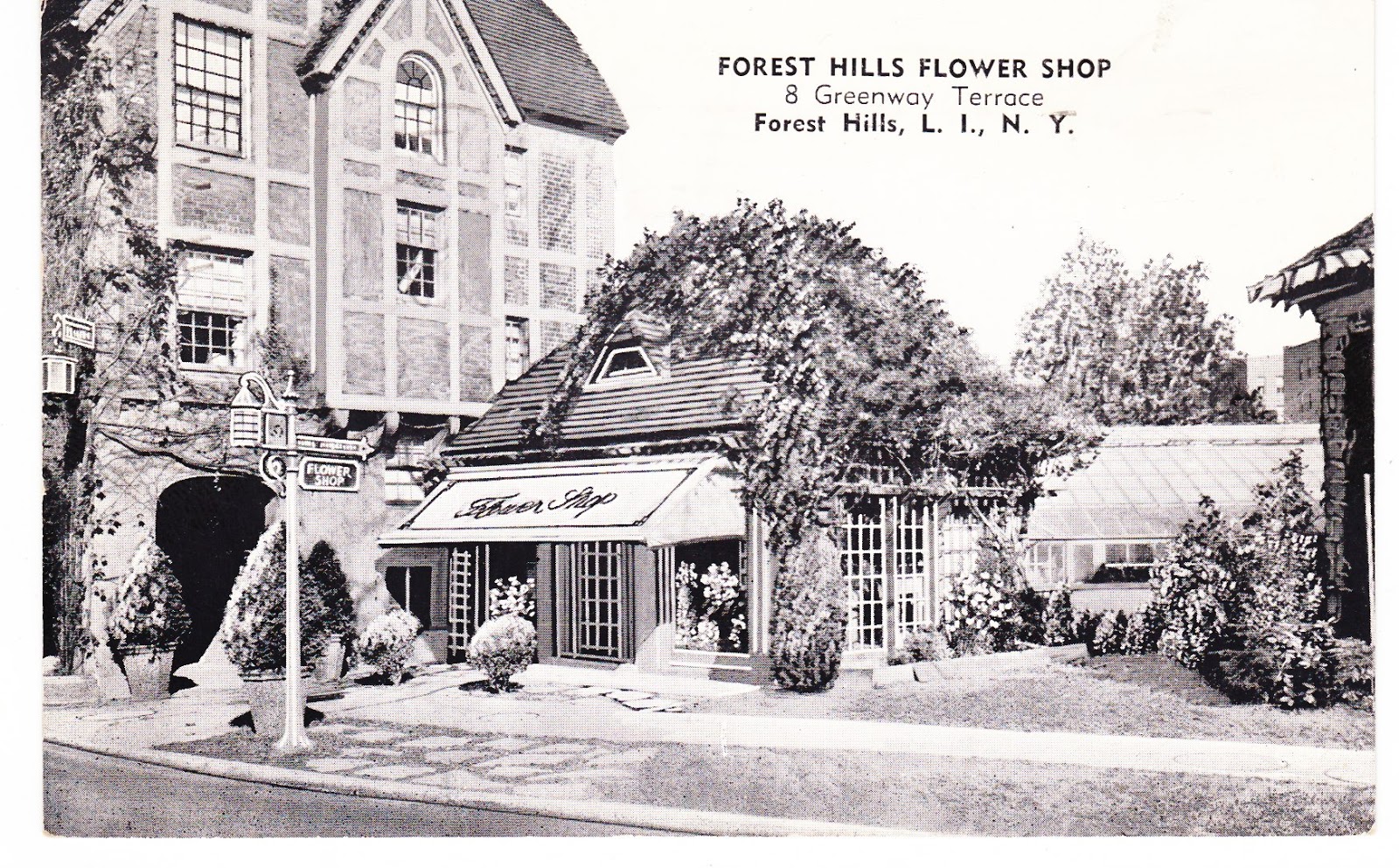
- Why is 8 Greenway Terrace, which  contains a greenhouse that once belonged to the popular Forest Hills Flower Shop left vacant in the exclusive Forest Hills Gardens for approximately 15 years?
- Will the Tea Garden see new light?
- Is the Forest Hills Gardens' standalone stone mailbox post the last of its kind locally?

Forgotten relics and some mysteries are very much alive in our backyard, and such is the case in the Forest Hills Gardens.

Established in 1909 as America's earliest planned garden community, Tudor and Arts & Crafts homes on winding streets featuring lush landscapes add up to a predominant preservation success story, thanks to restrictive covenants administered by the Forest Hills Gardens Corporation.

Principal architect Grosvenor Atterbury and urban planner Frederick Law Olmsted, Jr. would generally be content, despite the few features that have vanished.
Copyright Michael Perlman, 2015
On Village Green, situated along Greenway Terrace, one comes upon a pea gravel pedestal with four holes. Affixed to the top was once the “Sun Dial.” The pathways which extend from the pedestal are symbolic of the sun’s rays providing contrast from the lawn.

Back in 1915, it was boasted by The Newtown Register as “a very attractive feature which was depended upon as giving the correct time when the sun shines.”

Copyright Michael Perlman, 2015
Olivia Park offers a most intimate setting, but a tranquil and functional feature once known as the Fountain of Piping Pan has long vanished. In 1915, The Sun published, “The presiding genius of the fountain is a small nude boy in plaster playing a pipe and the water tumbles over the stones at his feet down into a miniature lake, where the birds may disport themselves as in one of nature’s own sylvan retreats.”

On July 4, 1915, with a local branch of the Audubon Society on scene, the fountain, designed by Beatrix Forbes-Robinson Hale, was dedicated to Margaret Olivia Slocum Sage, who was kindly regarded for her passion to birds.

Also part of her acclaim was her establishment of the Russell Sage Foundation, which sought to improve the social and living conditions in the United States.

Her vision was realized as this park often served as a natural amphitheater, where Irmgard, Baroness von Rottenthal performed interpretative dances at the ceremony to the sounds of Grieg and Tchaikovsky.

Copyright Michael Perlman, 2015
At 8 Greenway Terrace stands an Old English single-story Forest Hills Flower Shop with an adjoining greenhouse that opened in the 1920s as florist and landscape contractors, but shuttered around 1998.

“The florist John J. Loguercio ran the shop for many years, and would employ some of the local teens as delivery boys, including one that became an M.D. Andre, who now owns Forest Hills Flowers & Blossoms on Metropolitan Avenue, began working for John,” recalled Forest Hills native Maria Swanson.

“It was a beautiful spot with climbing roses and window displays,” added Kew Gardens resident Eileen Mahoney, who was raised at 14 Greenway Terrace. “Everyone in the neighborhood had him provide flowers for their weddings. Neighborhood Christmas trees and wreathes were purchased there.”

Copyright Michael Perlman
“It saddens me that some of these unique features have disappeared,” said Swanson, who recalled concrete slabs in front of the Forest Hills Inn, which consisted of Forest Hills’ Celebrity Walk.

On site were entertainers’ handprints and footprints. They included Frank Sinatra, Barbra Streisand, Sammy Davis, Jr. and likely Buddy Hackett, The Beatles, The Marx Bros, Betty Davis, Charlie Chaplin and John Wayne.

“They were possibly removed in the late 1970s,” she continued.

Former Forest Hills resident Steven Grimando was on scene at the time the slabs were salvaged during a construction project.

“They were framed in wood and placed on dollies, two at a time,” he said. “Under the Forest Hills Inn, there’s a ramp with doors, and the slabs were then placed deep within a series of catacombs.”


Copyright Michael Perlman
As the Inn was a center of a classy social life prior to its residential conversion in 1967, the Tea Garden, nestled behind the Inn was in full swing. Opened in 1912, it was once the site of afternoon teas, weddings, dances, and productions by The Gardens Players that took inspiration from the natural setting.

Guests would dine to the Inn Trio’s performance of Nevin’s “A Day in Venice” and Dvorak’s “Humoresque.” Today, behind an ornate gate on Greenway Terrace stands majestic trees and a defunct central brick fountain, but the cascading wall fountain has vanished. Now plans are underway to restore the Tea Garden.
Copyright Michael Perlman
On a stroll among forgotten spots, locals can stop at presumably the last pea gravel mailbox post on Ascan Avenue and Greenway South, which bears a 1938 inscription. The mounted miniature mailbox is long gone, but to its right is a more familiar 1950s-era blue mailbox.
The long gone eagle & Bill Tilden in 1937 at Forest Hills Tennis Stadium
And a couple of concrete eagles have mysteriously gone missing from the Forest Hills Tennis Stadium, which was designed as America’s first tennis stadium in 1923 by architect Kenneth Murchison and built by The Foundation Company.

Bea Hunt, former vice president of the West Side Tennis Club, noticed the pair in photos through the 1950s, but then examined a Rolling Stones concert photo marked July 2, 1966, where the eagles were missing.

“Today there are 11 concrete eagles at the upper façade overlooking the amphitheater, but originally an eagle stood on each pedestal at the lower ends of the horseshoe,” she said.


Source: Queens Ledger - Forgotten Past of The Forest Hills Gardens