Showing posts with label Tea Garden. Show all posts

Monday, July 21, 2025

Behind The Lens with Preservationist & Author Michael Perlman

Michael Perlman is a fifth generation Forest Hills resident and Chair of Rego-Forest Preservation Council, who takes pride in commemorating architectural and cultural history, as well as proposing sites for Individual Landmark and sections for Historic District status to the NYC Landmarks Preservation Commission. He is completing RFE nomination forms for Forest Hills (founded 1906) and Rego Park (1923), where the latter community was selected as a Historic Districts Council “Six To Celebrate” 2020 community in advance of turning 100 in 2023. 


Michael Perlman honored at Local Heroes reception by Queens Community House, Forest Hills Stadium stage, May 2023


Perlman is a Class of 2000 vocal major graduate of LaGuardia HS of Music & Art and the Performing Arts, and achieved a BA in Communications and Writing from Marymount Manhattan College in 2004. 


Perlman is the recipient of a 2014 Historic Districts Council Grassroots Preservation Award for NYC, and was appointed Grand Marshal of the 2017 Forest Hills Memorial Day Parade. In May 2023, he received a crystal “Local Champions” trophy by the Queens Community House on the Forest Hills Stadium stage.


“Legendary Locals of Forest Hills and Rego Park,” a book by Michael H. Perlman (foreword by Jerry Springer) features local history, landmarks, and the stories of 210+ notables ranging from celebrities to unsung heroes.


Perlman, a Forest Hills Times columnist since 2012, spotlights historic preservation, human interest stories, humanitarian initiatives, and the arts. He is an admin of Facebook groups Rego-Forest Preservation Council and Forest Hills, Rego Park, Kew Gardens – “Our Communities.”


Forest Hills Stadium, Michael Perlman in center with James Dylan Burris, great-great-grandson & Lynne DeWardener-Burris, great-granddaughter of Stadium architect Kenneth Murchison


Perlman is a member of the West Side Tennis Club’s Tennis History & Archives Council. He played a significant role in rescuing the iconic Forest Hills Stadium from demolition after founding a committee and spearheading a PR and preservation campaign, salvaged the Art Deco neon Jay Dee Bakery sign among other features, secured State & National Register of Historic Places status for Rego Park Jewish Center and First Presbyterian Church of Newtown, acquired landmark status for the Ridgewood Theatre, and prevented Cinemart Cinemas from shuttering.


Historic Rego Park Jewish Center, Photo by Michael Perlman

Perlman earned the nickname “Diner Man” as a result of preserving NYC’s Moondance Diner and Cheyenne Diner via transport to WY and AL in 2007 and 2009, respectively. In recent times, he brokered a deal to reopen the T-Bone Diner (1934) as T-Bone Diner & Delicatessen. 


Forest Hills Tree Giveaway Event in MacDonald Park, Photo by coordinator Michael Perlman, May 2014

In partnership with New York Restoration Project, Perlman founded the Forest Hills Tree Giveaway event in MacDonald Park. In 2011 to 2015, he recruited local volunteers, and with the help of sponsors, donated 1,225 trees to property owners and board members.


In November 2019, Perlman’s architectural photography and restored vintage prints exhibit, “Reflections of Historic Forest Hills” opened at Jade Eatery’s gallery. He decorated various lobbies with his prints. He also formed the Tea Garden Restoration Committee, which seeks to restore what feels like a magical tea garden from 1912. He spearheaded the replication of a detailed 11-foot ring for tea stand through a partnership with Jade Eatery, Flushing Iron Weld, and Noble Signs.


Replicated Ring For Tea stand in front of Tea Garden's ornate gate upon delivery

In 2020, Perlman co-founded the Forest Hills & Rego Park Graffiti Cleanup Initiative, which restores storefronts and street furniture. In 2021, he founded the Forest Hills & Rego Park Historic Plaque Initiative. As of 2023, the Tudor style Sutton Hall and the Mid-Century Modern style Park Briar have “Forest Hills Historic Site” bronze plaques, which he co-designed with Frank DiBella of Academy Engraving. 


In partnership with the New York Sign Museum since 2022, Perlman arranged several deals to salvage historic signs in Queens, Manhattan, and Brooklyn.


Along the LIRR Ascan Avenue underpass, Perlman developed two murals, “A Tribute To Ascan Avenue & The Forest Hills Gardens” (2017) and the “Helen Keller Forest Hills Tribute” (2019), painted by Crisp and Praxis, with a Helen Keller pictorial plaque in collaboration with Continental Photo. 


Forest Hills & Rego Park architectural mural, "Wish You Were Here... Forest Hills & Rego Park Historic Buildings" by Gigi Chen & accompanying sign by Michael Perlman

Since June 2025, The Bagel Spot at 101-01 Queens Boulevard, features his mural project with national artist Gigi Chen, which bears homage to local architectural treasures, where some have been demolished, such as the Trylon Theatre, Tower Diner bank building, Howard Johnson’s, and the Gulf Station building. Forest Hills Stadium is among the represented preserved properties.


Last September, Perlman traveled 500 miles to rescue famed muralist Andre Durenceau’s circa 1939 40-foot mural from Hugh Kelly of MA, who first salvaged it in 1974 from Rego Park’s once iconic Howard Johnson’s. Restoring the mural and resurrecting it in Queens is a goal.


One of three sections of the Howard Johnson's mural by André Durenceau, which Michael Perlman rescued last September in its entirety, 1940 photo in Fortune


Another goal is to erect a “Little Free Library” in Federoff Triangle, which will be modeled after a demolished historic building, as well as co-name streets after historic architects and builders.


His interests also include singing, dancing, deltiology, photography, botany, public relations, long exploratory walks, and travel. He performed solo shows at Carnegie Hall, NYC clubs, and aboard cruise ships.  


It is always timely to fulfill mitzvahs. To volunteer, email Michael Perlman at mperlman@queensledger.com and join www.facebook.com/groups/SaveRegoParkForestHillsQueens 


Sunday, September 25, 2016

Sept 25th: Four Forest Hills Events - Mark Your Calendar!


What do animals, books, a yard sale, & a street fair have in common? Between 10 AM & 4 PM on 9/25:

At the Forest Hills Street Fair, I will be offering signed copies of my book "Legendary Locals of Forest Hills and Rego Park" as a collaboration with Trylon Vet Care P.C.'s Posh Pets Rescue fundraiser. Stop by our table on Austin Street near Starbucks. I will also be selling signed copies at the Tea Garden of the Forest Hills Inn around the corner from Station Square, as part of the Inn's annual yard sale that will benefit this historic property. Feel free to email unlockthevault@hotmail.com with questions or requests.


- Michael Perlman


Saturday, November 21, 2015

Help Solve Forest Hills Gardens Mysteries & Rediscover Relics


Copyright Michael Perlman
Forgotten Past of The Forest Hills Gardens by Michael Perlman

- Why did the handprint & footprint concrete slabs featuring celebrities outside the Forest Hills Inn, once known as "Celebrity Walk" vanish?
- Why are the 2 concrete eagles at the base pedestals of the Forest Hills Tennis Stadium nowhere to be seen?
- Why is the only remnant of the Sun Dial on Village Green a 4-hole pedestal?
- Why & when did the historic Fountain of Piping Pan in Olivia Park vanish?
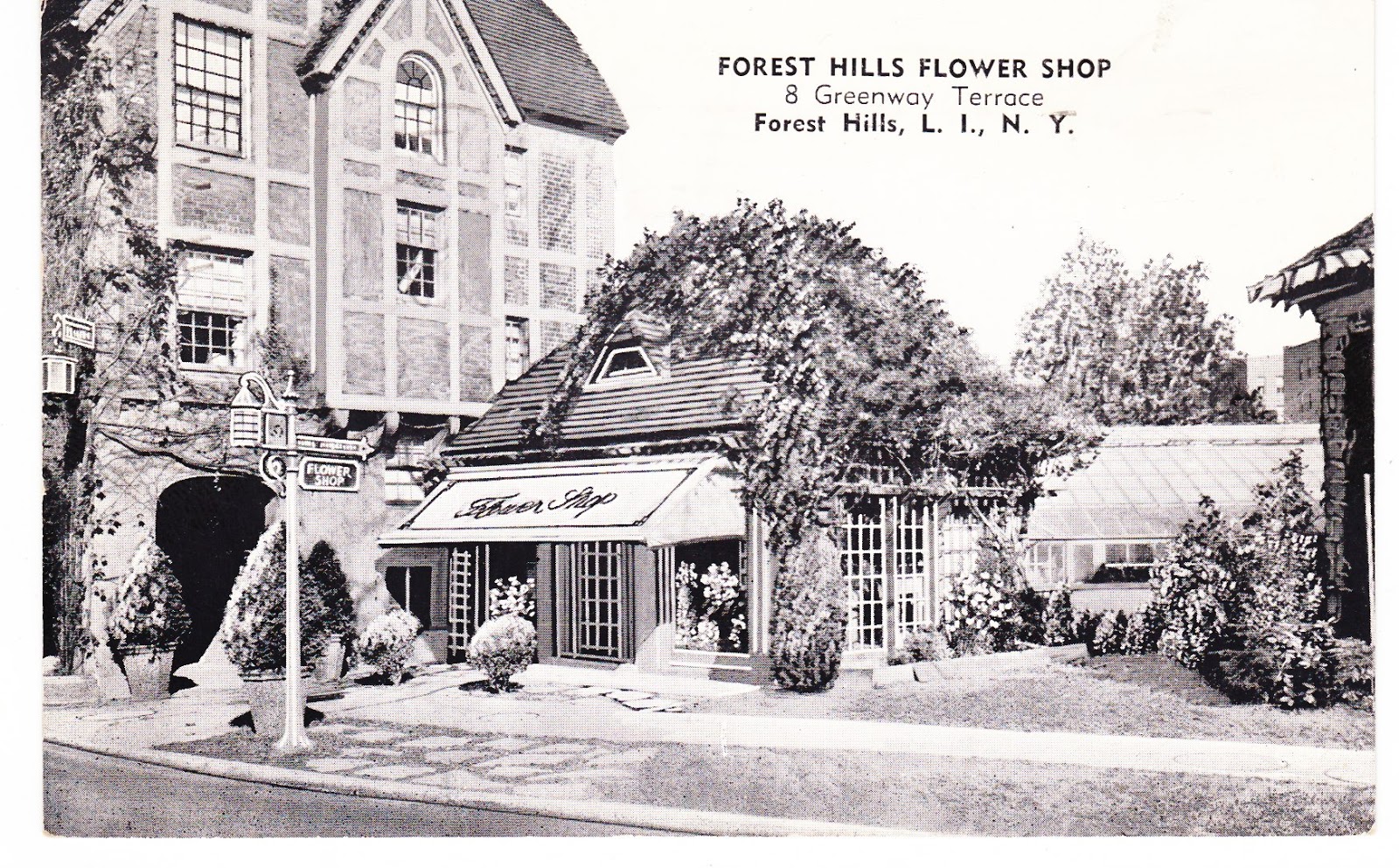
- Why is 8 Greenway Terrace, which  contains a greenhouse that once belonged to the popular Forest Hills Flower Shop left vacant in the exclusive Forest Hills Gardens for approximately 15 years?
- Will the Tea Garden see new light?
- Is the Forest Hills Gardens' standalone stone mailbox post the last of its kind locally?

Forgotten relics and some mysteries are very much alive in our backyard, and such is the case in the Forest Hills Gardens.

Established in 1909 as America's earliest planned garden community, Tudor and Arts & Crafts homes on winding streets featuring lush landscapes add up to a predominant preservation success story, thanks to restrictive covenants administered by the Forest Hills Gardens Corporation.

Principal architect Grosvenor Atterbury and urban planner Frederick Law Olmsted, Jr. would generally be content, despite the few features that have vanished.
Copyright Michael Perlman, 2015
On Village Green, situated along Greenway Terrace, one comes upon a pea gravel pedestal with four holes. Affixed to the top was once the “Sun Dial.” The pathways which extend from the pedestal are symbolic of the sun’s rays providing contrast from the lawn.

Back in 1915, it was boasted by The Newtown Register as “a very attractive feature which was depended upon as giving the correct time when the sun shines.”

Copyright Michael Perlman, 2015
Olivia Park offers a most intimate setting, but a tranquil and functional feature once known as the Fountain of Piping Pan has long vanished. In 1915, The Sun published, “The presiding genius of the fountain is a small nude boy in plaster playing a pipe and the water tumbles over the stones at his feet down into a miniature lake, where the birds may disport themselves as in one of nature’s own sylvan retreats.”

On July 4, 1915, with a local branch of the Audubon Society on scene, the fountain, designed by Beatrix Forbes-Robinson Hale, was dedicated to Margaret Olivia Slocum Sage, who was kindly regarded for her passion to birds.

Also part of her acclaim was her establishment of the Russell Sage Foundation, which sought to improve the social and living conditions in the United States.

Her vision was realized as this park often served as a natural amphitheater, where Irmgard, Baroness von Rottenthal performed interpretative dances at the ceremony to the sounds of Grieg and Tchaikovsky.

Copyright Michael Perlman, 2015
At 8 Greenway Terrace stands an Old English single-story Forest Hills Flower Shop with an adjoining greenhouse that opened in the 1920s as florist and landscape contractors, but shuttered around 1998.

“The florist John J. Loguercio ran the shop for many years, and would employ some of the local teens as delivery boys, including one that became an M.D. Andre, who now owns Forest Hills Flowers & Blossoms on Metropolitan Avenue, began working for John,” recalled Forest Hills native Maria Swanson.

“It was a beautiful spot with climbing roses and window displays,” added Kew Gardens resident Eileen Mahoney, who was raised at 14 Greenway Terrace. “Everyone in the neighborhood had him provide flowers for their weddings. Neighborhood Christmas trees and wreathes were purchased there.”

Copyright Michael Perlman
“It saddens me that some of these unique features have disappeared,” said Swanson, who recalled concrete slabs in front of the Forest Hills Inn, which consisted of Forest Hills’ Celebrity Walk.

On site were entertainers’ handprints and footprints. They included Frank Sinatra, Barbra Streisand, Sammy Davis, Jr. and likely Buddy Hackett, The Beatles, The Marx Bros, Betty Davis, Charlie Chaplin and John Wayne.

“They were possibly removed in the late 1970s,” she continued.

Former Forest Hills resident Steven Grimando was on scene at the time the slabs were salvaged during a construction project.

“They were framed in wood and placed on dollies, two at a time,” he said. “Under the Forest Hills Inn, there’s a ramp with doors, and the slabs were then placed deep within a series of catacombs.”


Copyright Michael Perlman
As the Inn was a center of a classy social life prior to its residential conversion in 1967, the Tea Garden, nestled behind the Inn was in full swing. Opened in 1912, it was once the site of afternoon teas, weddings, dances, and productions by The Gardens Players that took inspiration from the natural setting.

Guests would dine to the Inn Trio’s performance of Nevin’s “A Day in Venice” and Dvorak’s “Humoresque.” Today, behind an ornate gate on Greenway Terrace stands majestic trees and a defunct central brick fountain, but the cascading wall fountain has vanished. Now plans are underway to restore the Tea Garden.
Copyright Michael Perlman
On a stroll among forgotten spots, locals can stop at presumably the last pea gravel mailbox post on Ascan Avenue and Greenway South, which bears a 1938 inscription. The mounted miniature mailbox is long gone, but to its right is a more familiar 1950s-era blue mailbox.
The long gone eagle & Bill Tilden in 1937 at Forest Hills Tennis Stadium
And a couple of concrete eagles have mysteriously gone missing from the Forest Hills Tennis Stadium, which was designed as America’s first tennis stadium in 1923 by architect Kenneth Murchison and built by The Foundation Company.

Bea Hunt, former vice president of the West Side Tennis Club, noticed the pair in photos through the 1950s, but then examined a Rolling Stones concert photo marked July 2, 1966, where the eagles were missing.

“Today there are 11 concrete eagles at the upper façade overlooking the amphitheater, but originally an eagle stood on each pedestal at the lower ends of the horseshoe,” she said.


Source: Queens Ledger - Forgotten Past of The Forest Hills Gardens 


Friday, March 30, 2012

The Tea Garden: A Long-Lost Treasure Meets Controversy

This is Michael Perlman's feature story on the classic yet abandoned Tea Garden in the Forest Hills Times/Queens Ledger.  Will a century-old Forest Hills Gardens enclave which once hosted weddings, afternoon teas, plays, and dinners to the sounds of cellos and violins rise again?

Please feel free to post a comment on the article link, & share it with your friends:
http://www.foresthillstimes.com/view/full_story/18044815/article-The-Tea-Garden--A-Long-Lost-Treasure-Meets-Controversy 


Forest Hills Gardens holds a secret awaiting a new lease on life.

The back of the century-old Forest Hills Inn at 1 Station Square is home to a long-lost treasure known as the Tea Garden, of which the majority of Forest Hills is unaware.

Situated on Greenway South behind an ornate gate, a fantasy-like enclave would open in 1912 to the delight of Inn guests and residents. In 1909, Station Square was the center of social life in a planned garden community, with Grosvenor Atterbury as the Gardens’ principal architect, and Frederick Law Olmsted, Jr. as the landscape architect for public spaces and parks.

The Forest Hills Inn’s Tea Garden played host to numerous weddings, performances, and dinner dances, in addition to afternoon tea. Today, it is a shell of its former glory, and is prone to controversy between residents who wish to see it revitalized for social functions versus those who prefer restoring it as a private garden.

The Tea Garden borders the Forest Hills Inn and 20 Continental Ave, both of which are co-ops.

Nature has caused the monumental trees to flourish, but nature also cast a toll on the garden’s decorative features. The cascading fountain and pool has vanished. The “Ring For Tea” stand and rocking chairs, which were replaced with tables and umbrellas, have also vanished.

The central brick fountain is non-operational, the flagstone tiles are faded and cracked, and a gazebo bears rust. Upon first glance is a sad reality, but then the magic of what was and what could be resurrected becomes evident.

It is difficult to grasp how an integral feature could fall into abandonment and disarray, but not entirely surprising. In 1967, the Forest Hills Inn became apartments, which went co-op in the 1980s.

In 1977, it was announced that the U.S. Open would move from the nearby Forest Hills Tennis Stadium to Flushing Meadows Park. And music festivals in Forest Hills reached their peak in the 1960s.

With the change of occupancy of the Forest Hills Inn, and fewer tennis and music celebrities visiting Forest Hills, the Tea Garden was forgotten.

The July 12, 1924, edition of The Forest Hills Bulletin read, “The Tea Garden of the Forest Hills Inn is a veritable fairyland, when lighted with Japanese lanterns, with the trickling fountain heard in the background, and a new moon shining overhead. There is no more delightful place in Greater New York for one to spend the dinner hour.”

During the warmer months, every evening between 6:30 and 9 p.m. a delectable dinner was served, to the music of the Inn Trio, featuring selections such as Dvorak’s “Humoreske” and Albeniz’ “A Night In Seville.”

Ballroom dancing was featured on Saturday evenings, and the Tea Garden also hosted early performances of the Garden Players.

In a circa mid-1950s brochure uncovered in the Forest Hills Inn’s Historic Committee’s archives, the Tea Garden was then referred to as the Patio-Garden, and its glory continued. It offered “a bubbling fountain, candlelight, large umbrellas, and tall trees” with “violin strings in the spring and summer.”

Jade Eatery & Lounge holds a lease at the Forest Hills Inn, and the Tea Garden sits outside their back space.

“Many younger generations asked when the Tea Garden is opening, since they want to hold their weddings here like their ancestors,” explains manager Raymond Taylor. “We also want to hold community events, and allow the Inn and 20 Continental Ave to use the space as a common area. Jade has met some resistance from residents.”

Taylor visualizes “an authentic restoration of the garden, with possible outside funding.”

“If the fountain is approved in the plans, we would be delighted to resurrect such a tranquil piece of history,” he adds.

“Nothing can bring back the gentility of the Tea Garden,” says Martin Levinson, co-chairman of the One Station Square Historical Committee. “Instead of cellos and violins, the current era includes amplified music, liquor served to boisterous patrons, and people screaming on cell phones.”

He feels Jade’s public Tea Garden is “a security risk for those who live in the back of the Inn, since their apartments can be accessed by pranksters via terraces, trellises, air ducts, drain pipes, and roofs.” That said, Levinson does not mind a private garden.

George Hoban, co-chairman of the One Station Square Historical Committee favors re-implementing the Tea Garden, but states, "We need to communicate with our neighbors first, since its future involves them,” he says. “We are in litigation to determine who has use of the Tea Garden, which could be for Jade, our tenants, or both. We’re hopeful we will have all or partial use, since we plan to restore it."

“We are open to grants, and won’t allow work which doesn’t keep its integrity and historic character,” he adds. “Some work would be conducted off-site, to minimize on-site construction and noise. In summer 2011, we cleaned up the Tea Garden for optics purposes.”

An aesthetic and functional restoration can co-exist, with the establishment of bylaws and security measures, to appease Jade’s patrons and residents of the Forest Hills Inn and 20 Continental Ave.