Showing posts with label Forest Hills Tennis Stadium. Show all posts

Saturday, November 21, 2015

Help Solve Forest Hills Gardens Mysteries & Rediscover Relics


Copyright Michael Perlman
Forgotten Past of The Forest Hills Gardens by Michael Perlman

- Why did the handprint & footprint concrete slabs featuring celebrities outside the Forest Hills Inn, once known as "Celebrity Walk" vanish?
- Why are the 2 concrete eagles at the base pedestals of the Forest Hills Tennis Stadium nowhere to be seen?
- Why is the only remnant of the Sun Dial on Village Green a 4-hole pedestal?
- Why & when did the historic Fountain of Piping Pan in Olivia Park vanish?
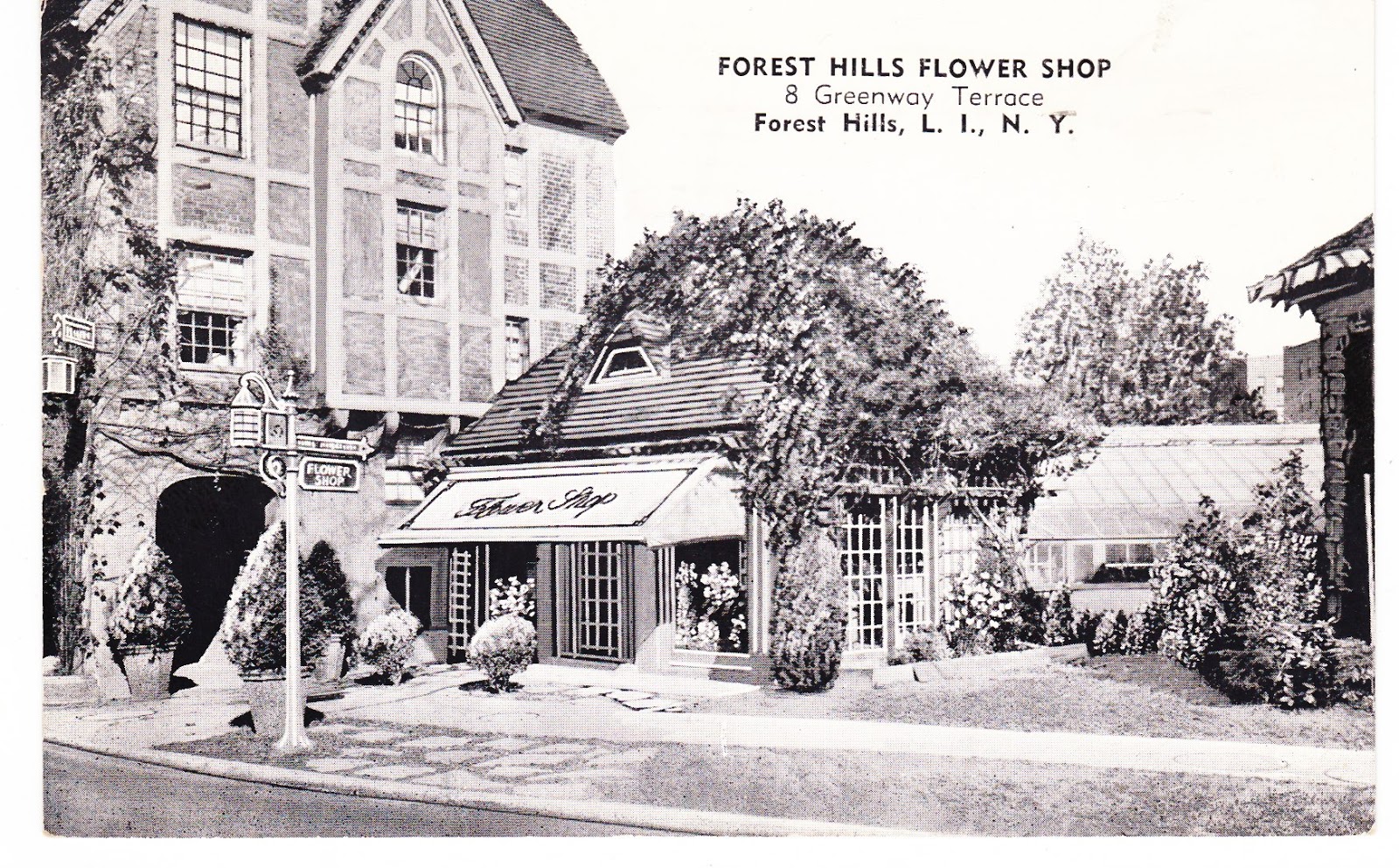
- Why is 8 Greenway Terrace, which  contains a greenhouse that once belonged to the popular Forest Hills Flower Shop left vacant in the exclusive Forest Hills Gardens for approximately 15 years?
- Will the Tea Garden see new light?
- Is the Forest Hills Gardens' standalone stone mailbox post the last of its kind locally?

Forgotten relics and some mysteries are very much alive in our backyard, and such is the case in the Forest Hills Gardens.

Established in 1909 as America's earliest planned garden community, Tudor and Arts & Crafts homes on winding streets featuring lush landscapes add up to a predominant preservation success story, thanks to restrictive covenants administered by the Forest Hills Gardens Corporation.

Principal architect Grosvenor Atterbury and urban planner Frederick Law Olmsted, Jr. would generally be content, despite the few features that have vanished.
Copyright Michael Perlman, 2015
On Village Green, situated along Greenway Terrace, one comes upon a pea gravel pedestal with four holes. Affixed to the top was once the “Sun Dial.” The pathways which extend from the pedestal are symbolic of the sun’s rays providing contrast from the lawn.

Back in 1915, it was boasted by The Newtown Register as “a very attractive feature which was depended upon as giving the correct time when the sun shines.”

Copyright Michael Perlman, 2015
Olivia Park offers a most intimate setting, but a tranquil and functional feature once known as the Fountain of Piping Pan has long vanished. In 1915, The Sun published, “The presiding genius of the fountain is a small nude boy in plaster playing a pipe and the water tumbles over the stones at his feet down into a miniature lake, where the birds may disport themselves as in one of nature’s own sylvan retreats.”

On July 4, 1915, with a local branch of the Audubon Society on scene, the fountain, designed by Beatrix Forbes-Robinson Hale, was dedicated to Margaret Olivia Slocum Sage, who was kindly regarded for her passion to birds.

Also part of her acclaim was her establishment of the Russell Sage Foundation, which sought to improve the social and living conditions in the United States.

Her vision was realized as this park often served as a natural amphitheater, where Irmgard, Baroness von Rottenthal performed interpretative dances at the ceremony to the sounds of Grieg and Tchaikovsky.
Copyright Michael Perlman, 2015
At 8 Greenway Terrace stands an Old English single-story Forest Hills Flower Shop with an adjoining greenhouse that opened in the 1920s as florist and landscape contractors, but shuttered around 1998.

“The florist John J. Loguercio ran the shop for many years, and would employ some of the local teens as delivery boys, including one that became an M.D. Andre, who now owns Forest Hills Flowers & Blossoms on Metropolitan Avenue, began working for John,” recalled Forest Hills native Maria Swanson.

“It was a beautiful spot with climbing roses and window displays,” added Kew Gardens resident Eileen Mahoney, who was raised at 14 Greenway Terrace. “Everyone in the neighborhood had him provide flowers for their weddings. Neighborhood Christmas trees and wreathes were purchased there.”

Copyright Michael Perlman
“It saddens me that some of these unique features have disappeared,” said Swanson, who recalled concrete slabs in front of the Forest Hills Inn, which consisted of Forest Hills’ Celebrity Walk.

On site were entertainers’ handprints and footprints. They included Frank Sinatra, Barbra Streisand, Sammy Davis, Jr. and likely Buddy Hackett, The Beatles, The Marx Bros, Betty Davis, Charlie Chaplin and John Wayne.

“They were possibly removed in the late 1970s,” she continued.

Former Forest Hills resident Steven Grimando was on scene at the time the slabs were salvaged during a construction project.

“They were framed in wood and placed on dollies, two at a time,” he said. “Under the Forest Hills Inn, there’s a ramp with doors, and the slabs were then placed deep within a series of catacombs.”


Copyright Michael Perlman
As the Inn was a center of a classy social life prior to its residential conversion in 1967, the Tea Garden, nestled behind the Inn was in full swing. Opened in 1912, it was once the site of afternoon teas, weddings, dances, and productions by The Gardens Players that took inspiration from the natural setting.

Guests would dine to the Inn Trio’s performance of Nevin’s “A Day in Venice” and Dvorak’s “Humoresque.” Today, behind an ornate gate on Greenway Terrace stands majestic trees and a defunct central brick fountain, but the cascading wall fountain has vanished. Now plans are underway to restore the Tea Garden.
Copyright Michael Perlman
On a stroll among forgotten spots, locals can stop at presumably the last pea gravel mailbox post on Ascan Avenue and Greenway South, which bears a 1938 inscription. The mounted miniature mailbox is long gone, but to its right is a more familiar 1950s-era blue mailbox.
The long gone eagle & Bill Tilden in 1937 at Forest Hills Tennis Stadium
And a couple of concrete eagles have mysteriously gone missing from the Forest Hills Tennis Stadium, which was designed as America’s first tennis stadium in 1923 by architect Kenneth Murchison and built by The Foundation Company.

Bea Hunt, former vice president of the West Side Tennis Club, noticed the pair in photos through the 1950s, but then examined a Rolling Stones concert photo marked July 2, 1966, where the eagles were missing.

“Today there are 11 concrete eagles at the upper façade overlooking the amphitheater, but originally an eagle stood on each pedestal at the lower ends of the horseshoe,” she said.


Source: Queens Ledger - Forgotten Past of The Forest Hills Gardens 


Wednesday, May 21, 2014

Forest Hills' Michael Perlman Wins 2014 Preservation Award - Historic Districts Council


Forest Hills' Michael Perlman Wins 2014 Preservation Award 

For Immediate Release

May 19, 2014
Contact:
Nadezhda Williams
Deputy Director
nwilliams@hdc.org/212-614-9107
New York- The Historic Districts Council (HDC), the citywide advocate for New York's historic neighborhoods, will present Michael Perlman, Queens native and chairman of the Rego-Forest Preservation Council with a 2014 Grassroots Preservation Award on Wednesday, June 4, 2014, at 6:30 PM at Grace Church, 254 Hicks Street, Brooklyn Heights.

The Grassroots Awards honor and celebrate the activists and groups who work to preserve New York City's historic neighborhoods. "These advocates are the foundation of the preservation movement and their efforts benefit everyone who lives, works or visits New York City," said Simeon Bankoff, executive director of HDC. "It's an honor and pleasure to be able to shine the spotlight on these neighborhood leaders."


A native Forest Hills resident, Michael Perlman is the Chairman of the Rego-Forest Preservation Council. The Council was founded in 2006 in response to that year's 100th anniversary of Forest Hills and the parcel which would become known as Rego Park in 1923. It works to preserve and commemorate the architectural and cultural history of Forest Hills and Rego Park, as well surrounding areas of Queens through advocacy and property owner assistance. In 2010, Mr. Perlman launched a public campaign to preserve and creatively reuse the iconic Forest Hills Tennis Stadium which was under threat of demolition. As a result of these efforts, the stadium has undergone some restoration work and has been reborn as a concert venue. He is involved in the continuing preservation efforts of a number of civic, religious and popular neighborhood institutions in Queens and earned the nickname "Diner-Man" after his efforts to save and relocate a number of historic freestanding diners.

The Historic Districts Council is New York's only citywide grassroots advocate for historic buildings and neighborhoods. Since 1971 HDC has been committed to preserving New York's rich architectural and historical heritage, working with communities to landmark and protect significant neighborhoods and buildings, as well as helping already designated historic communities to understand and uphold the Landmarks Law. HDC engages in community building and development, offers educational programs and delivers technical resources, strategic assistance and direct advocacy support to aid local groups in their individual preservation campaigns.

The event is open to the public at a cost of $30, $20 for Friends of HDC. Doors open at 6:15 pm, and the award ceremony will begin at 6:45 pm, with a reception to follow. For more information, go to the Grassroots page or call 212-614-9107.

Thursday, March 20, 2014

Zac Brown Band: Welcoming Summer 2014 at the Forest Hills Tennis Stadium

Stadium Architect Kenneth Murchison's great-granddaughter Lynne de Wardener-Burris and great great-granddaughter Skye Burris
Zac Brown Band, Courtesy of Zac Brown Band website


Act Two at the iconic Forest Hills Tennis Stadium! On June 21, the summer will begin with high notes as the three-time Grammy winner and Multi-Platinum Zac Brown Band will take the stadium stage, and open the summer 2014 concert series. Other great names headlining today’s entertainment will soon be announced.

On June 21, doors will open at 5 PM for a 6 PM show, and as the sun sets somewhat later that evening, the audience will be left with an impression for concerts to come. Tickets will be available on March 22 at 10 AM through Ticketfly.com. America’s first concrete tennis stadium, dating to 1923, has undergone restoration work in addition to some renovations, which include ticketed seating, improved ADA seating, widened aisles, handrails, and easier access to food, beverages, and other accommodations. The public can now bookmark a new website, www.foresthillsstadium.com

In August 2013, U.K. folk rock band Mumford & Sons, along with opening bands Bear’s Den and The Vaccines marked a new chapter of Forest Hills history by entertaining 17,000 fans in a stadium that was nearly sold for a condo just 3 summers earlier.

Mumford & Sons plays Forest Hills! Courtesy of Michael Perlman, Rego-Forest Preservation Council

Mumford & Sons became the first major musical act at the stadium since the 1980s, which not only attracted new fans, but struck a chord for patrons who recalled the annual Forest Hills Music Festivals of the 1960s through the early 1980s. Forty-nine years to the day, The Beatles delivered a legendary performance. Memorable summers also featured music greats including Frank Sinatra, Donna Summer, Bob Dylan, Barbra Streisand, and the Rolling Stones. 

Frank Sinatra about to go on stage with Count Basie at the Forest Hills Tennis Stadium's Summer 1965 Music Festival, Photo courtesy of Robert Rauschenbach

Some fans also recalled pivotal moments in tennis history, such as those witnessed during the U.S. Open prior to 1978, or when Arthur Ashe and Althea Gibson broke racial color barriers. Others reminisced the stadium’s cinematic role in “Strangers On A Train,” where Alfred Hitchcock filmed Davis Cup matches between Australia and the United States. 

"America's Tennis Stadium" ad, published in MIT's "The Technology Review" in 1922, Courtesy of Rego-Forest Preservation Council
A foremost public building architect, Kenneth Murchison, made his mark on Forest Hills by designing the stadium. “A resurgence of a concert scene at the Forest Hills Tennis Stadium is a wonderful addition to the cultural fabric of the city,” stated Murchison’s great-granddaughter Lynne de Wardener-Burris, who first visited with her family last summer. She explained, “Many current music and sports venues are so removed from the people they are meant to attract, that it was refreshing to see this gem in midst of a thriving residential community. It felt like a people's place built on a human scale, and I know my great-grandfather would love that his work is being preserved and utilized.”
Architect Kenneth Murchison, Courtesy of Pati de Wardener
Past and present community residents are equally enthusiastic about the stadium’s second season. “We are very excited to see the Zac Brown Band,” said Sandra Mandell, who owns Oliloli Studio on Metropolitan Avenue. “It is such a treat to attend a concert right in our neighborhood. I am looking forward to my first experience at the Forest Hills Tennis Stadium, a venue rich with history, and I hope this new era brings more art and culture to Forest Hills.”

Jodi Kass-Tracten now resides in Redding, Connecticut, but will never forget Forest Hills. “In the mid-1960s, the night that Sammy Davis Jr. performed was magical. The air was crisp and the place was packed. He sang for hours, and then of course no one wanted him to leave, so he sang some more.” She continued, “It’s still such an elegant place, and I'm thrilled that the Stadium has reopened for concerts.”

My mother knew my sister and I were Beatles fans, so she bought us tickets in the summer of 1964,” said Las Vegas resident Judith Becker. She explained, “I can vividly remember everyone’s excitement, as they looked up to see their helicopter arriving and landing on the grass courts. I spent my teenage years seeing concerts with friends, and I remember sneaking in through a hole in the fence.” In closing remarks, she added, “I haven't been back to Forest Hills for many years, but I would sure go back to see a concert at the Forest Hills Stadium, a beautiful and intimate venue.”

The audience at Mumford & Sons, August 28, 2013 photo courtesy of Michael Perlman, Rego-Forest Preservation Council

America's first concrete tennis stadium, Courtesy of Michael Perlman, Rego-Forest Preservation Council

 A similar edition of this feature appeared in Michael Perlman's Forest Hills Times column: http://www.foresthillstimes.com/view/full_story/24773509/article-Zac-Brown-to-kick-off-summer-in-Forest-Hills

Wednesday, August 28, 2013

Iconic Forest Hills Tennis Stadium Makes A Comeback with Mumford & Sons


For Immediate Release

Contact: Chairman Michael Perlman
Rego-Forest Preservation Council


Iconic Forest Hills Tennis Stadium Makes A Comeback with Mumford & Sons

QUEENS, NY (August 28, 2013) -   The iconic Forest Hills Tennis Stadium at 1 Tennis Place in Forest Hills is reopening as a concert venue on August 28 at 6 PM (doors open at 5 PM). British folk rock group, Mumford & Sons, along with two opening acts, will be the first major concert at the stadium since the 1980s. Over 16,000 tickets were sold within an hour. A reported nearly $1.5 million has been spent to restore and upgrade the Forest Hills Tennis Stadium since June 2013, and future restoration plans and upgrades are envisioned by the West Side Tennis Club and concert producers.

Chairman Michael Perlman of Rego-Forest Preservation Council launched a grassroots campaign in July 2010, calling for the preservation and creative reuse of the Forest Hills Tennis Stadium. Meetings with local elected officials and civic associations were held, as well as a petition drive and public relations campaign. That was followed by meetings with the West Side Tennis Club.

In October 2010, a bid by Cord Meyer Development to purchase the stadium parcel, and demolish the majority of the stadium for condos was rejected by the majority of West Side Tennis Club members. Perlman explained, "Disney-esque condos would have torn the heart out of Forest Hills. Mixed-use creative revitalization will likely yield a greater long-term economic return. The stadium has potential for tennis matches, concerts, ice hockey, weddings, exhibits, school trips, charity events, and art festivals.”

Rego-Forest Preservation Council feels the stadium has the potential to be a 21st century family destination, which would bring our communities closer together, boost tourism, convey historic pride, educate our children, assist local businesses through tough economic times, and be an incentive for newer businesses, such as along the Austin Street corridor.
 
The Forest Hills Tennis Stadium embodies firsts in tennis, music, and architectural history. Designed by famed architect Kenneth Murchison and built by The Foundation Company, it was the first concrete tennis stadium countrywide (1923). It also accommodated National Tennis Championships, the Davis Cup and Wightman Cup, and was the first home of the U.S. Open. It hosted tennis players such as Bill Tilden, Helen Jacobs, Ted Schroeder, Rod Laver, Helen Wills Moody, Billie Jean King, Roger Federer, Don Budge, Chris Evert, Martina Navratilova, and Arthur Ashe and Althea Gibson who broke racial color barriers during a segregated time in tennis history. The stadium also played cinematic roles, and was featured in key scenes of Alfred Hitchcock's Strangers On A Train.

The annual Forest Hills Music Festival and concerts took ground in the late 1950s and continued through the 1980s, featuring the likes of The Beatles, Frank Sinatra, Bob Dylan, The Doors, Ella Fitzgerald, Diana Ross, The Monkees, The Who, Johnny Mathis, Barbra Streisand, Simon & Garfunkel, Trini Lopez, Diana Ross, Donna Summer, and Peter, Paul, & Mary.

Rego-Forest Preservation Council will continue advocating for preservation, restoration, and historically-sensitive upgrades for the Forest Hills Tennis Stadium, for the benefit of the stadium, the West Side Tennis Club, and the Forest Hills community and beyond.  

PHOTOS
Forest Hills Tennis Stadium photos and memorabilia courtesy of Rego-Forest Preservation Council:
http://www.flickr.com/photos/8095451@N08/sets/72157607136282297


 ###

Thursday, April 25, 2013

West Side Tennis Club Raises The Flag To 100 Years


100 Years In Forest Hills, WSTC Flag Raising Ceremony, Photo by Suzan Causey
WSTC Members at 100th Anniversary Flag Raising Ceremony, Photo by Michael Perlman

"West Side Tennis Club celebrates 100th Anniversary" by Michael Perlman of the Forest Hills Times/Queens Ledger: http://www.foresthillstimes.com/view/full_story/22343330/article-West-Side-Tennis-Club-celebrates-100th-Anniversary

Generations young and old at the West Side Tennis Club (WSTC) will remember April 21, 2013, as the day they witnessed Forest Hills history in the making.

To welcome a summer filled with events celebrating a century of operation at 1 Tennis Place in Forest Hills Gardens, the club held a Flag Raising Ceremony. With a backdrop of crisp blue skies and trees in bloom, a tennis ball-themed flag reading “100 Years in Forest Hills” was raised, and now waves with pride alongside the American flag.

The West Side Tennis Club, comprised of a diverse membership, a stately Tudor clubhouse from 1913, and the iconic Classically-styled Forest Hills Tennis Stadium from 1923, commemorated its tennis, music, social and cinematic legacy by reminiscing and visualizing a promising future.

Club members assembled over a cocktail reception at the wood-paneled clubhouse overlooking the stadium, and were then guided by a bagpiper through a foyer to an outdoor ceremony. The historic walk featured a timeline of photos capturing the glory of Bill Tilden, Bobby Riggs, and Kenneth Rosewall, as well as Althea Gibson, Billie Jean King, and Chris Evert.

WSTC bagpiper escorts members through the Clubhouse, Photo by Nicole Zivkovic
Some notable guests were President Helen Griffin of the Women’s Club of Forest Hills, President Robert Schnell of the Men’s Club of Forest Hills, Community House Chair Lily Zivkovic, and Dan Olson, treasurer of the Church-in-the-Gardens. Sinead Whelan, WSTC Chair of Membership and Marketing delivered opening remarks, setting the stage for WSTC President Roland Meier, who referred to his audience as one big family of the West Side, and attributed part of the club’s road to success as the need to work with the greater community.


President Roland Meier, Photo by Michael Perlman
“When I researched 100 years, I did not find a bond between the West Side Tennis Club and Forest Hills,” Meier said. “We were the center of the tennis universe, and now we are trying to reinvent ourselves and become a children and family-friendly club which will revive the stadium and finally become part of the neighborhood.”

In addition to tennis, he envisions ice skating and concerts that respect the club’s ambiance.

Since the U.S. Open moved from the stadium in 1977 to larger accommodations at Flushing Meadows-Corona Park, and the Forest Hills Music Festival began phasing out after its peak from the 1950s to the 1970s, the club lost some of its prestige and the stadium began decaying under minimal use.

Griffin Fluhr & Alice Beatrice Adams raising the 100th Anniversary Flag, Photo by Michael Perlman

Sinead Whelan with Alice Beatrice Adams & Griffin Fluhr, Photo by Nicole Zivkovic

Following Meier’s remarks, two of the club’s younger members raised the commemorative flag. One was 11-year-old Alice Beatrice Adams of Greenwich, CT, who has played tennis at the club for as far back as she can recall.

“I felt pretty honored,” said Adams, who serves on the club’s junior committee and organizes parties for fellow junior members.

“I was proud,” said 11-year-old Griffin Fluhr of Forest Hills, who served as a ballboy for Children’s Day in Forest Hills Gardens, and is also part of the junior tennis program.

WSTC audience members take part in the festivities, Photo by Nicole Zivkovic
Over lunch, some club members shared their visions for the future. Fourteen-year member Richard Del Nunzio of Forest Hills is chair of the Facilities Committee.

“Development of the juniors is one way of expanding the membership of the club I love,” he said. “We’re spending $45,000 on a world-class playground and we’ve improved our children’s lounge, and now our summer camp has over 150 children and is growing annually. They’re our club’s future.”

He took pride in the role the WSTC has played in his own family.

“I have a son who was part of the juniors, and now earned a full scholarship playing tennis in college,” Del Nunzio said.

He then explained why revitalizing the stadium is most valuable.

“As a result of [music] pirating on the internet, performers are looking for open stadiums, and they have come to realize that live performances are the best source of income,” Del Nunzio said. “By default, we are at the right place at the right time, and are being approached by promoters who want to invest in the stadium’s restoration for concerts.”

The stadium may become the New York Philharmonic’s summer home.

Forest Hills resident Juan Reyes, a 42-year member relayed his heartfelt sentiment. He explained,

“My children were friendly with a group of kids from France, when we invited them to Forest Hills, they were excited to be part of the tennis tradition,” said 42-year member Juan Reyes. “We want to make the younger Americans aware, since they don’t have that same appreciation.”

Viewing a restored stadium as a source of long-term revenue from events, Reyes opposed Cord Meyer Development’s 2010 proposal to build condos in its place.

“Demolition of the stadium would have destroyed the club and the community,” Reyes said. “Some people have no respect for tradition.”

The club also serves as a second home to many of its elder members.

“At age 92, I still play tennis,” said Helen Allen of Forest Hills. “One thing I admire about President Roland Meier is how he’s opening membership to everyone. We are holding occasions to invite people to see the club and play tennis for the afternoon, and that helps create a diverse membership.”

The West Side Tennis Club informed club members about a series of 100th anniversary events planned for the spring and summer. The public events schedule features a Meet The Pro Staff and Fundraiser Round Robin on May 11; Level 1 Junior Sectional Tournaments from June 24–28; a Century Celebration and Tennis Carnival on June 30; the New York Open Tournament from July 4–7; the USTA Women’s National Championships from July 14–20; a 100-Year Celebration Extravaganza on August 18; and USTA Men’s National 40, 55, 60 Grass Court Championships from September 16–29.

WSTC Clubhouse exhibits Tudor charm, Photo by Joe Dutton
Linna Hunt, a 41-year member, can’t imagine the West Side Tennis Club minus its stadium, and last weekend’s ceremony reinforced its value.

“I’m pleased so many club members and the business community are looking forward to our historic stadium coming to life again,” she said. “I always love sitting on the clubhouse’s terrace, looking out into the sunset at our horseshoe stadium.”

Eagles & terra-cotta shields adorn the Forest Hills Tennis Stadium facade, Photo by Michael Perlman
Center court with the Forest Hills Tennis Stadium, Photo by Pat Lannan


Friday, March 22, 2013

Kenneth Murchison, The Mastermind Behind The Forest Hills Tennis Stadium


Rego-Forest Preservation Council, a longtime advocate of the Forest Hills Tennis Stadium and supporter of the late great architect, Kenneth Murchison, takes pride in sharing....

Kenneth Murchison, A Prominent Architect Who Left His Mark In Forest Hills
by Michael Perlman, Columnist of the Forest Hills Times/Queens Ledger

http://www.foresthillstimes.com/view/full_story/22026912/article-Kenneth-Murchison--a-prominent-architect-who-left-his-mark-in-Forest-Hills

Kenneth MacKenzie Murchison, a foremost public building architect & artist
An aerial photo of Forest Hills Tennis Stadium from 1929

Last week, this column noted that the West Side Tennis Club will host the first annual NY Open from July 4-7 as part of a series of summer events to commemorate the club’s 100-year Forest Hills operation.

President Roland Meier hoped the anniversary events would lead to a gradual restoration and revitalization of the iconic Forest Hills Tennis Stadium, which once hosted the U.S. Open, Davis Cup, Wightman Cup, and singles championships, in addition to the annual Forest Hills Music Festival.

“I believe we can hold quality tennis events, ice hockey in the winter, and a few classical and modern music concerts on a small scale which our club can associate with,” he stated.

In response to the stadium’s influential history and 90th anniversary this August, one may find it difficult to grasp its lack of use for nearly 15 years. Despite minimal maintenance and recent extreme weather, its condition is not as poor as some people claimed when condos were proposed for the site in 2010 and then rejected.

Recent engineering assessments by the club address likely needs such as sealing cracks and upgrading sewer lines, and the president speculated a cost of less than $2.5 million in repairs.

Now is the time to rediscover and honor the prominent architect behind America’s first concrete tennis stadium. His name is Kenneth MacKenzie Murchison (1872-1938), and the Forest Hills tennis stadium is a testament to his cultured life and legends that were born.

In November 1917, the NY Times referenced Murchison as part of the West Side Tennis Club’s nominating committee, which presumes why he was commissioned to design the stadium. Within 10 years of the West Side Tennis Club’s success in Forest Hills, the temporary grandstands surrounding the perimeter were inadequate.

The club and the United States Lawn Tennis Association partnered to finance the 14,000-seat stadium, which cost $150,000. Construction began in April 1923 and was completed that August in time for the Davis Cup, where an American victory took center court.

To help finance the expense, the NY Times reported on May 22, 1923, that 900 out of 1,500 choicest seats have already been taken under a 10-year subscription plan for $100, where the subscriber would have their name affixed to a metal plate, guaranteeing their seat for major events.

The Massachussetts Institute of Technology published “The Technology Review” (November 1922) which read, “America’s Tennis Stadium, now under construction at Forest Hills, Long Island is to be ready for the Women’s Nationals on August 13th and for the Davis Cup Challenge Round on August 31st. The West Side Tennis Club sought a general contractor whose record and facilities guarantee trustworthy workmanship and speed of construction without sacrifice of the economy. The Foundation Company was chosen to do the job.”

The firm specialized in superstructures and substructures, and built in Paris, Rio De Janeiro, London, Montreal, and Chicago. An authentic stadium plaque bears names of the architect, builders, engineer, Stadium Committee, and Board of Governors.

The horseshoe-shaped stadium’s concrete façade features a distinctive colonnade of archways, which appear golden at sunset, and allow spectators to walk underneath. The upper portion of the façade is embellished with cornice detail conveying understated charm, glazed terra-cotta shields which bear the West Side Tennis Club logo, and Moderne eagles which brace vertical flagpoles. Authentic concrete and wood grandstands face the tennis courts and the Tudor clubhouse designed by Grosvenor Atterbury in 1913.

Today, Kenneth Murchison’s descendants live in Rhode Island, New York, California, Oregon, Washington, D.C., and London. Lynne De Wardener-Burris, Kenneth Murchison’s great-granddaughter who lives on Long Island, expressed interest in volunteering to preserve the stadium, as well as other descendants.

Murchison’s grandson is Hays Browning of Washington, D.C., who visited the stadium at age 11. Based upon family stories, he described his grandfather as a good tennis player. In a detailed interview, he spoke of his grandfather’s accomplishments. He stated, “We’ve always been proud of his career, and he left buildings behind as evidence of his work.”

Murchison studied at Columbia University and Paris’ Ecole des Beaux Arts. That was where he befriended John Russell Pope, who designed Washington, DC’s Jefferson Memorial, National Gallery of Art, and the National Archives. Murchison worked with Realtor Douglas Elliman to design New York City’s first cooperative apartments at 39 East 79th Street for friends including Mrs. James Roosevelt and Emily Post.

His other New York residential projects are his family’s residence at 49 East 63rd Street, where Maxfield Parrish once painted, and his residence at the Beaux Arts Apartments at 307 & 310 East 44th Street, which is regarded as a major Art Deco work. His patriotic contribution can be found at Staten Island’s U.S. Marine Hospital.

“Large projects did not deter him,” said Browning. Some of his great public works are Baltimore's Pennsylvania Station, Jacksonville’s New Union Station, Buffalo’s Lehigh Valley and Lackawanna terminals in Buffalo, Havana’s Terminal Station, Hoboken’s Delaware-Lackawanna Station, and Jamaica’s Long Island Railroad Station.

On a more personal scale, he founded and designed the Dunes Club in Narragansett Pier, Rhode Island, where his family summered, and he also designed the once affluent Sands Point Bath and Tennis Club of Long Island. North Carolina’s famed Orton Plantation was the Murchison family’s winter retreat, and examples of his work were additions to the Manor House and the Luola’s Chapel designed in his sister’s memory. It remained in their family until recently. Also in North Carolina, his name is memorialized in Wilmington’s Neo-Classical Revival Murchison National Bank Building.

Besides architecture, Murchison furthered his artistic talents and was an individual of high society.

“He founded the Beaux Arts Balls at Hotel Astor, which benefitted architects during The Great Depression,” said Browning. “He was a talented musician of 14 instruments, was excellent on the piano, and he conducted New York’s Mendelssohn Glee Club.”

In Bryant Park, he stood in the footsteps of George Washington and dressed in his attire to participate in a pageant commemorating the 143rd anniversary of Washington’s inauguration.

Pati de Wardener of Exeter, Rhode Island is the wife of Murchison’s grandson, Max de Wardener. She echoed Browning’s pride, and emphasized how Murchison’s legacy is evident in her family.

“His grandchildren and great-grandchildren inherited his work ethic, sense of community, humor, and style,” she said. “Some are business owners, photographers, electrical engineers, and teachers. Everyone inherited his love of music.”

His 1916 Broadway musical comedy, “Come To Bohemia,” was one example of his expertise as a composer.

After examining stadium photos, de Wardener explained, “Even with its age and scars, it exudes a grace that is timeless. The stands, although wood and not limestone, transports one back to the beautiful amphitheaters of ancient Rome and Greece. I see an ice skating rink in the winter, rollerblading, a jogging track, a dog park, a space for arts & crafts festivals, and an inviting sidewalk cafe nestled under the shade of arches where neighbors would gather.”

Robert Rauschenbach, a 50-year Forest Hills resident who grew up around the stadium, feels enriched. He enjoyed acts including Frank Sinatra, Steve Lawrence & Eydie Gorme, Olivia Newton John, and Bette Midler, as well as the US Open and the Robert F. Kennedy Tournament featuring politicians playing celebrities.

“That stadium needs to be embraced as a shrine,” he said. “Without Forest Hills, there would be no US Open or Arthur Ashe Stadium.” He continued, “Forest Hills is a true icon in the classic sense of what a tennis stadium should be. It was built to last, and with some TLC, it will last hundreds of years.”