Showing posts with label Queens. Show all posts

Tuesday, June 1, 2021

Greener Horizons at Iconic West Side Tennis Club

By Michael Perlman

Tennis Captain Ed Flamos, tennis legend Virginia Wade, & WSTC President Monika Jain - Ribbon cutting, Photo by Michael Perlman

It was history-in-the-making for the West Side Tennis Club on May 28. The sun seemed to shine even brighter, as West Side Tennis Club members and guests were first to play in traditional white attire on the newly resurfaced field of eight state-of-the-art grass courts between a stately Tudor clubhouse (1913) and Forest Hills Stadium, America’s first tennis stadium (1923). This was followed by a patio luncheon overlooking a ribbon-cutting ceremony featuring British number-one Virginia Wade, the first U.S. Open champion in 1968, who is now a NYC resident. It also felt like a rebirth, since events were off limits due to the pandemic.
 
Playing the new grass courts, Photo by Michael Perlman

“I am excited to be part of this amazing event, and I’ve felt so welcomed by every member,” said Jason Weir-Smith, the new director of racquet sports who led the ceremony.

“To have been able to take on successfully a transformational upgrade of our grass courts at this moment in time,” said WSTC President Monika Jain, “is a testament to our Board of Governors, our playing members, and our commitment to our mission.” The Grass Court Committee was chaired by Chip Smith and Sarah Mannion. She credited a team effort in the works for over two years. “We want to offer the best racquet sports experience in New York.”

Tennis legend Virginia Wade, Club CEO Mario DiPreta, Dir of Racquet Sports Jason Weir-Smith, President Monika Jain, Photo by Michael Perlman


Virginia Wade was a guest of honor. “I had a real Déjà Vu watching all these good players out today. I know what good grass is like, and grass technology is so sophisticated these days, and the way that they can produce turf for all sports. It’s so exciting that this club chose to have advice from Wimbledon.” She told attendees, “All you good people, keep hitting the ball in the middle. Make sure that you’re very strict about the courts by the shoes that you wear, since we don’t want to damage these precious courts. One day I will manage to come out here and test it for myself.”

She also explained, “The WSTC lawns will become the envy of every tradition-loving club and player, and for those lucky enough to play on them, it will be a blissful experience.”

A ribbon was held across the net by President Monika Jain and Tennis Captain Ed Flamos, where Wade cut it with what Weir-Smith humorously portrayed as “a small pair of scissors.” That led to a champagne toast.

Celebrating the occasion, Photo by Michael Perlman

After the WSTC relocated from the Bronx to Forest Hills in 1913, grass was laid for seven courts, and by the following August, a Davis Cup match would attract an audience of over 12,000, transforming tennis. The hallowed WSTC grounds were where legends including Bill Tilden, Bobby Riggs, Ken Rosewall, Althea Gibson, Arthur Ashe, Billie Jean King, and Chris Evert made their mark.

Tennis greats Virginia Wade & Rennae Stubbs, Photo by Michael Perlman

In more recent times, the courts were considered past their prime with spongy and bent grass, and its overhaul would follow a decade of success stories with the revitalization of Forest Hills Stadium, two new European-style red clay courts, the renovation of one hard court for pickle ball, the upgrading of three platform tennis courts, and significant membership growth.

After Newport’s International Hall of Fame resurrected its turf venue, it inspired the WSTC leadership to examine its feasibility, which would cost $650,000 and deliver improved playability and consistency. The project was designed by Tom Irwin Advisors, a Massachusetts-based firm under Ian Lacy, the former head of Great Britain’s Institute of Groundsmanship Professional Services. Test pits were dug to evaluate layers of soil, and Lacy and his colleagues recommended a plan to replace the grass, upgrade the irrigation system, enhance the underlying dirt by adding a sand mixture for playability and durability, and regrade the courts. The scientific grass is a modern blend of three varieties of rye, and is now consistent with Wimbledon, the Newport Hall of Fame, and London’s Queens Club. Part of the upgrades were attractive Wimbledon-style wooden tennis posts with brass winder mechanisms and “West Side Tennis Club” etchings, and tennis net center straps.

The West Side Tennis Club etchings on new traditional wooden posts, Photo by Michael Perlman

Rennae Stubbs, 2nd from left, Photo by Michael Perlman

“My favorite surface in the whole world is grass,” said Rennae Stubbs, a legendary Australian tennis player, coach, and Racquet Magazine podcast host who was among the special guests. “It was the first time I ever played here, and it was great to be part of opening the courts for the first time this year. You just have to look around to know you’re in a historic tennis club. It’s nice to have Virginia Wade, such a great champion, to cut the ribbon and enjoy the day with.”

Enjoying the occasion, Photo by Michael Perlman


WSTC members in traditional white, Photo by Michael Perlman

Christian Kilrain Carter Coleman said, “It’s not only a WSTC historical moment, but one in my life, since it is the first time I played on grass. This is my new standard and where it all begins for me.” He continued, “It’s amazing to see Virginia Wade, one of my tennis idols. I remember when she won in 1977 at Wimbledon, when I was just a kid, getting into tennis. It’s also amazing to see Rennae Stubbs, a four-time Grand Slam champion (women’s doubles), and people from Racquet Magazine. Everyone here adds to the equation, and brings together a beautiful tennis community.”

Longtime WSTC member Dr. Juan Reyes said, “The new grass courts are much better, since the ball bounces higher and we can rally and really enjoy it. Before the ball would hardly bounce.” He called it a step in the right direction and a reason for delivering value to the membership. “It is nice to see the old-timers and the younger generations remembering them,” he continued.

WSTC executives alongside tennis legend Virginia Wade, Photo by Michael Perlman

“This is one of the most revered sites, as the first home of the U.S. Open, along with a great history of players such as Billie Jean King and Virginia Wade, who really put women’s tennis on the map,” said Frank Milillo, a pickleball ambassador. “The courts have always been top notch, and it’s exciting to see how well the Club improved it with a new lawn. This is where the sport grew, and now it’s coming back to its roots.”
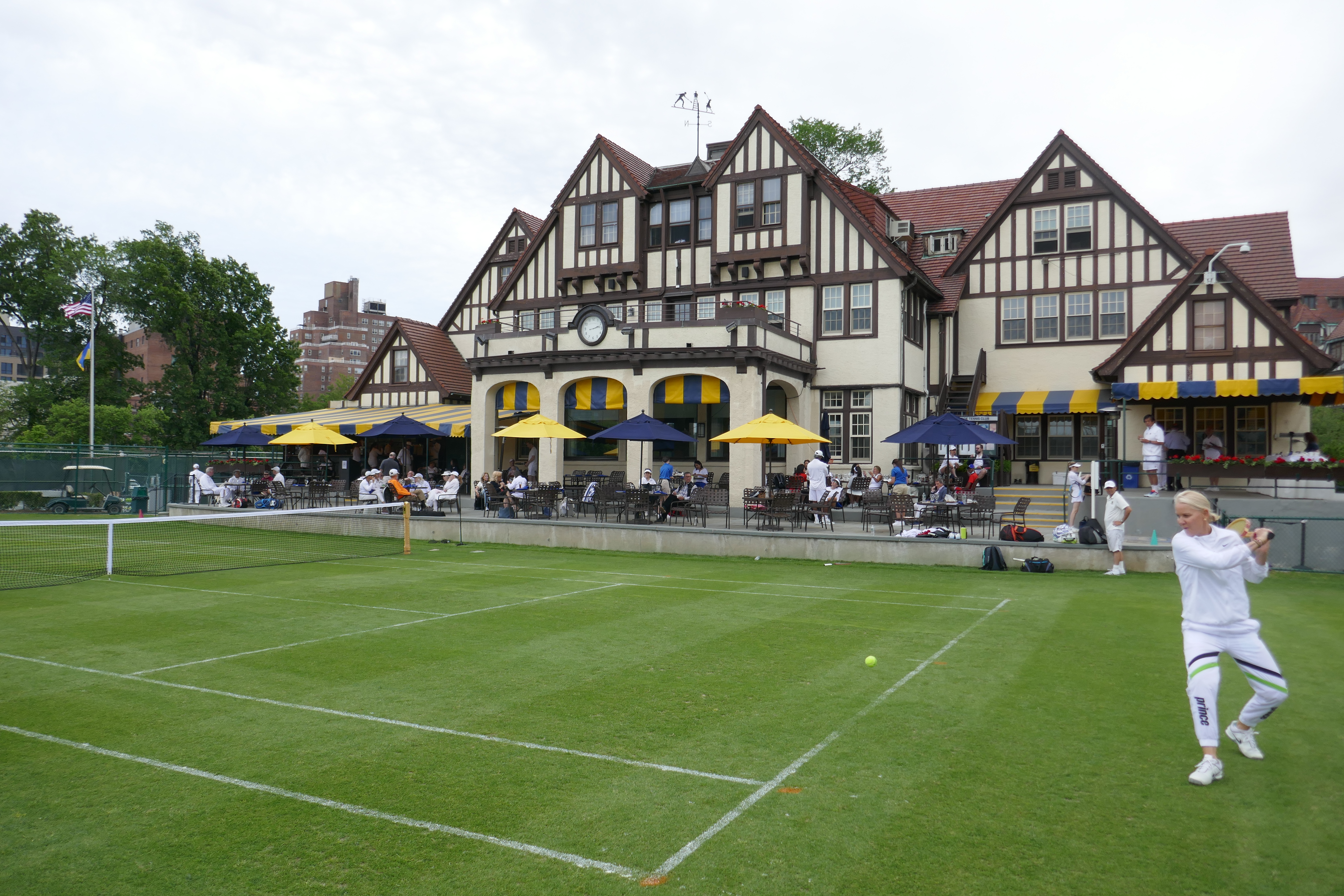
Rennae Stubbs testing the new grass courts, Photo by Michael Perlman


Saturday, February 6, 2021

Sweet Memories of Eddie’s Sweet Shop as Witt’s Confectionery & Ice Cream

 By Michael Perlman

Eddie's Sweet Shop, January 2021, Photo by Michael Perlman

Forest Hills is known for tennis, music, and of course ice cream! Eddie’s Sweet Shop at 105-29 Metropolitan Avenue holds the record for the most intact and what is likely the longest continuously operating ice cream parlor citywide.

In July 1979, artist Randy Jones sketched “The Great Ice Cream Safari” comic strip for The New York Times, which featured an elephant touring ice cream parlors, an endangered species. Eddie’s Sweet Shop was saved for last, where a patron on a swivel stool said, “This antique parlor would make a fine trophy in the Smithsonian!”

That vision continues today as patrons encounter vintage signs with Coca-Cola insignias and thematically decorated windows with stained-glass reading “Candy” and “Ice Cream.” Around 20 homemade flavors are prepared on the premises along with fresh whipped cream. Original flavors include rum raisin, butter pecan, and tutti frutti.

Patrons can sit on the same cast-iron swivel stools their great-grandparents sat on and enjoy a sundae or a float at the mahogany and marble counter facing stenciled built-ins and one of the first electric Frigidaire freezers. The authentic ambiance also features a honeycomb pattern mosaic floor, a tin ceiling with rose stamped molding, leaded glass windows with a sunburst and tulip motif, and tapestry appointed woodwork topped off by a wall clock by the pioneer Seth Thomas Clock Company.

In 1925, a 2-story brick building with a corner entranceway was filed and Seelig & Finkelstein drafted blueprints. One of the earliest owners was reportedly Mr. Krohn, followed by Schaefer. Around the mid-1940s, the shop was renamed Witt’s Ice Cream & Confectionery after owner William Witt, a German immigrant. When Witt retired, he sold the shop to the Citrano family in 1968, and it became a success ever since. Giuseppe and his son Vito Citrano and wife Angelina are cherished Forest Hills personalities. Three generations worked alongside one another until Vito’s grandpa, also Vito, passed away in 1995.

Three generations of the Citrano family in the footsteps of the Witts, 2014 photo by Michael Perlman 

Much of the shop’s history prior to 1968 is undocumented, but is being rediscovered thanks to the memories of patrons. Owner William Witt and his wife Elsie, who were often addressed as Mr. and Mrs. Witt, as well as their daughter with the same name, would also be proud.

Michael Dillon lived around the corner on Nansen Street since 1953, and after playing ball in the street with his friends, Witt’s was the go-to place. He said, “In the mid-60s while working at Associated Food Stores on Metropolitan Avenue, I was fortunate to deliver sugar and get a glimpse of all the wonderful ice cream making machines. The Witts were always such kind and lovely people, who always reminded me of the ideal grandma and grandpa.”

“My father, Joseph proposed to my mother, Clara at Witt’s. It was a fine treat for our parents to take my sisters and I on a walk there in the summer, and we always sat in ‘Mom and Dad’s booth,’ which was the first towards the back,” said Joe Burchill, who lived on Greenway Terrace followed by Burns Street. He reminisced, “I tried my first ice cream soda and my first sundae there. All of their ice cream was so creamy and the taste was very real. My absolute favorite was coffee.” He was also tempted by the candy display across from the soda fountain. “There were so many, it was hard to choose, but root beer barrels were a favorite.” He also remembered unique Panasonic radio ads photographed there. “They were promoting their unusually shaped and brightly colored line. There was a spherical radio and the ‘Toot-a-Loop’ that you could put on your wrist and untwist, so it could stand up on its own.”

John Mattis lived on Loubet Street and now resides near Tampa. He said, “I remember watching Mr. Witt pack the containers, really pushing the ice cream into them as hard as he could. Later on, when I would get ice cream from other places and watched them pack it gingerly, I realized how much the Witts always did the right thing for their family of customers. I also remember the cold feel of the marble countertops, the glorious banana splits, and the girls swim teams that would pack the booths and loudly and joyously talk among themselves. I was always sneaking a peak on a girl I liked!”

Witt's ad, December 1958, Community House Chatter publication 

Northern California resident Nick Covell feels fortunate to have lived in Forest Hills three times. “I delivered the Long Island Press there in 1956. When I collected for the 40 cents a week bill, Bill Witt used to give me a 35-cent malted for a tip, a big deal for a 13-year-old kid.”

Another account of graciousness was shared by Paul Hettler, who was raised on Kessel Street. “My dad and I would walk there every Saturday in the mid-fifties, and he would buy me a vanilla ice cream soda which cost about a quarter. A few years later, when I was old enough to walk alone, I would get the ice cream soda and give Mr. Witt a quarter. This went on for several weeks, when finally, he quietly told me they haven’t been a quarter for several years.”

Nancy Jeanne O’Connor, a Bronxville and Danbury resident, was raised on Manse Street between 69th and 70th Avenue. She said, “Many a night between 1951 and 1962, my parents walked up to Witt’s for dessert. Mom’s favorite was butter pecan and dad’s was chocolate, sometimes with orange sherbet. Our Lady of Mercy had processions of the little girls usually on Holy Thursday and the Feast of Corpus Christi, and many of us went to Witt’s afterward with our friends and parents. We went many Sundays with the ‘Klaum girls.’ We ordered hot fudge sundaes, but when funds were low, a 15-cent cherry coke. Now my siblings and I have the pleasure of introducing the next generation to Eddie’s, and it was always a special treat for them.”

Phyllis Pellitteri Cush especially remembers marshmallow sundaes and quality time at Witt’s after swim meets at Our Lady Queen of Martyrs. “My friends and I used to storm into Witt’s at one time and take over the whole shop. Sometimes there weren’t enough seats for us. I cannot forget the icicles in our hair!”

Andrea Stone also recalled swim meets, which were followed by banana splits and chocolate egg creams. Witt’s was also a tradition after 6th to 8th grade dances at The Community House. She said, “I told a friend in Colorado that Witt’s is now Eddie's Sweet Shop, and he said that he can't wait to try it the next time he goes to NYC. I love that it still looks the same!”

Reflecting on how the beloved ice cream parlor withstood the test of time, the Citrano family had much to share. “We feel so happy to see that Eddie’s Sweet Shop served generations of customers through the years we have been here, as well as new ones. Our family estimates that over 30 films, commercials, and ads have been produced at our shop during the years we own it.” Vito added, “My father showed me not to be afraid to work hard. When it’s time to make hot fudge, I will keep stirring until it’s right, no matter how late it is or tired I am.” Angelina is also grateful. “We had many proposals at Eddie’s, and the first wedding ceremony in front of our doors a few months ago. We were honored!”

Friday, September 4, 2020

Historic Forest Hills Banks Merit New Lease on Life & Not Demolition!

 By Michael Perlman

Banks were traditionally erected as freestanding buildings with solid construction comprised of high ceilings and classical architectural features, to instill a sense of financial stability, integrity, security, and commitment, and were regarded as community centerpieces. In Forest Hills, three bank buildings became available over the past year, echoing the neighborhood’s past, as they were designed in harmony with their surroundings. Now community residents and visitors are hopeful that their unique period details will be preserved, whether the buildings continue to operate as a bank or are adaptively reused, which has been accomplished countrywide. 
 

A “For Sale” sign was posted on the façade of Forest Hills National Bank of New York at 99-00/02 Metropolitan Avenue , which most recently operated as a branch of Chase. This Greek Revival meets Colonial building style building’s façade remains mostly intact, retaining its brick and stonework consisting of pilasters, a door surround, arched windows, and a pediment. It opened in December 1928 to primarily serve a growing community of south Forest Hills which was 22 years old at that time, whereas Rego Park was 5 years old. The Queens Chamber of Commerce’s “Queensborough” publication stated, “The capital stock of $200,000 is held for the most part by Queens Borough business men who believe in the future of the borough. The bank starts with a surplus of $50,000.” It also explained that the bank operated a Special Interest department and a Christmas Club.

Daniel J. Flynn, Vice President of Jones Lang LaSalle, a commercial real estate services company, explained that he and his colleague is currently under negotiations with a buyer. The façade’s few modifications include the uppermost arched section of the windows covered with aluminum siding, replaced windows, and the building’s original etched name also covered with aluminum. The interior has dropped ceilings, but can be eliminated to reveal distinctive details from 1928. While examining the façade, he said, “I love the look of the building. It captures a bygone era, in which materials and labor were disproportionately less expensive. At this point, the buyer fully plans to utilize the building and not modify the exterior.” Considering its ideal location, he continued, “This part of Queens serves a very important function in housing and commerce.” 


The longtime location of HSBC Bank at 107-15 Continental Avenue was home to The Williamsburgh Savings Bank in 1975 to benefit Forest Hills’ growing community. It is now available for lease and its use remains to be seen. In the 1970s, the bank appointed an architect to creatively design the façade in the Tudor style, a hallmark of Forest Hills architecture, which complements the harmonious ambiance along Austin Street, Continental Avenue, and Forest Hills Gardens. A few decades ago, the commercial district was still referred to as “The Village” by community residents. The façade remains mostly intact and includes signature half-timbering, ornamental brick and stone chimneys, a slate pitched roof, a finial, Roman numeral clock, and flagpoles. 

A leasing opportunity advertises an available 6,500 square feet with an additional mezzanine and basement. It also references heavy daytime traffic and the space’s excellent condition which remains fully built out as a bank.

As of March 1975, The Williamsburgh Savings Bank, which was incorporated in 1851, increased in resources to over $1.7 billion. An ad featuring a façade rendering read, “Get a free gift at our new Forest Hills office only for opening a new savings account of $5,000, $1,000, $500 or $200 or more during the opening celebration.” Weekly door prizes ranged from a G.E. cassette recorder or a Polaroid SX-70 camera to a Raleigh 10-speed bicycle or a Panasonic 16 in. solid state TV. Grand door prizes included a trip for two to Bermuda or Las Vegas, a choice of grandmother’s or grandfather’s clock, a G.E. washer & dryer, a Panasonic Quadruplex stereo, or a Sun Fish sailboat. Nineteen prizes for a new account of $5,000 or more included a Caravelle by Bulova, a Manning-Bowman stainless steel rotisserie broiler, and a Corelle 20-piece Livingware set by Corning. For over $1,000, 14 options included an ICP AM/FM portable radio, a Sankyo digital alarm clock, and a flight bag. 


In November 1921, the Corn Exchange Bank received permission from the State Banking Department to open a Forest Hills branch at 106-24 Continental Avenue. Now it is known as Boston Market and also consists of the recently shuttered Aldo, which is being advertised as a store for rent. Around 1922, patrons were welcomed to a prominent Tudor style brick and stone building at a major intersection. It features a pitched sweeping roof with terra-cotta tiles and a spire harmonious to the nearby Forest Hills Inn, as well as tall windows with motifs of crops and flowers. The bank’s name, etched in stone, reportedly exists underneath Boston Market’s signage. As renovations were underway in Aldo nearly ten years ago, the removal of a faux ceiling revealed a much higher curved ceiling with period details, but was only witnessed by the modern eye briefly.

In January 1928, readers of “Queensborough” learned that the firm, which began business on February 1, 1853, had eight of its more than 60 branches in Queens. It stated, “The bank has a capital of $11,000,000 and surplus and undivided profits of $16,527,000. The bank entered the Queens field on August 28, 1899, when it absorbed the Queens County Bank.” The Forest Hills branch manager was Edward L. DeForest.

“Part of the lure and rewards of exploring New York’s history is how every neighborhood has its own character,” said Riley Kellogg, an adjunct lecturer in history and a licensed NYC tour guide. My hometown’s rich history teaches us about all the people who have been drawn here for myriad reasons, and how all have contributed to building the New York City we know and love. One of the most visible, and we hope lasting marks of those characters, are a place’s architecture. The evidence of who Forest Hills has been, who it is now -- who we are now -- is there to be seen in the mix of Tudor and Classical, humble and grand, commercial and residential buildings. These former bank buildings each reveal one of the faces of this ever-growing, ever-evolving neighborhood. There are good reasons to keep our older buildings. We needn't obliterate our past in order to grow our future. In fact, the future will have stronger roots, and be sounder and more truly ours, if we build with the past, rather than demolishing and forgetting it.”

Helen Day, Richmond Hill Historical Society VP, is also concerned about Forest Hills’ historic buildings. She was surprised to see Chase closing its Metropolitan Avenue branch. “It is a lovely building that I would really like to see preserved with a new use. It is large enough for a restaurant or another bank.” She continued, “The Tudor style buildings on Continental Avenue also fit well with the neighborhood. They don’t need to go to the expense of tearing a building down or doing a complete renovation of the façade. Each one of these buildings contributes to the character and appeal of their location. It is unfortunate that the businesses are no longer there, but this is an opportunity for another business to make good use of them.”

She explained a case in point. “Many period features get covered up, but that doesn’t mean you cannot uncover them. I know of a hair salon in Ridgewood, where the owner pulled out all the modern stuff and found tin ceilings and great details that she incorporated into her décor. The interiors should have as much character as the exterior! Preserving something unique will give a special look to whatever they will open at those three Forest Hills locations.” 

Saturday, March 21, 2020

Coronavirus Relief Initiative – Local volunteers ready to serve our community!


Coronavirus Relief Initiative – Local volunteers ready to serve our community by offering services including supplies, food, & conversation. All volunteers are strongly advised to wear a face mask & gloves!

** Annamaria Girardi: amgirardidolfini@gmail.com & 347-272-6149

** Thomas Mei: thomas.mei@gmail.com & 718-909-5874
https://www.facebook.com/ThomasMei

** Peter Fleming: pjfleming@verizon.net & 917-584-9900

** Anna Demetrashvili: Ademetra@aol.com & 646-775-1949 

** Nathania Horowitz: Nathaniajayne@yahoo.com

**Marie DiBella: Mariedibella@gmail.com  

** Alexandra Kay: Iluvelyfe@yahoo.com

** Tiffany Pierce: tiffanyspierce@gmail.com

** Gabriella Golan: gabgabgo@gmail.com 

** Roger Mashihi: (347) 489-6828

** Yvonne Scibelli: ynagan@optonline.net

** Cari Cohen: cbccohen@gmail.com

** Elizabeth Stoddard: larubiachula33@gmail.com


** Patty Bugland: lisabugland@aol.com & itsmsbug@aol.com  

** Amy Beth Goldman: amybeth4@aol.com  

** Paige Cragg & her husband: plc.cragg@gmail.com

** Christine Liem & husband Chris: itschrismail@yahoo.com 

** Astrid Munera & Elkin Verona: astrmuar@hotmail.com

** Madiha Zoobear: madihaz1987@gmail.com 

** Yael Yomtov-Emmanuel: yaelyom@aol.com

** Jessica Keller & Noel John: jkeller.interiors@yahoo.com & noeljohn1986@yahoo.com

** Congressional candidate Sandra Choi: sandra.choix@gmail.com & 347-286-1140

** Bruce Goerlich: 917-592-8335

** Batya Kaufman: Batya.S.Kaufman@gmail.com

** Dina Bouzier Murphy: dbouzier@yahoo.com

** Cristina Liparulo: cparadelo@gmail.com

** Mickey Blume-Zacarias: M2zacarias@yahoo.com 

** Marla Kleinman: mpkleinman@gmail.com

** Melanie Rudolfo: Mrudolfo1@aol.com

** Helaine Lu: lainey557@gmail.com

** Jessica Crespo: jessicafcr@gmail.com

** Patricia Bernard: Patriciabernard9@gmail.com

** Yvette Jong: Yvettejong@gmail.com & 718-5444037
https://www.facebook.com/yvette.jong 

** David C. Vitt : dcvitt@gmail.com
https://www.facebook.com/dcvitt
Donating his time in honor of his employer, Farmingdale State College.


** Mike Arcati, Forest Hills American Legion Post Advocate: michaelarcati@outlook.com & 646-512-1359
“We want the community to know that the American Legion Post's members and building is available to help in the best capacity possible.  Our initial thought is to connect with a local hospital and make our location either a testing/vaccination site or a triage location.  As an alternative, it can be a location to collect supplies, for volunteers to meet & gather supplies to deliver to community members who cannot leave their homes.” 

** Kim Collins, The Bowery Mission: kcollins@bowery.org
In need of critical supplies and food as we feed and shelter those who have no home.

** Questions? Contact founder Michael Perlman, co-admin of Forest Hills, Rego Park, Kew Gardens – “Our Communities”

Wednesday, March 18, 2020

A New Local Facebook Volunteer Unit To Help Those in Need


As Coronavirus cases surge, lending a helping hand as a community is essential. Over the weekend, this columnist, who is a co-admin of the 16,500+ member Facebook group, Forest Hills, Rego Park, Kew Gardens – “Our Communities” founded a new volunteer unit comprised of members who came forward within hours. The post reads, “Times of crisis can bring us closer together. Who would like to volunteer to help community residents in need? For example, we can run errands for seniors who are advised to stay home during the pandemic. We can commit good deeds that are small, while socially distancing ourselves among other precautions. As a large Facebook group, we can help some of our neighbors.”

Several members of a new growing volunteer initiative have spoken! “It’s always important to give back, but in this time of social distancing, it is imperative that those with stronger immune systems help those who cannot go out in public without risking their health,” said Batya Kaufman. “I have no family nearby, so I know how lonely and difficult it can be without a nearby support system. I also hope I will make some lasting connections that continue beyond this pandemic.”

“Volunteering in a time of crisis enables me to connect with my community and helps affirm my purpose,” said Melanie Rudolfo. She envisions picking up groceries for seniors.

A group member, Kris Supangkat of Kew Gardens, was able to help Forest Hills resident Barbara Glick, who was in need. “She offered to bring me eggs and face masks, and I never met her before. Our group changed overnight from simple posts to life-saving help for others who might die because they can’t get out or they don’t have money to buy stuff. We need to realize that we can be someone who needs others.”

Glick feels a “need to go back to the old Forest Hills and know your neighbors’ names.” She explained, “How can it be when you live in a building for 48 years that nobody knows who you are and nobody helps you? It takes a village, and more than ever that’s been proven. Giving back is great karma and receiving is love, but when it comes down to it, it’s about love and empathy. It doesn’t matter what religion you practice, or what political party you’re part of. Any of us could die from the Coronavirus!”

Alexandra Kay’s grandmother will always be a huge inspiration. “She is the definition of selflessness, and although she passed away, I will never fail to follow in her ways. I was raised around loving and giving people. I want to give back to the world everything that I got in my life, especially to people who need it and can’t always ask for help. I would like to see a significant amount of love and giving in a time where people and businesses are in a crisis. There shall always be light, even in the darkest of times.”

A crisis can particularly make people feel lonely, but Dina Bouzier Murphy hopes to make a difference. Her volunteerism is motivated by the recent loss of a neighbor. “We tried to help him as much as we can, since nobody ever came to visit. He passed away alone, and we realized that he had no surviving family or friends but us. He was grumpy at times, but now we understand why. For that reason, I really want to reach out to everyone that needs our attention.”

“No one is alone” is part of a Sondheim song, which is true, explained Marlene Meltz. “This is a crisis for all. The hydro- Christian teachings inspire us to reach out, so whenever people can share their time, do it.”

As for volunteering to help the community and elders, Mickey Zacarias said, “When there is a need, you fill the need. We are a community and that’s what we do. It’s just like helping a family member.”

In a time of crisis, our most vulnerable populations are at highest risk, explained Elizabeth Stoddard. “My idea for helping seniors would be to divide a call list, where volunteers could call seniors on their list to offer conversation, see how they’re feeling and if they have any medical needs, and offer to pick up groceries or medications.” After learning that schools are closing citywide, she said, “If anyone can’t feed their kid breakfast or anything, I have extra unopened cereal boxes among non-perishable foods.”

Christine Liem was raised in Indonesia and moved to America 15 years ago. “In Indonesia, if someone needed help, we would provide money or food.” Besides her husband Chris, she does not have much family in the U.S. “I can relate when someone lives alone and needs help, so I will contribute my time and energy,” she continued. Looking ahead, she envisions opening a local food pantry for all.

Congressional candidate Sandra Choi describes Queens as a model for the world and a collective community. She said, “Now, more than ever, we have to look after one another and continue to build a community, so no one feels alone.” She visualizes innovative policy reforms to support the most vulnerable in our community, and especially those left behind by policymakers. She explained, “No one lives a single issue life, as we are all impacted by a number of factors. For example, a senior in our community who lives on a fixed income and depends on homecare service will undoubtedly be affected by COVID-19 since it can isolate them, limit access to a caregiver, or they may no longer perform the basic tasks needed including errands to the pharmacy, grocery store, or bank. We need more collaboration among federal, state, local agencies, and private non-profits to ensure our seniors are able to lead lives with dignity and independence.”

“When people say they have no time, no one really does, but we have to find some way to get involved and serve,” said Patty Bugland, who served on her Forest Hills building board for 14 years. “The sense of being part of a small town within a 105 unit co-op is very real, and we can all benefit by being on call for each other. During those years, I worked anywhere from 35 to 60 hours weekly between my job as a special ed teacher for the DOE and a speech and debate judge for a Long Island high school.” She is willing to prioritize for people in need within a radius of 72nd Road, Grand Central Parkway, and Queens Boulevard.”

A list of volunteers and people who need their services is underway. To participate, contact Michael Perlman over Facebook or at mperlman@queensledger.com and provide your name, Facebook link, phone number, and email.

Wednesday, June 19, 2019

New Helen Keller Mural Lighting The Way in Forest Hills

By Michael Perlman


The Ascan Avenue LIRR underpass is now a historic passageway, with the “Tribute To Ascan Avenue & Forest Hills Gardens” mural on the east wall, completed in 2017, and the “Helen Keller Forest Hills Tribute” mural, completed on the west wall on June 14. For many local residents and visitors who observed the dedicated and humorous LIRR crew installing the mural within a couple of hours, it was a historic moment. They stood proudly in memory of Keller, an advocate, author, and lecturer who persevered in her mission to remove stigmas associated with sight and hearing disorders despite being blind and deaf.

From 1917 to 1938, Helen Keller resided in a 7-room house, along with her teacher and closest companion “Miracle Worker” Anne Sullivan Macy and her secretary Polly Thomson. Today it is home to The Reform Temple of Forest Hills at 71-11 112th Street. 

Helen Keller, Anne Sullivan Macy, & Polly Thomson's house, 71-11 112th St, Courtesy of Michael Perlman
Helen Keller inside her home, Courtesy of Susanna & Robert Hof
The 48-foot by 4-foot mural on preservation-friendly panels, was designed by Crisp from Australia and Praxis from Columbia, and developed by this columnist. It also became a reality due to the partnership with lead sponsor Council Member Karen Koslowitz, Queens Economic Development Corporation, and The Reform Temple of Forest Hills among local organizations, restaurants, shops, and residents who served as benefactors. 

Helen Keller & dog Sieglinde in bottom row, Anne Sullivan Macy & Polly Thomson in top row, Courtesy of the Hof family
The mural features a hand touching Braille, Helen Keller’s portrait and profile view, her pets, her demolished house, an equal rights voting box, and her feature on a 15-cent stamp with Macy. Her voice comes alive through two of her many quotes, “The only thing worse than being blind is having sight but no vision” and “The millions of blind eyes must be opened.” Her spirit initiates much light through a plaque designed in collaboration with Continental Photo, which features her local to international accomplishments, quotes, signature, and photos. 

 
Muralists Praxis & Crisp painting a Helen Keller mural panel, Photo by Michael Perlman
The mural was painted at The Reform Temple on June 12 and June 13, and the public had the opportunity to have a sneak peek and hear several presentations at two “Helen Keller Comes Home” events. Guest speakers shared valuable insights, discussing her history and the importance of contributing. 

Helen Keller Comes Home guest speaker panel, Day 1, Photo by Michael Perlman

Helen Keller Comes Home Day 1 attendees, Reform Temple of Forest Hills holding Helen Keller plaque & photos, Photo by Alvin Callo
Helen Keller Comes Home, Day 2 panel & guests, Photo by Alvin Callo

Teamwork was essential for every aspect of the project. Transporting the mural panels from the temple to Ascan Avenue nearly did not transpire in time, until Home Depot donated their services. Home Depot Assistant Manager Christina Strongilos said, “A mural commemorating Helen Keller was installed in Forest Hills, thanks to the Glendale Home Depot which came to the rescue when there was no other way to get the mural panels there. A great job to our very own department heads Fredy and Drew who made it happen!” 

Home Depot dept heads Drew & Fredy load Braille mural panel on flatbed, Photo by Michael Perlman
Helen Keller mural fans & benefactors
Reform Temple congregant Barry Joseph co-founded Girl Scout Troop 04281 last February, which consists of fourth and fifth graders who meet at the temple. “This season, they are working on a badge to learn more about their neighborhood and create something to teach others. They came up with the idea of creating Helen Keller playing cards that could be shared with people who came to the mural painting events at the temple. I was really proud of them for doing something to teach others about local history that was also connected to art and human rights.” 

LIRR staff displays Helen Keller mural panels, Photo by Michael Perlman
“Murals are not just artwork, but at their best tell a story,” said congregant Barry Wollner. “The Helen Keller story is worth telling and those who know her story will reflect on her life. Parents and their children will walk by the mural, and it will encourage discussion and result in a visit to the library to learn more about her life.” 

LIRR crew along with Crisp & Michael Perlman
The temple’s Rabbi Mark Kaiserman organizes the annual “Helen Keller Shabbat of Inclusion” featuring a guest speaker facing challenges but permits will power to lead the way. “The mural offers a real artistic and social benefit to Forest Hills, and it is an honor to have Crisp and Praxis’ beautiful art fill our town. Helen Keller was not Jewish, but embodied the blessings and values of our faith and every faith; the idea of overcoming incredible obstacles and working together with the community and living her life to making it a better world. She chose to become an ambassador across the planet, traveling places that many of us would never dream of, to reach out and inspire people.”

Rene David Alkalay, who contributed on behalf of Red Pipe Cafe and Genesis Society, said “I hope we can continue to maintain growth through the arts and find ways to communicate with one another.”

On behalf of benefactor West Side Tennis Club, archivist Bea Hunt explained, “West Side came to Forest Hills in 1913, four years before Helen Keller. She had friends in the neighborhood including the Marsh family who were Club members.” Hunt is determined to further research if Helen Keller ever visited the Club.

James Ng represented benefactor Elmhurst History & Cemeteries Preservation Society and called it an “honor to participate.” “I like to volunteer to make sure our history is preserved, since if you lose it once, it’s lost forever. When I watched the movie ‘Miracle Worker,’ the actress who played her was Patty Duke, who was born in Elmhurst. Also, I worked for a company that sold American Sign Language interpreting services to hospitals, so in a way, Helen Keller provided me with that avenue of work.”

Alexa Arecchi, Chief of Staff for Assemblyman Andrew Hevesi stated, “Helen Keller is truly the embodiment of what you can achieve when you persevere and don’t let people get you down or tell you otherwise. I am sure it would have been easier if she resigned to what many thought would be her fate – life in an asylum, but she knew that she was destined for more. That is a mindset, where we can all take our daily lives to achieve what we want. Hopefully when people pass the mural, they will be inspired and feel the same things.”

On behalf of the Queens EDC, tourism director Rob MacKay explained, “Whenever anyone hears that Helen Keller lived in Forest Hills, it will create pride. Hopefully it will become instagramable, since many people pass by murals and take photos and get the word out for free on the internet.”

Benefactors Rob Hof and his wife Susanna Hof of Terrace Sotheby’s International Realty were in attendance. He shared his family photos featuring Helen Keller. “My mother’s family was geographically proximate to Helen Keller’s house in a home where the John Alden building stands today. My mother and her siblings would walk from PS 3 to home, and would have milk and cookies daily with Helen. My grandparents were also dear friends. They were all members of the First Presbyterian Church of Forest Hills across the street from the Reform Temple. As a young child and into the sixties, my grandmother would read letters from dear Helen to my siblings and I. Many stories always had the characteristics of gentleness, wisdom, and progressive ideas.” Rob’s maternal grandfather was Robert E. Marsh, VP of Cord Meyer Development Company, who helped secure Keller’s house. Rob added, “Helen nicknamed her house ‘castle on the marsh.’” 

Helen Keller, Courtesy of Queens Community Board 6
 “Like Helen Keller, I am deaf-blind,” signed Lesley Silva-Kopec. “Deaf-blindness has a wide spectrum of hearing and vision loss. I have Usher syndrome, which is genetic. My transition from deaf to deaf-blind was difficult. It took many years to embrace myself as a deaf-blind person. When I accepted my deaf-blindness, my burden eventually lifted off my shoulder and I felt free. It doesn’t mean that it’s easy and that people are 100 percent accepting and kind. For the most part people are helpful, but I still get the looks, since I am sighted and I use a white cane. My cane helps me see what I may not see due to the blind spots and the dark areas. I also have two wonderful dogs that help me. My husband is also deaf-blind. We still experience oppression, but have to stay positive and support each other.” She then explained, “What the city lacks is the Support Service Provider (SSP), also known as a sighted guide. I am currently working with the Mayor’s Office for people with disabilities to have SSP, so they can have autonomy life. It serves as an extra pair of eyes, and is helpful for activities that may not be safe for deaf-blind people.”

She continued, “I am so touched that Helen Keller was chosen to be painted on the Ascan Avenue LIRR underpass. It is a place where I walk with my dogs, so it’s going to make my walk extra special. “ 

“I brought my niece today, since she really didn’t know anything about Helen Keller,” said Leslie Brown, Forest Hills Chamber of Commerce President. She explained, “On 72nd between 110th and Queens Boulevard was the Seeing Eye Dog Foundation, where dogs were training. There was a cornerstone that read, ‘The house that love built – Helen Keller.’” Then the house was demolished. “My mother wanted my sister and I to search through the rubble and find the cornerstone.”

Benefactor Helen Day, VP of Richmond Hill Historical Society said, “It is fabulous to bring Helen Keller back to life and create a special remembrance of where she lived for so many years. She was a person on the world stage, and to come from so far away to a great city of the world and become a part of this great community really needs to be remembered.”

Muralists Praxis & Crisp with historian & mural developer Michael Perlman, Photo by Linda Perlman

Helen Keller's quote & signature, Feb 24, 1920


Wednesday, March 27, 2019

Behind The Lens with Photographer Joe Raskin

By Michael Perlman

Joe Raskin & his father Jack in Rochdale Village, 1980s
One of the most active urban explorers and gifted citywide photographers of our generation is Joe Raskin, a native of Queens. When asked to estimate how many street scenes he has captured citywide over the years, he said, “I've posted over 48,000 photographs on Wandering New York (his photoblog) over the last seven years, but that's just a drop in the bucket, considering how long I've been taking pictures. It’s easily well over triple that number.” The city becomes his canvas, as he largely documents buildings of varying architectural styles that are most classical, followed by subways and commuter rail lines. Every so often, his eye will turn to nature. 

Joe Raskin & Creative Musings on Mass Transit at the NY Transit Museum, 2016 photo by Marc A Herman
“Ideally, I am out every day of the week in one part of the city or another, and I spend two to three hours each day, not including travel time,” said Raskin. Even in the rain and snow he can be found with a camera in hand. He said, “Creative expression is a wonderful thing, and it always feels great to be out and about taking photographs.” His achievements continue with his subway history book, “The Routes Not Taken, A Trip Through New York City's Unbuilt Subway System.” 

A charming Forest Hills Gardens home

Brownstones in Park Slope
Raskin uploads photos in at least 10 Facebook groups, where some are posted nightly, drawing quite a fan base. Besides Wandering New York, his work can be viewed on Instagram under @rochdalian and on ThisistheBronx.info. It can also be spotted on NY1 and channels 2, 7, and 11. Raskin made appearances on In Transit on NY1, BronxTalk on the Bronxnet network, and on the Single Shot show on the Manhattan Neighborhood Network.

One may speculate how his passion originated. First off, he looks up to his father Jack, who passed away six years ago. He recalled, “My dad was always taking a lot of family pictures, so he's the one to credit. I began using his 35mm cameras in the late 1970s.” Secondly, Raskin embodies the spirit of some of the past generation’s most highly regarded photographers. He said, “Berenice Abbott, Arnold Eagle and Todd Webb's work has an immense effect on me, with Abbott's in particular. They made it easier to focus on subjects and appreciate the everyday scenes of life in the city.” 

Ridgewood Rooftops,  Mathews Model Flats
For 33 years, Raskin resided in Rochdale Village, Sunnyside, and Astoria, and now calls Chelsea home. Prior to retirement, he served as Assistant Director of Government and Community Relations at the MTA. Now he considers his hobby as his “current job.” Raskin is a graduate of York College, where he majored in Political Science, and achieved a Masters in Urban Studies from Queens College. “I took a photography class at York, which certainly enriched my interest, but I would describe myself as being self-taught,” he said.

Some of Raskin’s most memorable experiences transpire when he encounters people in a diverse range of neighborhoods. He said, “I get into conversations about their communities, and for the most part, they are curious about my work and enjoy that I'm taking pictures there. I'll point out that it is what people usually do in the touristy areas of town, and explain that I’m not a real estate agent or working for one. Generally, they appreciate that, and even suggest other places for me to look at.” He continued, “I also value it most when someone sees a photo that triggers a pleasant memory.” 

Fall foliage along the Franklin Shuttle
A No 7 train approaches the 52nd Street, Lincoln Avenue station in Woodside
“My original camera was a Kodak Brownie, followed by a Kodak Instamatic,” said Raskin. Today his cameras of choice are a Panasonic Lumix and Casio Exilim, and even his Samsung Galaxy phone. Then the question becomes safeguarding a massive photo inventory. He said, “I store them on a lot of flash drives. It's much better to be redundant when it comes to storage. I don't trust the Cloud as the only place.”

Raskin’s explorations take him through the Rego Park Crescents, a most enjoyable enclave. “It’s hard not to get a little bit lost there,” he chuckled. He can also be found wandering through the Forest Hills Gardens, as well as photographing houses north and south of Metropolitan Avenue. Raskin said, “Both communities are consistently beautiful. Although there are some new buildings, much hasn't changed in decades, and hopefully it remains that way.” 

Rego Park rowhouses
 
Rego Park houses
Among his favorite photos are ones captured along and from elevated subway lines. “It's a great way to get a real slice of life look at the city,” he said. Also in high ranks are houses in Glendale, Ridgewood, Astoria, and Woodside.

Being a history buff, he explained, “What's most meaningful is knowing how these buildings and streets tell the story of how the city grew and expanded from just the downtown areas in each borough. That's also what is most meaningful about the subway photos.” The architectural styles that he finds most intriguing relate to photographing classic city housing, such as Art Deco Bronx apartment houses, row houses such as Mathews Model Flats, brownstones, and townhouses. “All of them definitely add to the spirit of city life, especially when they are well maintained,” he said. 

Townhouses on the Upper West Side
One must wonder if there are there any neighborhoods that Raskin has not documented. He explained, “There has to be some that I've missed. I'd like to think that at some point I've walked on every city block. If there's a to-do list, I'd like to go inside buildings such as the Flatiron Building and take pictures from them.” 

Alleyway from Pelham Parkway

Grand Concourse Historic District
Over the years, Raskin has learned how each community varies and how each section of a neighborhood can offer a spirit of its own. He said, “For the most part, the stereotype images of each community are wrong. I've learned not to take any neighborhood for granted. If it wasn't for my photographic trips, I may never know much about areas like Stuyvesant Heights and Longwood.”

In the long-term, Raskin would like to publish his photos in several books. Sharing his wisdom with younger generations, he says, “Be curious and follow your vision of what you want to do.” 

A similar version of this feature appears in Michael Perlman's Forest Hills Times column:  http://foresthillstimes.com/view/full_story/27633557/article-Behind-the-lens-with-photographer-Joe-Raskin