
Showing posts with label Architecture. Show all posts
Showing posts with label Architecture. Show all posts
Friday, March 6, 2020

Monday, December 21, 2015
Dec 27: FREE Forest Hills Gardens Tour!

FREE Forest Hills Gardens Holiday Tour on Sun, Dec 27 from 2 PM - 4 PM.
To RSVP, visit: www.facebook.com/events/935178509883356
Please add your friends to the event page & share over social media.
We will visit historic sites including the storied Forest Hills Inn & Tea Garden, PS 101, The Leslie, Adolph Weinman's WWI Soldiers & Sailors Memorial, Church-in-the-Gardens, & the Christian Science Church. Also to be explored is the Gardens' celebrity culture with names i.e. Burt Bacharach, Fred Hart, & Alrick Man, Jr.
We will meet at Station Square outside the LIRR Station at Continental Ave & Burns St. Please join Jeff Gottlieb (Central Queens Historical Association, President), Michael Perlman (Rego-Forest Preservation Council, Chair, & Legendary Locals of Forest Hills and Rego Park, Author), & Cheryl Cuddeback (longtime resident, author, & real estate salesperson).
The forecast is predicted to be mild. Questions? Email jeffgottlieb@hotmail.com & unlockthevault@hotmail.com
We will visit historic sites including the storied Forest Hills Inn & Tea Garden, PS 101, The Leslie, Adolph Weinman's WWI Soldiers & Sailors Memorial, Church-in-the-Gardens, & the Christian Science Church. Also to be explored is the Gardens' celebrity culture with names i.e. Burt Bacharach, Fred Hart, & Alrick Man, Jr.
We will meet at Station Square outside the LIRR Station at Continental Ave & Burns St. Please join Jeff Gottlieb (Central Queens Historical Association, President), Michael Perlman (Rego-Forest Preservation Council, Chair, & Legendary Locals of Forest Hills and Rego Park, Author), & Cheryl Cuddeback (longtime resident, author, & real estate salesperson).
The forecast is predicted to be mild. Questions? Email jeffgottlieb@hotmail.com & unlockthevault@hotmail.com
Tuesday, December 15, 2015
The Kennedy House At 50 - A Landmark of Luxury Living
By Michael Perlman


Towering 34 stories over Queens Boulevard is the Kennedy House at 110-11 Queens Boulevard, which has been a prestigious address since its 1966 opening. On track to its 50th anniversary, past and current residents, as well as descendants of its architect and builder are proud to relive memories and emphasize the distinctive accommodations.
The Kennedy House was developed while the 1964 – 1965 World’s Fair was underway, and not long after the November 22, 1963 assassination of President John F. Kennedy. It was designed by award-winning architect Philip Birnbaum (1907 – 1996) and developed by another award winner, Alfred L. Kaskel (1901 – 1968), President of Carol Management Corporation, who frequently partnered to introduce projects to the growing Forest Hills community, including a majority of presidential-titled buildings along 108th Street and Yellowstone Boulevard. Without a surprise, their latest endeavor was the recipient of a 1st prize bronze plaque by the Queens Chamber of Commerce in 1966.
When residents picked up The New York Times in April 1965, highly stylized ads featured cartoon-like renderings of the tower offset by a rooftop pool. A few were titled “A Landmark of Luxury Living” and referenced a “new dimension of urban living.” Accommodations would include a landscaped park and gardens which occupies 75 percent of the site, banded terraces with turquoise lights, and central air with individual room controls. Rent for a studio to a three-bedroom apartment began at $162, and all-inclusive was gas, electric, and use of “vacation-at-home facilities,” such as two rooftop swimming pools, a sauna, a sun deck, a recreation room, a 24 hour doorman, and an attended garage.
Historically, the owner called the Kennedy House “the tallest swimming pool foundation in the world.” Florida resident Daniel Kaskel, great-grandson of builder Alfred Kaskel explained, “Alfred is credited for constructing the first elevated pool on the rooftop of an apartment building. He experienced engineering issues, but resolved them by combining concrete and steel framing to support the heavy loads.”
Residents and visitors continue to make an entrance under a colonnade marquee past a driveway, and walking across marble floors in a 2-story domed lobby by the famed interior designer Tom Lee, and topped off with an elegant crystal chandelier. Manhattan resident Dara Birnbaum, daughter of architect Philip Birnbaum offered a detail account. “My father grew up in poverty on the Lower East Side, and it meant the world to him to be able to provide the rising middle class, post-WWII, with a sense of status, achievement, and refinement.” She continued, “He paid utmost attention to the layouts of the apartments, yielding more open floor plans, with less square footage dedicated to hallways, and instead added expansive living rooms and bedrooms.”
Her father took pride in living on the 29th floor of what was deemed the tallest building in Queens. “My birthday and my mom’s birthday are on October 29th and September 29th, so that held meaning for us. My brother and I were a little intimidated by the height of the terrace, and we would tease about how people walking on the street looked like ants.” Her favorite accommodation was the rooftop pool, which she took advantage of in the summer while pursuing architecture. “I could return home from college and swim as the sun set over Manhattan, which was magical,” she recalled.
The Kennedy House remains a beacon of light. “The markers of the blue lights used for the terraces reminded my father of an airport runway, specifically those at JFK Airport,” she said. The lobby’s crystal chandelier holds more stories. “It typified my father's desire that the rising middle class could identify with items of luxury, and while it can be seen as a status symbol, it is also a wondrous sparkling light to welcome one home.” She pointed out that his entryways and lobbies were designed to be prominent, and he and Kaskel would often fly to Europe seeking chandeliers and antiques.
Erected with the family in mind, the Kennedy House symbolized traditions. Las Vegas resident Judith Becker’s grandparents Jack and Pauline Schwartz were among the first tenants and remained until the mid-1980s. She said, “I visited them weekly and when I became a parent, my son and I visited together.” Also among the first tenants were Forest Hills resident David Schwartz’s grandparents, and his most cherished memories included playing in the property’s small park with his grandfather. He continued, “I loved being greeted by John, the doorman who was there years later, when I dropped off my daughter to visit her friend. I walked in and said ‘hello John,’ and he said ‘hello David.’”
Since 1995, the Kennedy House has been part of resident Regina Judith Faighes’ harmonious experience. It faces Our Lady Queen of Martyrs Church, where she sings in the choir. She explained, “It is set back from Queens Boulevard, and its grounds include spacious lawns and beautiful trees, including a majestic linden tree. This year, they planted evergreen trees on which lights are hung, so they are living Christmas trees.”
James Griffin and his wife have called the building home for 15 years. “It is superbly maintained and skillfully managed, and the location is a contender for the best in Queens,” he said, referencing its convenience to diverse restaurants, shops, the subway, and the LIRR. He also praised the refurbished gym, the 24-hour doorman, and the pool.
Native Forest Hills resident Robert Rosner said, “I remember a bust of JFK facing fountains, which was removed soon after its installation.” Bert Schwartz’s 6-faced bronze sculpture that captured various moods of JFK was set against a meteorite, and was rejected for its small size. Its whereabouts are unknown, but what is known is how the majority of the Kennedy House’s grand features and services withstood the test of time, proving “A landmark of luxury living.”
A similar version also appeared in the Forest Hills Times: www.foresthillstimes.com/view/full_story/27003251/article-The-Kennedy-House-At-50


Towering 34 stories over Queens Boulevard is the Kennedy House at 110-11 Queens Boulevard, which has been a prestigious address since its 1966 opening. On track to its 50th anniversary, past and current residents, as well as descendants of its architect and builder are proud to relive memories and emphasize the distinctive accommodations.
The Kennedy House was developed while the 1964 – 1965 World’s Fair was underway, and not long after the November 22, 1963 assassination of President John F. Kennedy. It was designed by award-winning architect Philip Birnbaum (1907 – 1996) and developed by another award winner, Alfred L. Kaskel (1901 – 1968), President of Carol Management Corporation, who frequently partnered to introduce projects to the growing Forest Hills community, including a majority of presidential-titled buildings along 108th Street and Yellowstone Boulevard. Without a surprise, their latest endeavor was the recipient of a 1st prize bronze plaque by the Queens Chamber of Commerce in 1966.
 |
| Kennedy House rising, as Forest Hills musician Peter Dizozza & his father pose alongside Our Lady Queen of Martyrs Church on May Day, 1965, Courtesy of Peter Dizozza |
When residents picked up The New York Times in April 1965, highly stylized ads featured cartoon-like renderings of the tower offset by a rooftop pool. A few were titled “A Landmark of Luxury Living” and referenced a “new dimension of urban living.” Accommodations would include a landscaped park and gardens which occupies 75 percent of the site, banded terraces with turquoise lights, and central air with individual room controls. Rent for a studio to a three-bedroom apartment began at $162, and all-inclusive was gas, electric, and use of “vacation-at-home facilities,” such as two rooftop swimming pools, a sauna, a sun deck, a recreation room, a 24 hour doorman, and an attended garage.
 |
| Alfred Kaskel & Philip Birnbaum hold a 1st prize building award, Courtesy of Daniel Kaskel |
Historically, the owner called the Kennedy House “the tallest swimming pool foundation in the world.” Florida resident Daniel Kaskel, great-grandson of builder Alfred Kaskel explained, “Alfred is credited for constructing the first elevated pool on the rooftop of an apartment building. He experienced engineering issues, but resolved them by combining concrete and steel framing to support the heavy loads.”
Residents and visitors continue to make an entrance under a colonnade marquee past a driveway, and walking across marble floors in a 2-story domed lobby by the famed interior designer Tom Lee, and topped off with an elegant crystal chandelier. Manhattan resident Dara Birnbaum, daughter of architect Philip Birnbaum offered a detail account. “My father grew up in poverty on the Lower East Side, and it meant the world to him to be able to provide the rising middle class, post-WWII, with a sense of status, achievement, and refinement.” She continued, “He paid utmost attention to the layouts of the apartments, yielding more open floor plans, with less square footage dedicated to hallways, and instead added expansive living rooms and bedrooms.”
Her father took pride in living on the 29th floor of what was deemed the tallest building in Queens. “My birthday and my mom’s birthday are on October 29th and September 29th, so that held meaning for us. My brother and I were a little intimidated by the height of the terrace, and we would tease about how people walking on the street looked like ants.” Her favorite accommodation was the rooftop pool, which she took advantage of in the summer while pursuing architecture. “I could return home from college and swim as the sun set over Manhattan, which was magical,” she recalled.
The Kennedy House remains a beacon of light. “The markers of the blue lights used for the terraces reminded my father of an airport runway, specifically those at JFK Airport,” she said. The lobby’s crystal chandelier holds more stories. “It typified my father's desire that the rising middle class could identify with items of luxury, and while it can be seen as a status symbol, it is also a wondrous sparkling light to welcome one home.” She pointed out that his entryways and lobbies were designed to be prominent, and he and Kaskel would often fly to Europe seeking chandeliers and antiques.
Erected with the family in mind, the Kennedy House symbolized traditions. Las Vegas resident Judith Becker’s grandparents Jack and Pauline Schwartz were among the first tenants and remained until the mid-1980s. She said, “I visited them weekly and when I became a parent, my son and I visited together.” Also among the first tenants were Forest Hills resident David Schwartz’s grandparents, and his most cherished memories included playing in the property’s small park with his grandfather. He continued, “I loved being greeted by John, the doorman who was there years later, when I dropped off my daughter to visit her friend. I walked in and said ‘hello John,’ and he said ‘hello David.’”
Since 1995, the Kennedy House has been part of resident Regina Judith Faighes’ harmonious experience. It faces Our Lady Queen of Martyrs Church, where she sings in the choir. She explained, “It is set back from Queens Boulevard, and its grounds include spacious lawns and beautiful trees, including a majestic linden tree. This year, they planted evergreen trees on which lights are hung, so they are living Christmas trees.”
James Griffin and his wife have called the building home for 15 years. “It is superbly maintained and skillfully managed, and the location is a contender for the best in Queens,” he said, referencing its convenience to diverse restaurants, shops, the subway, and the LIRR. He also praised the refurbished gym, the 24-hour doorman, and the pool.
Native Forest Hills resident Robert Rosner said, “I remember a bust of JFK facing fountains, which was removed soon after its installation.” Bert Schwartz’s 6-faced bronze sculpture that captured various moods of JFK was set against a meteorite, and was rejected for its small size. Its whereabouts are unknown, but what is known is how the majority of the Kennedy House’s grand features and services withstood the test of time, proving “A landmark of luxury living.”
A similar version also appeared in the Forest Hills Times: www.foresthillstimes.com/view/full_story/27003251/article-The-Kennedy-House-At-50
Friday, December 4, 2015
Dec 6: FREE Historic Forest Hills Tour!

FREE Historic Forest Hills Tour on Sun, Dec 6 from 2 PM - 4 PM.
We will explore stately residential buildings, the business district, & the Forest Hills Gardens. We will meet at La Boulangerie at 109-01 72nd Rd. Please join Jeff Gottlieb (Central Queens Historical Association, President), Michael Perlman (Rego-Forest Preservation Council, Chair & Legendary Locals of Forest Hills and Rego Park, Author), & Susanna Hof (Terrace Sotheby's Realty, Principal).
Questions? Email jeffgottlieb@hotmail.com & unlockthevault@hotmail.com
RSVP on Facebook: www.facebook.com/events/1513120738986003


Wednesday, April 2, 2014
Children Envision The QueensWay’s Future - Historic Route May Be Redefined
By Michael Perlman
There are nearly 2,500 QueensWay petition signers. Will you add your name & a comment? https://www.change.org/petitions/the-city-of-new-york-create-a-greenway-along-the-abandoned-rockaway-beach-branch-right-of-way
A similar version of this feature appeared in Michael Perlman's Forest Hills Times column: http://www.foresthillstimes.com/view/full_story/24862255/article-Children-share-their-vision-for-QueensWay
You can advocate for a historical route and Queens' future by joining Friends of The QueensWay: https://www.facebook.com/TheQueensWay
 |
| Youthful visionaries at the QueensWay Mobile Workshop, Photo by Michael Perlman, Rego-Forest Preservation Council |
Our children
are our future. On March 29, Queens’ youth had a creative opportunity to shape
our borough’s future by illustrating and presenting their visions for the QueensWay,
which bears potential as a 3.5-mile linear elevated public park. The event was
held at the Metropolitan Expeditionary Learning School, which uniquely sits in
the foreground of a section of the abandoned LIRR Rockaway Beach Branch Line in
Forest Hills.
 |
| QueensWay conceptual rendering with children's play area, native trees, & wildflowers |
Along with numerous Queens residents, the
Trust For Public Land and Friends of The QueensWay envision converting an
abandoned stretch of tracks, depleted with weeds and trash into a multi-faceted
resource which Queens can pride as its symbolic representation of the 21st
century. This was one event among a series of QueensWay workshops and mobile workshops,
which the organizations hope will inspire Queens communities to contribute
ideas, pose questions, and receive feedback.
 |
| The Rockaway Beach Branch Line in Forest Hills as of 2011, Courtesy of Friends of The QueensWay |
 |
| Woodhaven Junction Station in 1950, Courtesy of Friends of The QueensWay |
In 1962, a small section of the line
succumbed to a fire, and city officials responded by decommissioning the entire
line. The conceived QueensWay would bridge central to southern Queens
communities, as it intersects Rego
Park, Forest Hills, Glendale, Woodhaven, Richmond Hill, and Ozone Park, and
also provide direct access to Forest Park. According to the Trust, the
QueensWay would serve 250,000 residents living within a mile, while fostering a
major economic boost to Queens.
Queens is a few steps closer to
the QueensWay, as evident by a number of recent developments. After New York State Governor Andrew
Cuomo awarded the Trust for Public Land a $467,000 to determine if the
QueensWay is feasible, it led to the commissioning of two planning and design
firms, WXY architecture + urban design and dlandstudio, which was recently
joined by Hester Street Collaborative, a community engagement nonprofit. The
organizations debuted preliminary design renderings at the Metropolitan
Expeditionary Learning School on March 24, followed by their presentation at
the High School For Construction Trades, Engineering and Architecture on March
26. To reach residents who are unable to attend major workshops, QueensWay
mobile workshops will continue to be held.
The March 29th
children’s mobile workshop was monitored by Shelma Jun of the Hester Street
Collaborative and joined by Friends of The QueensWay volunteers Travis Terry of
Forest Hills and Ruben Ramales of Woodhaven. Jun opened the QueensWay Mobile
Workshop toolkit, and across a communal table, displayed a foldout aerial map
bearing the neighborhoods that the QueensWay would intersect. She explained
what led to the tracks’ abandonment and how it has creative reuse potential. The
map was then reversed to reveal 10 photos which depict the area’s conditions and
its embankments.
Ramales explained, “You'll find yourself on grade in the
north. As it starts to work itself south, it’s pretty much earth embankments
until it hits Forest Park, which then becomes more of a ravine. It changes back
to earth embankments until it becomes an elevated viaduct.”
Jun explained how the areas vary
in width, and drew comparisons to the width of two school buses, an airplane,
or the Statue of Liberty. For example, the QueensWay is 72 feet wide near
Jamaica Avenue, but 133 feet wide adjacent to the Metropolitan Expeditionary
Learning School. “Where an area is really wide, we can introduce lots of
activities,” she said. In response, the children were presented with a map with
bold titled communities along the QueensWay, and were asked to place buttons pinpointing
activities which they could enjoy along specific stretches. The buttons ranged
from bird watching to garden spaces to food festivals.
The children were then handed a “QueensWay
History Coloring Book.” It illustrated the line’s origins to its abandonment, and
showed how some sections grew wild and others began housing businesses below. The
last steps enabled them to imagine how an old railroad can be transformed into
a park, and encouraged drawing what they would like to see in a circle. The
children created a pond with frogs and fish, trees, flowers, bike paths, a zip
line, and swings. Then they placed their 4 favorite program stickers, which
included nature walks, ecology classes, and picnic areas.
The event concluded with children
presenting their work and exhibiting much respect for each other’s visions. This
proved how community residents need to listen to each other’s views and work as
team players, to achieve a win-win solution for Queens.
“Through our QueensWay workshops,
we are coordinating fun activities for students in kindergarten through grade
12. We want to get ideas from kids in schools or afterschool programs, since
they can be very positive and creative,” said Ramales.
 |
| Conceptual renderings of the QueensWay |
 |
| Conceptual renderings of the QueensWay |
 |
| Conceptual renderings of the QueensWay |
A similar version of this feature appeared in Michael Perlman's Forest Hills Times column: http://www.foresthillstimes.com/view/full_story/24862255/article-Children-share-their-vision-for-QueensWay
You can advocate for a historical route and Queens' future by joining Friends of The QueensWay: https://www.facebook.com/TheQueensWay
Tuesday, November 26, 2013
Forest Hills South: Helping Hands Improve Historic Ambiance
By Michael Perlman


George McGrath, President of the Board of
Forest Hills South, first learned about the availability of free Tulip trees by
corresponding with Rego-Forest Preservation Council, and sent Resident Manager
Jose Leon to adopt some trees which remained from a fall 2013 tree giveaway
event at the PS 219 Paul Klapper School. Forest Hills South experienced the
loss of trees due to storms including Hurricane Sandy, so introducing Tulip
trees was the ideal fit. They are fast-growing, hardy, bear colorful flowers,
and will assimilate well with an ambiance of flowers and the foliage of mature
Beech, Sycamore, Maple, Cherry, and Japanese Maple trees.

At age 5, Oliver Mandell helped
plant a Tulip tree and bulbs. His reaction was “I loved it! I learned how to
plant bulbs and trees.” Matt Mandell, a resident since 2000, has participated
in many events with his children and wife. He said, “Since we live in an
apartment, this is a rare opportunity for us to do some gardening. In the
spring, we walk around and try to figure out which flowers we planted.”
Next week, staff members will plant bulbs around the fountains, and
residents can also anticipate more happy times with their neighbors. A Hanukkah
menorah and an Evergreen with colored lights will be placed in the central
gardens. McGrath explained, “We will be stringing hundreds of white lights on
the trees and shrubs throughout the property, have a countdown, and throw a
switch that turns on all the lights. Then we will go into our community room
for a party with hot chocolate and cookies.”
Photos by Michael Perlman of tree & bulb planting ceremony: http://www.flickr.com/photos/8095451@N08/sets/72157638069132195/
Michael Perlman's column in the Forest Hills Times/Queens Ledger, "Forest Hills South: Helping Hands Improve Historic Ambiance" http://www.foresthillstimes.com/view/full_story/24121199/article-Forest-Hills-S--is-grounds-for-improvement


On a
chilly but sunny Saturday morning before Thanksgiving, residents of the Forest
Hills South cooperative demonstrated why every day should be “Thanksgiving.” As
approximately 20 multi-generational residents took their shovels and planted 3
Tulip trees, 200 Tulip bulbs, and 100 Daffodil bulbs on November 23rd,
they also instilled humanitarian values and lessons comprised of community
service, environmental beautification, and neighborliness.
Forest Hills South exemplifies
neighborliness in a unique country style setting blocks from the heart of
Forest Hills, and is situated between Queens Boulevard and Grand Central
Parkway from 76th Drive to 78th Avenue. Residents come
home to a retreat consisting of seven well-preserved Georgian Colonial
buildings facing a park-like campus which is unnoticeable from Queens
Boulevard, and offers monumental trees, pathways, benches, and fountains.
Residences are The Parkview, Meadowbrook,
Beaverbrook, Girard, Dover, Dartmouth, and The Marlborough. Developed between
1939 and 1941, Forest Hills South was completed during the population boom
witnessed as a result of the 1939 World’s Fair. The complex contains 604
apartments, and was designed by famed architect Philip Birnbaum, who was often
recognized for his efficiency of layouts and communal living.
 |
| Forest Hills South in 1941, Courtesy of Library of Congress & James Griffin |
“Our
residents and staff take pride in our trees and gardens which make this such a
unique property in Forest Hills,” said McGrath. Residents planted bulbs in the
central courtyards between 77th and 78th Avenues. The
trees were planted along the garden walkway in front of the Dover, on the side
of the Dover, and adjacent to a recently completed parking lot at the corner of
78th Avenue and the Grand Central Parkway. He added, “We have been coordinating
bulb plantings for 10 years, and this is the first time we invited residents to
plant trees.”

Migda Cartagena made a move to Forest Hills South last January, and was
drawn by its landscaping. She said, “I want to participate in every event that
I can. It’s fun, and even more fun when everything is in bloom.”
Jose Leon, who took pride in attending the
event with his grandson, always makes sure that each residence is notified about
events. He stated, “We are teaching the children how important it is to keep
our area nice, and how to get together like a big family, which Forest Hills
South is. They will grow up and teach their children to do the same.”
Greening the complex can be accomplished
through additional methods, where being environmentally sustainable while
restoring period architectural features is considered a priority. “Whenever we
make property enhancements, we make sure it is in the style of what was here,”
said McGrath. Next year, the board envisions installing LED lighting with
classic style fixtures.
A conversion from oil to natural gas was made in 2008, which
cut fuel costs in half. McGrath then explained, “We were one of the first in Forest Hills
to install white roofs, which reflect 70% of sunlight to help keep our
buildings cool. The installation costs 2/3 of a
traditional asphalt roof. This allows us to retain more capital for future
building maintenance and improvements.”
Photos by Michael Perlman of tree & bulb planting ceremony: http://www.flickr.com/photos/8095451@N08/sets/72157638069132195/
Michael Perlman's column in the Forest Hills Times/Queens Ledger, "Forest Hills South: Helping Hands Improve Historic Ambiance" http://www.foresthillstimes.com/view/full_story/24121199/article-Forest-Hills-S--is-grounds-for-improvement
 |
| Forest Hills South prospectus from 1941 |


Wednesday, November 28, 2012
Our Lady Queen of Martyrs To Host Centennial Gala
Rego-Forest Preservation Council is proud to support the preservation and any historically-accurate restoration of Our Lady Queen of Martyrs Church in Forest Hills.
Our Lady Queen of Martyrs To Host Centennial Gala
http://www.foresthillstimes.com/view/full_story/20960017/article-Our-Lady-Queen-of-Martyrs-to-host-centennial-gala
 |
| Our Lady Queen of Martyrs photos by Michael Perlman |


Our Lady Queen of Martyrs Roman Catholic Church is a sacred and scenic cornerstone in the heart of Forest Hills, and has been for generations. Now parishioners, alumni, and family and friends have the chance to be part of history in the making.
The “100 Years of Gratitude Centennial Dinner Dance Gala” will take place on December 3, at 6 p.m. at Russo’s On The Bay, 162-45 Cross Bay Boulevard in Howard Beach. All proceeds will benefit the church.
This conclusive centennial gala will mark a new chapter, while rejoicing its deeply rooted history of development and the growth of Catholicism since the congregation’s founding in 1912 in Forest Hills.
The gala will follow the glory of the November 18th Centennial Mass of Thanksgiving by Bishop Nicholas DiMarzio, and the June 3rd Centennial Concert, which featured the Sacred Music Society and honored Reverend Monsignor Joseph Funaro upon his retirement. Rev. Paul R. Sanchez is the new pastor.
As religious buildings age and congregations sometimes dwindle, this church has fared well in both areas, but is in need of funding for restoration and improvements. According to the church’s website, the Centennial Campaign seeks to raise $1,240,000, and $1,440,541 has been pledged by 433 families to date.
Parishioners expressed a bond and recognized the church’s commitment to the community. Parishioner BarbaraAnn Balzaretti Flannery, a member of the Sacred Music Society, will always recall the immediate welcome she and her husband received upon moving to Forest Hills six years ago.
“I have made friends for life, and we are truly part of an amazing family,” she said. “Our Lady Queen of Martyrs is such an important part of Forest Hills history, and I have always favored a magnificent, traditional cathedral. As a musician, the acoustics enable a glorious sound from the organ and orchestra when we have our Christmas concert, a sound that can be heard even from the street.”
Regina Judith Faighes, a parishioner for over 10 years and a lector and choir member, highly anticipates attending the Centennial Gala.
“As this Centennial year draws to a close, I will be a part of the generation that will begin our parish's next century,” she said. “Our church, school, rectory, and convent are architectural gems that are esthetically pleasing even to people who are not members of our Catholic faith. The beauty of these structures augments their sacredness, and I am grateful it did not undergo the modernization that happened to other churches its age following Vatican II.”
Our Lady Queen of Martyrs was modeled after England’s Durham Cathedral, which was erected from 1093 to 1130, and conveyed Medieval ties. The church’s campus is one of the most pristine, stately, and memorable sites in Forest Hills, and spans Queens Boulevard, Ascan Avenue, Austin Street, and 72nd Road.
Its architecturally harmonious buildings of three decades cast a Tudor Neo-Gothic presence within a suburban country setting, which passersby would not typically expect to encounter along the highly civilized Queens Boulevard. Regal architecture is complemented by mature Sycamore and Oak trees, a landscaped perimeter, and inner gardens.
The church’s sanctuary building at 110-06 Queens Boulevard was the recipient of a 1st prize architectural award in the Queens Chamber of Commerce’s annual building competition in December 1939.
Designed by architects Maginnis & Walsh of Boston and erected by the Edmund J. Naughton Building Corp. for a cost of $365,000, it was part of a $2,000,000 building plan. The groundbreaking took place on May 18, 1938, where Reverend Joseph R. McLaughlin told the operator “Now do your stuff.”
After the church was able to acquire a square block, McLaughlin shared his vision of a church and a rectory on December 3, 1936. It came to fruition when the church opened on November 5, 1939. In front of 3,000 attendees, Bishop Molloy led a dedication ceremony on May 30, 1940. The church signified the enthusiastic nature of a small Catholic community in Forest Hills, but with expanding demographics due to the nearby 1939-1940 World’s Fair, the new church became an icon in the eyes of many.
Backtracking, in January 1929, the church’s Parochial School at 72-15 Austin Street won a 1st prize award in the Queens Chamber of Commerce’s Institutional Buildings category. It was also designed by Maginnis & Walsh, and erected by Laurence J. Rice. To the benefit of the 22-year-old Forest Hills community, the sisters of the Immaculate Heart of Mary opened the school on September 9, 1928, and would later teach its students. Through 1939, the 500-plus seat School Hall hosted church services, and in 1984, it was named McLaughlin Hall in homage to the first pastor.
A three-story convent would rise on 72nd Road in 1953. In December 1954, it was also the recipient of a 1st prize architectural award by the Chamber. It would house 24 sisters of the teaching order, and contain a chapel. Carved in stone, the convent features a life-sized statue of Our Lady Queen of Martyrs.
Our Lady Queen of Martyrs’ 100 years can be traced to November 13, 1912, when permission was granted by Bishop Charles E. McDonnell for a Sunday Mass in Forest Hills. The Bishop was noted for the development of Catholic schools and churches to address Catholic immigrants’ spiritual needs.
Margaret Dealy offered her Forest Hills home for Mass. On May 28, 1916, a humble wood-framed chapel was dedicated by the bishop, but succumbed to fire on April 29, 1929.
The current church’s interior is grand yet warm, with its vaulted ceilings, archways, columns, and abundant stained glass. The perspective from the pulpit area makes it seem more intimate. The church is cruciform in layout, reminiscent of most early churches.
Architectural features are enriching, and offer a lesson in religious history. For example, The Pieta is one of many limestone carvings found over the arched main portal and secondary entrances on Ascan Avenue, as well as the Queens Boulevard portal.
Ornamental carvings include the Scale of Judgment and the Ten Commandments tablets, and the pelican brass gate in front of the altar. Wooden pulpit statues include St. Augustine.
The extensive quantity of multi-sized and shaped stained glass windows of the campus’ Weymouth granite, Indiana limestone, and Deer Island granite trimmed façades offer varying motifs and biblical lessons. A rectangular steeple bears dominance over Queens Boulevard, and a traditional spire adds uniqueness to Austin Street.
“The architecture and stained glass are magnificent, and with its illuminated façade at night, as our Administrator and former pastor Msgr. Funaro so well phrased it,” said Faighes, “it is a beacon of faith on Queens Boulevard.”
Friday, May 11, 2012
Forest Hills Firehouse Landmark Hearing on May 15th - Please Testify In Support

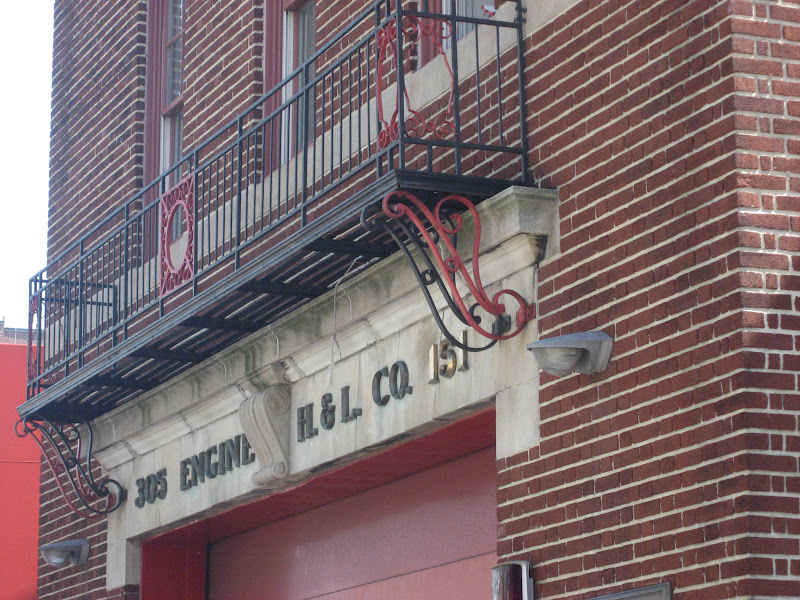
The NYC Landmarks Preservation Commission will hold a public hearing on Tues, May 15th from 10:30 AM - 10:40 AM at the Municipal Building at 1 Centre St, 9th Floor, NYC. Please either email testimony or testify in person, in favor of Individual Landmark status for Engine Company 305/Hook & Ladder Company 151. This historic firehouse is at 111-02 Queens Boulevard, Forest Hills. Anyone can testify. The firehouse will be public hearing item #5: http://www.nyc.gov/html/lpc/downloads/pdf/calendar/05_15_12.pdf
- Landmarks Preservation Commission Hearing Comments: comments@lpc.nyc.gov
- Director of Intergovernmental Affairs Jenny Fernandez: jfernandez@lpc.nyc.gov
- Chairman Robert Tierney: rtierney@lpc.nyc.gov
- Director of Research Mary Beth Betts: mbetts@lpc.nyc.gov
- Rego-Forest Preservation Council Chairman Michael Perlman: unlockthevault@hotmail.com
For historic information as part of your letter of support, please visit Michael Perlman's feature in the Forest Hills Times/Queens Ledger:
http://www.foresthillstimes.com/view/full_story/18433020/article-Forest-Hills-firehouse-may-become-landmark
 |
Pictured from left to right are
Dan Trabucchi, Lieutenant John Gleave, Henry "Hank" Rider, Anthony
Quinones, and John Cabrera.
|
On April 17, Engine Company 305/Hook & Ladder Company 151 at 111-02 Queens Boulevard was scheduled for a May 15th hearing by the Landmarks Preservation Commission (LPC), offering temporary protection from significant alterations.
The next step is a public hearing, where citizens, preservationists, and elected officials can testify. A public meeting will then follow, when the LPC will announce its decision.
According to Rego-Forest Preservation Council’s Freedom of Information Law request and an LPC visit in 2008, it was determined that the LPC's Survey Department conducted a Community Board 6 Survey in January 1990, comprised of Forest Hills and Rego Park.
The firehouse was one property recommended as a potential landmark, among a few hundred pages referencing other potential individual landmarks and historic districts. However, it is unknown why no designations were pursued at that time.
In recent years, architecturally and culturally significant sites - which offer a one-of-a-kind history - such as Eddie’s Sweet Shop, the Forest Hills Tennis Stadium, the Trylon Theater, and Bank of America (originally Metropolitan Industrial Bank, 99-01 Queens Boulevard), have not been given a public hearing by LPC, although some of those sites have been recommended for landmarking by earlier commission staff members.
Some sites were rejected, despite apparently meeting the LPC’s landmark provisions, based upon a site’s 30-year age requirement and architectural and cultural significance.
Queens residents hope that landmarking the firehouse will signify more designated buildings in Forest Hills and Rego Park at large. In 2000, the façade of the Ridgewood Savings Bank was landmarked, and the Remsen Family Cemetery was landmarked in 1981.
If the firehouse is landmarked, it would be the first Forest Hills property designated under LPC Chairman Robert Tierney's tenure.
LPC Communications Director Lisi de Bourbon would not comment on whether other Forest Hills properties have been surveyed by the commission due to policy issues, but did say, “The proposed designation of Engine Co. 305 is part of a wider effort to preserve New York City’s great municipal architecture.”
Mitchell Grubler, Chair of Queens Preservation Council, explains, “While we applaud the LPC for calendaring a Forest Hills building, this is a poor attempt at LPC recognition of the many deserving, but undesignated areas and buildings in Forest Hills,” said Mitchell Grubler, chair of the Queens Preservation Council.
“This is a case of picking-off the lowest-hanging fruit,” he continued. “It is a city-owned building, with no owner opposition. Landmark designation of city-owned buildings is advisory, since city agencies abide by LPC as a courtesy. This also seems to be somewhat of a thematic calendaring, in that a couple of Bronx firehouses were calendared at the same LPC meeting.”
During a time when the Bloomberg Administration has proposed firehouse closings due to budget cuts, Engine Company 305 has proudly served the community for nearly 90 years.
Built circa 1922-1924 and designed by John R. Sliney, it offers a distinctive and rare Neo-Medieval presence on Queens Boulevard. The firehouse has harmony with nearby Forest Hills Gardens, and its height and ecclesiastical nature is unique in the face of New York City firehouse architecture.
LPC’s statement of significance explains that the firehouse was “intended to serve the growing population of Forest Hills, which had seen a boom in residential construction following WWI.”
It then explains it is “clad in red brick laid in a Flemish bond, and enlivened with decorative limestone details and subtle patterned brickwork. The asymmetrical massing of the building is accentuated by steep gables clad with copper standing-seam roofs, two prominent square towers featuring round-arched window openings, and a slender chimney rising nearly a story above the western elevation.”
“It is exciting to know that the firehouse can be held to landmarking standards,” said FDNY spokesman Jim Long. “If it follows through, we will do everything in cooperation with the landmark guidelines, and adhere to requests and requirements.”
Commitment to the community is abundant. John DePierro is a senior firefighter who has been with Engine Co. 305 since 1969.
“What makes work enjoyable is the great camaraderie,” said firefighter John Cabrera. “This helps when we respond to a fire. There’s no emergency we don’t respond to, and no one has been shooed away from us. Some people knock on our door.
“There’s an officer who received a medal for saving a community resident,” he added. “We received Christmas cards and cakes from the community, and really appreciate their support.”
On September 11, Engine Co. 305 witnessed casualties. Peter Nelson was a senior firefighter who began his career with Engine 305, was transferred to Ladder 151, and then perished at Rescue 4. Joe Hunter worked up to a year at Engine 305, and also perished.
“I thought it was landmarked already,” said Lieutenant John Gleave. “There’s no other firehouse quite like it.”
Twelve-year Forest Hills resident James Griffin is a retired teacher and a volunteer photo archivist of the American Museum of Natural History.
“The firehouse is a noble expression of civic values, and a beautiful building gracing Queens Boulevard,” he said.
"Forest Hills and Rego Park have numerous iconic buildings that contribute greatly to the cultural history of our community,” said Assemblyman Andrew Hevesi. “This well-known structure should be given landmark status, which would preserve its integrity and value for many generations to come.”
Photos courtesy of Michael Perlman: http://www.flickr.com/photos/8095451@N08/sets/72157623132704134




Subscribe to:
Posts (Atom)


 Posts
Posts

