This is Michael Perlman's article, "Autumn Tree Giveaway In Forest Hills: A Colorful Opportunity," published in the Forest Hills Times/Queens Ledger on Oct 10,
2012. Please feel free to comment & share:
http://www.foresthillstimes.com/view/full_story/20432000/article-Autumn-Tree-Giveaway-in-Forest-Hills--A-Colorful-Opportunity
 |
| Volunteers at the May 20, 2012 4BNPA Tree Giveaway, Courtesy of Dennis O'Brien Photography | |
 |
| Varied species at the 4BNPA Tree Giveaway May 20, 2012, Courtesy of Michael Perlman |
This autumn, the boroughs are about to become greener with a splash of color.
The
Four Borough Neighborhood Preservation Alliance (4BNPA) will hold its
third tree giveaway event in Forest Hills, which will be the first of
its kind in the fall. On Sunday, October 14th from 1 to 3 PM, citywide
residents will have the chance to line up in MacDonald Park on Queens
Boulevard and 70th Avenue and adopt one of the unique 100 trees to take
home and plant on private property.
To make this event possible,
4BNPA is working in partnership with MillionTreesNYC and New York
Restoration Project (NYRP). Toyota is a lead sponsor, and lead partners
are NYRP, plaNYC, and the Parks Department.
This season, in
combination with other citywide tree giveaways, 1,450 trees will be
donated. There are 14 tree giveaways scheduled, with four in Queens. In
spring 2013, NYRP expects to give away between 3,300 and 3,700 trees. In
spring 2012, more than 5,000 trees were donated, which means that NYRP
will donate greater than 6,500 trees over the course of a year.
“Forging
long-lasting, inter-city relationships are the best way to develop a
sense of community in New York City,” said Mike Mitchell, NYRP Community
Initiative coordinator. “NYRP is very excited about our third giveaway
with 4BNPA. The commitment 4BNPA has shown for improving our urban
environment is amazing, and we hope 4BNPA continues to push the envelope
when it comes to expanding NYC’s urban tree canopy.”
NYRP began
coordinating tree giveaways in 2008. Inspiration stemmed from the
understanding that MillionTreesNYC was focused on greening public
spaces, but private homes, religious institutions, and community gardens
also represent a great portion of the city, and therefore merit tree
planting.
On September 16, 2010, parts of Queens, Brooklyn, and
Staten Island experienced a rare macroburst tornado. Joseph Bruno of the
city's Office of Emergency Management reported 3,113 trees fell in
Queens. Furthermore, Hurricane Irene contributed to the loss of trees
citywide in August 2011.
As Queens vice president of the Four
Borough Neighborhood Preservation Alliance Corporation and a native
Forest Hills resident, I documented the local devastation, submitted a
proposal to NYRP, and developed a bond.
4BNPA agreed to host
its first tree giveaway event on June 12, 2011, and its second giveaway
on May 20, 2012, where 100 trees and 245 trees were donated,
respectively. Volunteers from Rego-Forest Preservation Council also
played a prominent role. With a major emphasis on donating native tree
species at the second event, it helped restore the natural and historic
local beauty.
Many community residents did not realize the
benefits of trees, until some of which were a century-old succumbed in
seconds during the natural disasters. Trees convey life, beauty,
contribute to environmental sustainability, and enhance property values.
MacDonald Park was once again selected as the event site, in
order to shed light upon a concentrated space which lost sixty mature
trees during the tornado, and to initiate memories of productive
community events. Forest Hills was one of the greatly damaged
neighborhoods, and the Four Borough Neighborhood Preservation Alliances
seeks to restore its “forest” factor, as a case in point.
Most
common trees in the boroughs include Gingko, Honey Locust, Callery Pear,
Oak, and Sycamore. Many graceful Maple and Elm trees that lined streets
succumbed to the Asian Longhorn Beetle and Dutch Elm disease,
respectively, so it is urgent to maintain surviving trees.
To
diversify the tree population, four unique species will now be
available, which are American Beech, Serviceberry, Common Witch Hazel,
and Black Walnut.
American Beech is native from Quebec to
Florida, and is a slow to moderate-growing tree that reaches 30 feet in
20 years. Many can live greater than 150 years. After 50 to 75 years, it
will reach its maximum height of 50 to 70 feet. Its fall color will be a showy yellow or copper.
“There
is no replacement for the American Beech, as far as its value to
wildlife,” said Mitchell. “We believe planting and keeping these trees
healthy is key to creating ecological corridors for wildlife traveling
to and from Jamaica Bay.”
Serviceberry is native from Maine to
the Carolinas, and is a slow to moderate-growing tree that reaches its
full height of 20 to 25 feet in 20 to 40 years. It can survive between
50 and 150 years.
It produces white flowers in the spring, and
edible red or purple fruit from May to July. In the fall, its leaves are
orange, red, or yellow, and its bark is silver and gray with stripes.
“This
tree is truly a year-round stunner,” Mitchell said. “Its fruit is also
delicious raw, and you can use it for jellies or jam. It is a favorite
of New York City birds.”
Common Witch Hazel is native to eastern
and central U.S. and is a moderate grower reaching 15 to 25 feet in
approximately two decades. It lives between 50 and 150 years.
Witch
Hazels are known for their late fall and winter blooms, and the Common
Witch Hazel produces showy yellow fragrant flowers in the late fall. Its
bark is brownish-gray.
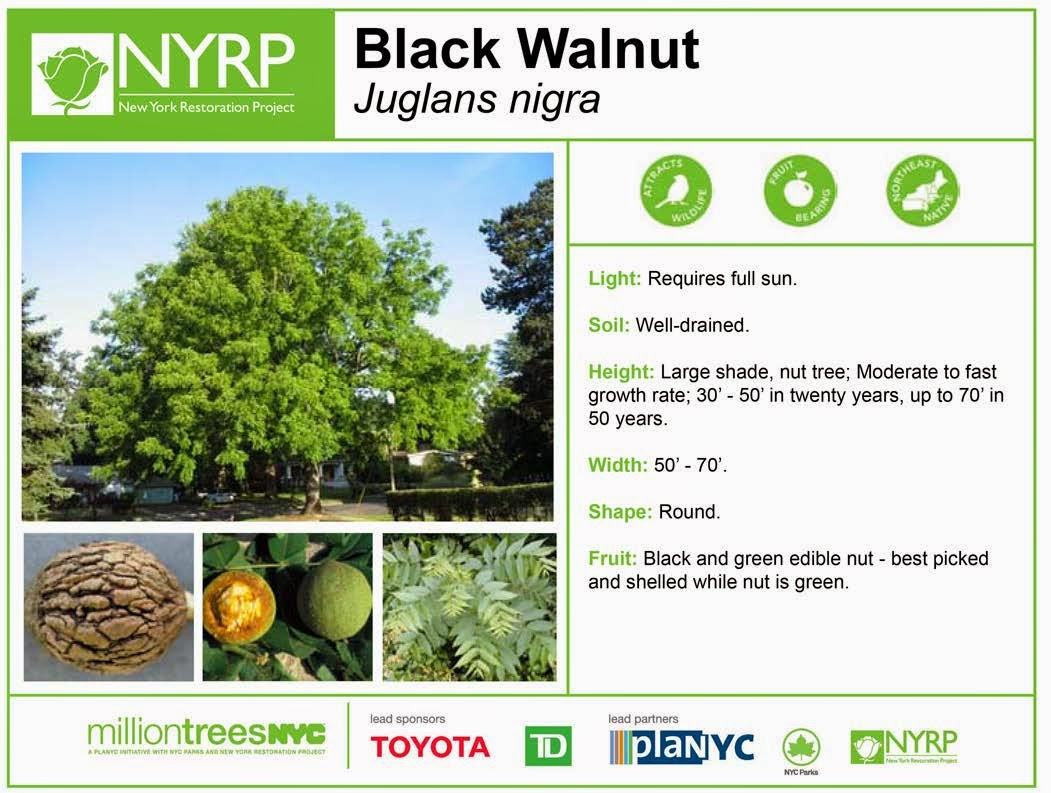
Black Walnut is native from Quebec to
Florida, and is a large, moderately fast grower, reaching 30 to 50 feet
in two decades. Its full height ranges from 50 to 70 feet in the city.
The tallest Black Walnuts reach greater than 120 feet. Healthy Black
Walnuts can live longer than 150 years.
“The Black Walnut
produces black walnuts, which are delicious,” Mitchell said. “Best
picked and husked when they are green, it is one of the most prized
nut-producing trees in the U.S.”
“This endeavor is
consistent with the borough-wide movement toward ecological
sensitivity,” said James Trent, president of 4BNPA. “Four Borough's
involvement is a great event, since our mission is to preserve and
improve the quality of life for low-density neighborhoods.
“Some
trees may end up in highly dense neighborhoods, but that is not a
problem, since none of us live in a vacuum,” he added. “Trees improve
air quality and beautify the city for all.”
On October 14, those
who wish to adopt a potted tree should line up before 1 p.m. at
MacDonald Park. In advance, tree adopters may reserve their tree online
at
www.nyrp.org/QueensTrees.




 Posts
Posts

