You're Invited: Learn an overview of our NY preservation movement, and network with preservation professionals and advocates from citywide neighborhoods. Support your neighborhoods and also be a friend to others! See you there?
When: Apr 26, 2010 at 6:30 PM
Where: Central Park Arsenal.
Contact: Municipal Art Society's Melissa Baldock at ameisels@mas.org
More info: http://www.facebook.com/event.php?eid=105546202821144&ref=mf
Monday, April 19, 2010

Friday, April 16, 2010
Join Our New Facebook Group For Rego-Forest Preservation Council
A huge thanks to everyone who became a fan of Rego-Forest Preservation Council on our Facebook Fan Page to date! Please help us fulfill our mission by joining our new Facebook Group via the link below, or search Rego-Forest Preservation Council on Facebook.
http://www.facebook.com/#!/group.php?gid=363711621253&ref=ts
Benefits for Members
* A chance to learn about and post feedback to neighborhood preservation campaigns, preservation resources and new programs, historic preservation/history events, historic research, as well as interact with other members that share your interest in historic preservation of Rego Park, Forest Hills, and other noteworthy Queens-wide preservation causes.
* Access to e-mails from Rego-Forest Preservation Council to your inbox via Facebook, which ensures delivery. News items posted on the Facebook Group wall will automatically be posted to your Facebook homepage newsfeed.
Questions? Suggestions? Interest in volunteering? E-mail unlockthevault@hotmail.com
Pride in your neighborhood's historic character must begin with YOUR support. A little input can go a looooooooong way!!!
Greater communication = Greater teamwork = More neighborhood landmarks designated and preserved!
Wednesday, April 14, 2010
Early Rego Park Architecture Merits Preservation
Consider these questions....
- How was Rego Park named?
- Between all the bustle of Queens Blvd, where is Rego Park's history?
- What can we do as citizens to preserve our neighborhood from insensitive alterations and demolition? Are there any benefits?
What Rego Park has to offer in the name of history is directly in front of our eyes, but for some residents and passersby, it can be a needle in a haystack, so we have to be informed........
Rego Park was named in 1923 by developers Henry Schloh and Charles Hausmann of the “Real Good” Construction Co, after buying farmland. The land was once part of Forest Hills, which was named in 1906, but changed for real estate purposes. The first developments included 525 8-room Colonial houses bordering 63rd Dr and Elliot Ave, followed by elaborate apartment houses on Saunders St in the late 1920s, which continued through the 1940s on Saunders St and Queens Blvd, and were also highly regarded. A large quantity of the original homes stand today in a relatively unaltered state, and the apartment houses remain mostly intact. The first street was Remsen Ave (now 63rd Drive), named after the Remsen family, which owned a large parcel of farmland in Rego Park, which is difficult to visualize today.
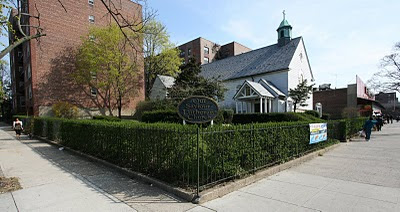
Some other notable sites that are reflective of Rego Park's historic fabric include Public School 139 on 63rd Dr, which was filed with the Dept of Buildings in 1928, Lutheran Church of Our Saviour, which opened its first formal home in 1931 on 63rd Dr, and Rego Park Jewish Center on Queens Blvd with a cornerstone reading 1948 (Placed on the State & National Register of Historic Places in Oct. 2009), and the Lost Battalion Hall on the north side of Queens Blvd between 63rd Dr & Horace Harding. In the late 1930s and throughout the 1940s, classic Art Deco shops were erected on Queens Blvd and along 63rd Dr, and some were considered showrooms for goods, with customers appreciative of their mom & pop status and revolutionary architectural touches.
Remo Hall, erected 1927, is the earliest apartment house in Rego Park on Saunders St. It is a Tudor architectural gem alongside neighboring buildings that exhibit a smorgasbord of styles in our neighborhood, including Georgian Colonial, Art Deco, Moorish, and Medieval. Other historic apartment houses include Marion Court, Jupiter Court, Savoy Gardens, Elizabeth & Victoria complex, and the Oxford and Cambridge complex, and the the Saunders Gardens complex, which were all developed from the late 1920s - early 1940s. Many apartment houses are symbolic of Ebenezer Howard's Garden City Movement, since they grant a sense of place by reserving space for landscaping and breathing space by not developing the land in its entirety, have recessed building wings, feature courtyards, are low-rise in scale, feature roof gardens for residents to associate and keep cool during the summer months, and most incorporate traditional English architectural touches. Even though the Saunders Gardens complex is a later addition with Art Deco touches, it features recessed areas and the traditional roof garden, along the lines of Marion Court, and was developed around the central theme of a park.
The architectural and cultural diversity within a concentrated section of the neighborhood, sheds lots of history, and therefore merits preservation within a Rego Park Historic District by the NYC Landmarks Preservation Commission (http://www.nyc.gov/html/lpc/html/home/home.shtml). The general boundaries are inclusive of Queens Blvd, 63rd Dr, Saunders St, and Elliot Ave, and touch upon Booth St and Wetherole St. Rego-Forest Preservation Council has been documenting and researching this section of the neighborhood (and other sections of both Rego Park and Forest Hills) for nearly 2 years. This is much-needed, and will ensure survival of its historic and harmonious character, ensure that any future development is in context, and will maintain and enhance property values over time. NYC Landmarking (sometimes in combination with State & National Register of Historic Places status) also increases the likelihood of acquiring grants for property owners, through funding programs for historically-sensitive restoration work and building upgrades.
This is a collection of Saunders St, Queens Blvd, & 63rd Dr photos by Chair Michael Perlman of Rego-Forest Preservation Council: http://www.flickr.com/photos/8095451@N08/collections/72157617606028777/
This is a work-in-progress! Please browse and become our flickr friend and a supporter throughout the research process. E-mail unlockthevault@hotmail.com with questions, suggestions, or to become a preservation supporter. All contributors will be recognized.




- How was Rego Park named?
- Between all the bustle of Queens Blvd, where is Rego Park's history?
- What can we do as citizens to preserve our neighborhood from insensitive alterations and demolition? Are there any benefits?
What Rego Park has to offer in the name of history is directly in front of our eyes, but for some residents and passersby, it can be a needle in a haystack, so we have to be informed........
Rego Park was named in 1923 by developers Henry Schloh and Charles Hausmann of the “Real Good” Construction Co, after buying farmland. The land was once part of Forest Hills, which was named in 1906, but changed for real estate purposes. The first developments included 525 8-room Colonial houses bordering 63rd Dr and Elliot Ave, followed by elaborate apartment houses on Saunders St in the late 1920s, which continued through the 1940s on Saunders St and Queens Blvd, and were also highly regarded. A large quantity of the original homes stand today in a relatively unaltered state, and the apartment houses remain mostly intact. The first street was Remsen Ave (now 63rd Drive), named after the Remsen family, which owned a large parcel of farmland in Rego Park, which is difficult to visualize today.
Some other notable sites that are reflective of Rego Park's historic fabric include Public School 139 on 63rd Dr, which was filed with the Dept of Buildings in 1928, Lutheran Church of Our Saviour, which opened its first formal home in 1931 on 63rd Dr, and Rego Park Jewish Center on Queens Blvd with a cornerstone reading 1948 (Placed on the State & National Register of Historic Places in Oct. 2009), and the Lost Battalion Hall on the north side of Queens Blvd between 63rd Dr & Horace Harding. In the late 1930s and throughout the 1940s, classic Art Deco shops were erected on Queens Blvd and along 63rd Dr, and some were considered showrooms for goods, with customers appreciative of their mom & pop status and revolutionary architectural touches.
Remo Hall, erected 1927, is the earliest apartment house in Rego Park on Saunders St. It is a Tudor architectural gem alongside neighboring buildings that exhibit a smorgasbord of styles in our neighborhood, including Georgian Colonial, Art Deco, Moorish, and Medieval. Other historic apartment houses include Marion Court, Jupiter Court, Savoy Gardens, Elizabeth & Victoria complex, and the Oxford and Cambridge complex, and the the Saunders Gardens complex, which were all developed from the late 1920s - early 1940s. Many apartment houses are symbolic of Ebenezer Howard's Garden City Movement, since they grant a sense of place by reserving space for landscaping and breathing space by not developing the land in its entirety, have recessed building wings, feature courtyards, are low-rise in scale, feature roof gardens for residents to associate and keep cool during the summer months, and most incorporate traditional English architectural touches. Even though the Saunders Gardens complex is a later addition with Art Deco touches, it features recessed areas and the traditional roof garden, along the lines of Marion Court, and was developed around the central theme of a park.
The architectural and cultural diversity within a concentrated section of the neighborhood, sheds lots of history, and therefore merits preservation within a Rego Park Historic District by the NYC Landmarks Preservation Commission (http://www.nyc.gov/html/lpc/html/home/home.shtml). The general boundaries are inclusive of Queens Blvd, 63rd Dr, Saunders St, and Elliot Ave, and touch upon Booth St and Wetherole St. Rego-Forest Preservation Council has been documenting and researching this section of the neighborhood (and other sections of both Rego Park and Forest Hills) for nearly 2 years. This is much-needed, and will ensure survival of its historic and harmonious character, ensure that any future development is in context, and will maintain and enhance property values over time. NYC Landmarking (sometimes in combination with State & National Register of Historic Places status) also increases the likelihood of acquiring grants for property owners, through funding programs for historically-sensitive restoration work and building upgrades.
This is a collection of Saunders St, Queens Blvd, & 63rd Dr photos by Chair Michael Perlman of Rego-Forest Preservation Council: http://www.flickr.com/photos/8095451@N08/collections/72157617606028777/
This is a work-in-progress! Please browse and become our flickr friend and a supporter throughout the research process. E-mail unlockthevault@hotmail.com with questions, suggestions, or to become a preservation supporter. All contributors will be recognized.


New Preservation Grant for Queens: The Elizabeth & Robert Jeffe Preservation Fund for NYC

The National Trust for Historic Preservation is pleased to announce creation of a new grant fund targeting historic preservation and community revitalization in New York City, made possible by the generous support of Elizabeth and Robert Jeffe.
The Elizabeth and Robert Jeffe Preservation Fund for New York City will provide seed monies to nonprofit organizations and government agencies for critical work in stewarding and safeguarding the rich heritage and vitality of the nation's largest city. These grants are intended to build capacity, leverage additional support, and provide momentum to get community preservation and revitalization projects off the ground, by providing capital in early stages and at important junctures.
More information, including application and guidelines, is available at: www.preservationnation.org/about-us/regional-offices/northeast/jeffe_preservation_fund_nyc.html
· Government agencies and nonprofit organizations are eligible to apply. Individuals and private, for-profit entities are ineligible.
· Grants are awarded for planning and education activities focused on preservation and revitalization within New York City limits. Examples of eligible activities include: retaining professional consulting services in areas such as architecture, archaeology, engineering, preservation or land-use planning, economics, fundraising, organizational development, media relations, and education; sponsoring workshops or community forums; designing, producing, and marketing printed materials or other media communications to advance historic preservation; surveys and inventories of historic resources.
· Grants will not be awarded for bricks-and-mortar construction activities, property acquisition, salaries, operating expenses, staff time, or academic research.
· Grants must be matched on a dollar-for-dollar basis. Typical award amounts will generally range from $2,500 to $10,000 (in exceptional cases, up to $15,000).
· The application deadline for the inaugural grant round is June 1, 2010. Thereafter, round deadlines are October 1, February 1, and June 1 yearly.
Applicants are required to contact the National Trust’s Northeast Office for guidance and assistance before submitting an application.
Northeast Office
National Trust for Historic Preservation
Brent Leggs, Field Representative
7 Faneuil Hall Marketplace, 4th Floor
Boston, MA 02109
The National Trust for Historic Preservation helps people protect, enhance, and enjoy the places that matter to them. Learn more at www.PreservationNation.org
Wednesday, March 17, 2010
Historic Preservation Funds Available
Rego-Forest Preservation Council received an e-mail from the NY Landmarks Conservancy, and we consider this a must-read for property owners in need of funding for their historic properties, and for community preservation advocates:
As you may know, the New York Landmarks Conservancy is a private, nonprofit organization dedicated to preserving and reusing architecturally and historically important buildings in New York City. Much of the Conservancy’s work takes place in low and moderate income neighborhoods, demonstrating over and over again the positive effect of historic preservation on community development and revitalization. Through its Neighborhood Preservation Programs, the Conservancy has provided millions of dollars in grants and low-interest loans, as well as countless hours of project management and technical assistance, to owners of all types of buildings.
There are funds available in our Neighborhood Preservation Programs to help finance exterior (and interior structural) capital work and related costs on older buildings. The properties need not be designated landmark buildings in all cases, as the funding programs have different guidelines. All of the programs are accompanied by project management assistance to foster landmark quality work and facilitate public approval processes. The Neighborhood Preservation Programs are:
1. Historic Properties Fund – A revolving loan fund for any type of property or owner. Low interest, collateralized loans for preservation work on buildings that are officially landmarks, within historic districts, or eligible for listing in the State or National Register of Historic Places. (Conservancy staff can help you to obtain this determination from the State Historic Preservation Office; it involves little further public regulation or compliance cost.) Loans range from $20,000 to approximately $300,000 per project.
2. City Ventures Fund – A grant program for nonprofit owners/developers of properties that serve lower income people. Although there is a priority for projects that provide affordable and special needs housing, properties that provide services to lower income people, such as employment training, socials services, and other educational purposes, are also eligible for funding. Capital grants of up to $30,000 are available for preservation work on older buildings that generally do not have any landmark status but have good architectural quality and integrity; consulting grants of up to $10,000 are available for professional services.
3. Emergency Preservation Grants – Capitalized by The New York Community Trust, a grant program for nonprofit owners of historic properties for emergency repair work. Grants of up to $25,000 are available for immediate work that addresses public safety, water penetration, or other issues that threaten the preservation of the property.
In addition to the Neighborhood Preservation Programs, the Conservancy also provides city and statewide matching grants specifically for houses of worship (Sacred Sites Fund). Visit our website at http://www.nylandmarks.org/ for more information about our programs. Please call me or any of the people listed below to see if your project may be eligible for one of our programs.
Thank you,
- Karen Ansis
Fund Manager, New York Landmarks Conservancy
karenansis@nylandmarks.org
One Whitehall Street, 21st Floor
New York, New York 10004
http://www.nylandmarks.org/
Tel: (212) 995-5260 Tel
Fax: (212) 995-5268 Fax
Program Coordinators:
Ashley Hahn: ashleyhahn@nylandmarks.org
Jim Mahoney: jamesmahoney@nylandmarks.org
As you may know, the New York Landmarks Conservancy is a private, nonprofit organization dedicated to preserving and reusing architecturally and historically important buildings in New York City. Much of the Conservancy’s work takes place in low and moderate income neighborhoods, demonstrating over and over again the positive effect of historic preservation on community development and revitalization. Through its Neighborhood Preservation Programs, the Conservancy has provided millions of dollars in grants and low-interest loans, as well as countless hours of project management and technical assistance, to owners of all types of buildings.
There are funds available in our Neighborhood Preservation Programs to help finance exterior (and interior structural) capital work and related costs on older buildings. The properties need not be designated landmark buildings in all cases, as the funding programs have different guidelines. All of the programs are accompanied by project management assistance to foster landmark quality work and facilitate public approval processes. The Neighborhood Preservation Programs are:
1. Historic Properties Fund – A revolving loan fund for any type of property or owner. Low interest, collateralized loans for preservation work on buildings that are officially landmarks, within historic districts, or eligible for listing in the State or National Register of Historic Places. (Conservancy staff can help you to obtain this determination from the State Historic Preservation Office; it involves little further public regulation or compliance cost.) Loans range from $20,000 to approximately $300,000 per project.
2. City Ventures Fund – A grant program for nonprofit owners/developers of properties that serve lower income people. Although there is a priority for projects that provide affordable and special needs housing, properties that provide services to lower income people, such as employment training, socials services, and other educational purposes, are also eligible for funding. Capital grants of up to $30,000 are available for preservation work on older buildings that generally do not have any landmark status but have good architectural quality and integrity; consulting grants of up to $10,000 are available for professional services.
3. Emergency Preservation Grants – Capitalized by The New York Community Trust, a grant program for nonprofit owners of historic properties for emergency repair work. Grants of up to $25,000 are available for immediate work that addresses public safety, water penetration, or other issues that threaten the preservation of the property.
In addition to the Neighborhood Preservation Programs, the Conservancy also provides city and statewide matching grants specifically for houses of worship (Sacred Sites Fund). Visit our website at http://www.nylandmarks.org/ for more information about our programs. Please call me or any of the people listed below to see if your project may be eligible for one of our programs.
Thank you,
- Karen Ansis
Fund Manager, New York Landmarks Conservancy
karenansis@nylandmarks.org
One Whitehall Street, 21st Floor
New York, New York 10004
http://www.nylandmarks.org/
Tel: (212) 995-5260 Tel
Fax: (212) 995-5268 Fax
Program Coordinators:
Ashley Hahn: ashleyhahn@nylandmarks.org
Jim Mahoney: jamesmahoney@nylandmarks.org
Friday, March 12, 2010
Fundraiser To Save RKO Keith's Flushing Theatre, Fri, March 19 at 8 PM

Fundraiser Details
- Friday, March 19th at 8 PM at Fuzzy's Wolfrose, 239-21 Braddock Avenue, Bellerose, NY. Please hurry, since tickets are selling out fast!
- Besides an evening of comedy, it will also feature a silent auction, music & dancing!
- If you cannot attend, you can still donate.
For the most up to date campaign information, history, photos, and contact information, please visit and bookmark:
1. http://www.savethekeiths.com/
2. Facebook Group for Friends of RKO Keith's Flushing Theatre: http://www.facebook.com/profile.php?ref=profile&id=1450792045#!/group.php?gid=60984938277
(Join the 2,860 members...& growing!)
3. Petition: http://new.petitiononline.com/rkokeith/petition.html
Please attend and contribute to a noble movement in the history of our diverse borough and city, and help spread the word to your colleagues and friends. With creativity and dedication, nothing is impossible to achieve. Power to the people! If you would like to volunteer or have questions, please contact Chair Ed Tracey: ejtracey3@gmail.com


Friday, February 19, 2010
You're Invited: Newtown & Its Newtown Pippin Apple, Feb 21, 2010

OLD NEWTOWN AND ITS NEWTOWN PIPPIN APPLES
* Learn about the history of old Newtown
* Re-Discover its famous 1700s export, Newtown Pippin Apples.
* Become a supporter of the efforts to bring back the long vanished apple trees to this area.
According to the Newtown Historical Society, the First Presbyterian Church of Newtown was the site of a planting in 2002, which brought the apple back to its area of origin for the first time since the early 19th century (http://www.greenforqueens.org/). The presentation will explain the history of the apple in Queens and the new replanting project that has been underway for the past year. The 2009 City Council resolution calling for recognition of the Newtown Pippin as the official apple of the City of New York will also be discussed and samples of the apples will be available for tasting.
Presenters:
President Christina Wilkinson, Newtown Historical Society, http://www.newtownhistorical.org/
Co-Founder Erik Baard, Newtown Pippin Project, http://www.newtownpippin.org/
Vice President Bob Singleton, Greater Astoria Historical Society, http://www.astorialic.org/
Historian Marjorie Melikian, First Presbyterian Church of Newtown, http://www.fpcn.org/
Agenda:
Church service, 10:45 AM - 12:00 PM, Sanctuary
Refreshments, 12:00 PM - 12:30 PM, Gym
Slideshow & Lecture, 12:30 PM, Sanctuary
For more information, please call the Newtown Historical Society at (718) 366-3715, e-mail newtownhistory@gmail.com or call the Newtown Pippin Project at (917) 697-9221.

Subscribe to:
Posts (Atom)


 Posts
Posts

