Showing posts with label Chairman Michael Perlman. Show all posts

Friday, August 5, 2011

Forest Hills Post Office History Recognized in Queens Chronicle


test4A post office deemed risque 1
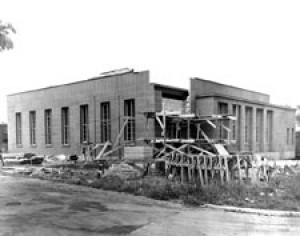
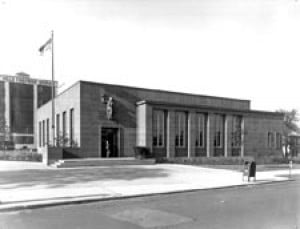
The Forest Hills post office under construction in September 1938 and completed in 1940. The topless female sculpture above the door was criticized at the time. The building behind the facility is labeled “Forest Hills Fireproof Storage.” Courtesy of Ron Marzlock, Queens Chronicle Historian
 
test4A post office deemed risque 2
Forest Hills Post Office in September 1938 - Courtesy of Ron Marzlock, Queens Chronicle Historian
2007 photo courtesy of Greg Godfrey
The Forest Hills Post Office is currently the only building in Forest Hills on the State & National Register of Historic Places, making it eligible for federal tax credits and state-matching grants for preservation-friendly upgrades & restoration work. Rego-Forest Preservation Council is currently documenting the Forest Hills Post Office's history and authentic features for a good cause, so imagine how we felt when we discovered the building in the 8/4 edition of the Queens Chronicle's "I Have Often Walked" column, written by Historian Ron Marzlock:

Queens Chronicle: A Post Office Deemed Risque

In the 1930s, most post offices in Queens were little candy store-type buildings housing only a few letter carrier routes in a leased building.

In June 1936, the Emergency Construction Program Act was passed. Politically strong Forest Hills was able to arrange the construction of a federal building to house a post office, at 106-28 Queens Blvd.

The new building was to be a showpiece of the area, topped off with a sculpture called “The Spirit of Communication.” The Art Deco-style work, a bare-breasted woman holding a clock and dove, was denounced by conservative 1938 Forest Hills as bad art in bad taste. But sculptor Sten Jacobson’s creation was valued at more than $150,000 in 1990, and is protected today and cared for by the General Services Administration.

Most other buildings of the era put up by the Works Progress Administration got a painting for artwork. Forest Hills got real sculpture. The other fortunate areas of Queens to secure WPA buildings for a post office were Jackson Heights, Woodhaven, Far Rockaway and Flushing. All of them are protected by landmark status.

Today, the fine 71-year-old structure facing MacDonald Park is dwarfed by the highly-concentrated apartment houses which have since engulfed so much of Forest Hills. At least it’s not one of the five post offices in Queens the United States Postal Service is considering closing.

"The Spirit of Communication" adorns the terra-cotta facade. Recent photos courtesy of Michael Perlman, Chair of Rego-Forest Preservation Council

Polished brass doors bear Art Deco handles

The Forest Hills Post Office made the grade on the 10th annual walking tour of Downtown Forest Hills in September 2010 by Historian Jeff Gottlieb, President of the Central Queens Historical Association.

Admiring the verticals and cubism of an International Style/Art Moderne Federal building. Most other post offices designed in the 1930s & prior were of (Georgian) Colonial design in Queens. This design would be found in a 1939 World's Fair pavilion, but this predated it! A patriotic mark is made upon Queens Boulevard!

Wednesday, December 1, 2010

Happy Hanukkah From Rego-Forest Preservation Council!

Wishing the members of Rego-Forest Preservation Council, our community, and all families and friends abound, a HAPPY HANUKKAH, and a miraculous season & beyond!!!

For the meaning, significance, and how to celebrate Hanukkah, visit: http://judaism.about.com/od/holidays/a/hanukkah.htm

Now enjoy a rare historic postcard treasure from the Jewish Soldiers Welfare Committee, which dates to 1942, and depicts why it truly is the Festival of Lights in the face of hard times....


 Fast forwarding to 2010, if you like Taio Cruz' song "Dynamite," you will enjoy this humorous Hanukkah rendition, built upon a traditional foundation. It is called "Candlelight" by the Maccabeats:

http://www.youtube.com/watch?v=qSJCSR4MuhU

Thursday, October 28, 2010

Unveiling Our Flyer: Please Volunteer & Distribute


 Extra! Extra! Rego-Forest Preservation Council has just released its promotional flyer...

The flyer encompasses our mission statement, links to our Rego-Forest Preservation Council Blog and self-titled Facebook Group, and a link to distinctive and historic neighborhood photos and memorabilia on Rego-Forest Preservation Council's Flickr It also explains how the public can support the preservation of Rego Park, Forest Hills, and Queens at large.

We are seeking support from community and citywide residents, preservation and cultural organizations, property owners, architects, urban planners, conservationists, and more. You name it! Let's bring the teamwork back into the neighborhood, and subtract greed which would culminate in insensitive alterations and the demolition of site & district "landmarks at heart," and would also result in the elimination of our precious green spaces and trees, if we don't "fight the good fight" in a proactive manner.

Please download the flyer by clicking on the photo, contact Chairman Michael Perlman at unlockthevault@hotmail.com, provide copies to your family and friends, bring it to your board meetings and events, and please don't hesitate to invite us.

The images on our flyer (left to right) represents a fraction of the types of individual buildings and sometimes surrounding neighborhood districts that merit preservation:

1. Sutton Hall, 109-14 Ascan Ave, Forest Hills
2. Midway Theatre, 108-22 Queens Blvd, Forest Hills
3. Earliest apartment houses on Saunders St between 63rd Dr & Elliot Ave, Rego Park
4. Forest Hills Tennis Stadium, 1 Tennis Place, Forest Hills Gardens
5. Forest Hills Inn & Station Square, Forest Hills Gardens
6. Eddie's Sweet Shop (formerly Witt's Ice Cream), 105-29 Metropolitan Ave, Forest Hills

Monday, September 27, 2010

Downed Trees Represent The Loss of History in Forest Hills: Michael Perlman's Interview with Forest Hills Patch

Local historian Michael Perlman stands with a monumental Weeping Willow that was destroyed during the tornado. Photo by Forest Hills Patch
Approximately a week after the September 16, 2010 macroburst, which tore through Forest Hills and sections of Rego Park within minutes, as well as other parts of Queens & Brooklyn, I was privileged to meet reporter Rob MacKay of Forest Hills Patch, a fairly new neighborhood publication. We surveyed the damage in Forest Hills' Cord Meyer section, and along Queens Blvd near MacDonald Park, which were 2 of the sections that were drastically affected. On the basis of my interview, which revolves around the historic "forest" factor in Forest Hills, Rego-Forest Preservation Council is proud yet sad to feature the 9/25 Forest Hills Patch article, Downed Trees Represent The Loss of History In Forest Hills:

http://foresthills.patch.com/articles/downed-trees-represent-loss-of-history-in-forest-hills


Hundred-year-old growth swept away in 'minutes'

The storm system that ripped through Brooklyn and Queens on Sept. 16 caused one death, vast property damage and left thousands without power. It also destroyed hundreds of trees in the Forest Hills area, including some that had predated the neighborhood's turn-of-the-century founding.

Commissioner Joseph Bruno, of the New York City Office of Emergency Management, said Queens lost 3,113 trees in total, with 4,000 more damaged.

"You took a major hit, there's no question, that's over 7,000 trees affected in a significant way," Bruno said at a town hall meeting.

"It was like a living horror film," said Michael Perlman, a third-generation resident who was walking in his neighborhood when the storm struck. "This tragedy took the 'forest' out of Forest Hills."

The city has not taken an official count yet, but Perlman, who chairs the Rego-Forest Preservation Council, thinks that more than 1,000 trees were destroyed in just Forest Hills. The majority were maples, oaks and elms, but the neighborhood lost weeping willows, cherry blossoms, apple blossoms and ginkoes, too. Many of the trees stood 100-feet high, and some were close to 150 years old, he said.

Perlman, who has walked around the streets with his camera to document the damage, noted that trees located on street corners more often perished than ones at mid-block that were protected by large apartment complexes. He was surprised to discover that so many of the younger, thinner trees survived, while the thick trunks of many mature ones were snapped apart and blown 30 to 40 feet away. "It's haunting that what took an entire life — almost a century — can be eliminated in a couple of minutes," he said. "It proves that we have to be thankful for what we have and what we had."

No streets in the community were without damage, but the Leslie Apartments in Forest Hills Gardens and MacDonald Park on Queens Boulevard and 70th Road were hit particularly hard.

Other devastated areas include the portion bounded by 108th Street and Yellowstone Boulevard from 68th Street to Continental Avenue and what is known as "The Cord Meyer Section," which includes the vicinity of 110th Street and Jewel Avenue. One apartment building near the intersection of Queens and Yellowstone boulevards was left with a barren sidewalk as all its trees fell down like dominoes.

According to Perlman, some of the felled trees predated the establishment of Forest Hills in 1906 and Forest Hills Gardens in 1909, and most uprooted trees were older than the apartment buildings that were constructed beside them between 1920 and the 1940's. The macroburst, as it has become known, came 50 years to the day after Hurricane Donna ravaged Forest Hills, destroying the West Side Tennis Club and causing a seven-day suspension of the 1960 U.S. Open tennis tournament final that was being played there.

Perlman, 28, said he hoped to live in Forest Hills for his entire life, and he has just begun an effort to re-green the neighborhood. Some of the trees can be resurrected through re-planting and pruning, he believes, and if that's not possible, he wants to plant new ones. He said he plans to reach out to arborists, neighbors, civic associations, building complexes, the Parks Department, and the community board.

"Nothing is impossible," he said. "It would be very inspirational for the neighborhood."

End of an era! The tree of all trees; 1 of 2 cherished Weeping Willow trees in front of the regal James Madison on 108th St is uprooted & mourned by residents & passersby. Photo by Forest Hills Patch
A prominent oak tree, likely dating to the 1920s, snaps & twists at the trunk, falling  into the lawn of The Continental Apartments. It was planted when the first Continental Apts was erected or perhaps pre-dated it, and then Cord Meyer Development built around several of its type on the block, when the replacement building was erected. Photo by Forest Hills Patch

Wednesday, April 14, 2010

Early Rego Park Architecture Merits Preservation

Consider these questions....

- How was Rego Park named?
- Between all the bustle of Queens Blvd, where is Rego Park's history?
- What can we do as citizens to preserve our neighborhood from insensitive alterations and demolition? Are there any benefits?

What Rego Park has to offer in the name of history is directly in front of our eyes, but for some residents and passersby, it can be a needle in a haystack, so we have to be informed........

Rego Park was named in 1923 by developers Henry Schloh and Charles Hausmann of the “Real Good” Construction Co, after buying farmland. The land was once part of Forest Hills, which was named in 1906, but changed for real estate purposes. The first developments included 525 8-room Colonial houses bordering 63rd Dr and Elliot Ave, followed by elaborate apartment houses on Saunders St in the late 1920s, which continued through the 1940s on Saunders St and Queens Blvd, and were also highly regarded. A large quantity of the original homes stand today in a relatively unaltered state, and the apartment houses remain mostly intact. The first street was Remsen Ave (now 63rd Drive), named after the Remsen family, which owned a large parcel of farmland in Rego Park, which is difficult to visualize today.

Some other notable sites that are reflective of Rego Park's historic fabric include Public School 139 on 63rd Dr, which was filed with the Dept of Buildings in 1928, Lutheran Church of Our Saviour, which opened its first formal home in 1931 on 63rd Dr, and Rego Park Jewish Center on Queens Blvd with a cornerstone reading 1948 (Placed on the State & National Register of Historic Places in Oct. 2009), and the Lost Battalion Hall on the north side of Queens Blvd between 63rd Dr & Horace Harding. In the late 1930s and throughout the 1940s, classic Art Deco shops were erected on Queens Blvd and along 63rd Dr, and some were considered showrooms for goods, with customers appreciative of their mom & pop status and revolutionary architectural touches.

Remo Hall, erected 1927, is the earliest apartment house in Rego Park on Saunders St. It is a Tudor architectural gem alongside neighboring buildings that exhibit a smorgasbord of styles in our neighborhood, including Georgian Colonial, Art Deco, Moorish, and Medieval. Other historic apartment houses include Marion Court, Jupiter Court, Savoy Gardens, Elizabeth & Victoria complex, and the Oxford and Cambridge complex, and the the Saunders Gardens complex, which were all developed from the late 1920s - early 1940s. Many apartment houses are symbolic of Ebenezer Howard's Garden City Movement, since they grant a sense of place by reserving space for landscaping and breathing space by not developing the land in its entirety, have recessed building wings, feature courtyards, are low-rise in scale, feature roof gardens for residents to associate and keep cool during the summer months, and most incorporate traditional English architectural touches. Even though the Saunders Gardens complex is a later addition with Art Deco touches, it features recessed areas and the traditional roof garden, along the lines of Marion Court, and was developed around the central theme of a park.

The architectural and cultural diversity within a concentrated section of the neighborhood, sheds lots of history, and therefore merits preservation within a Rego Park Historic District by the NYC Landmarks Preservation Commission (http://www.nyc.gov/html/lpc/html/home/home.shtml). The general boundaries are inclusive of Queens Blvd, 63rd Dr, Saunders St, and Elliot Ave, and touch upon Booth St and Wetherole St. Rego-Forest Preservation Council has been documenting and researching this section of the neighborhood (and other sections of both Rego Park and Forest Hills) for nearly 2 years. This is much-needed, and will ensure survival of its historic and harmonious character, ensure that any future development is in context, and will maintain and enhance property values over time. NYC Landmarking (sometimes in combination with State & National Register of Historic Places status) also increases the likelihood of acquiring grants for property owners, through funding programs for historically-sensitive restoration work and building upgrades.

This is a collection of Saunders St, Queens Blvd, & 63rd Dr photos by Chair Michael Perlman of Rego-Forest Preservation Council: http://www.flickr.com/photos/8095451@N08/collections/72157617606028777/

This is a work-in-progress! Please browse and become our flickr friend and a supporter throughout the research process. E-mail unlockthevault@hotmail.com with questions, suggestions, or to become a preservation supporter. All contributors will be recognized.


Saturday, January 16, 2010

Ridgewood Theatre Facade Earns Individual Landmark Status on 1/12/10 & The Broader Picture


The Individually Landmarked 1916 Ridgewood Theatre!


The broader picture by Michael Perlman, Chairman of Friends of The Ridgewood Theatre, in affiliation with Rego-Forest Preservation Council....

After attending the Landmarks Preservation Commission 1/12/10 Public Meeting, I am elated to report that the historic Ridgewood Theatre was unanimously voted by commissioners as an Individual Landmark! A nearly 2-year effort under Friends of The Ridgewood Theatre as Chairman (since March 2008), in affiliation with various preservation and cultural groups, members of Cinema Treasures, elected officials, and a mass audience, truly paid off! I extend my thanks to the broad coalition of supporters, and the Landmarks Preservation Commission for doing the right thing on behalf of the people.

The LPC Commissioners vote on the Ridgewood Theatre facade
in the public hearing room


The Ridgewood Theatre landmarking cause can be perceived as a case study, from the theater's sudden closure to the hearing and public meeting, through the theater's future. It represents a new and intriguing 21st century chapter in the theater's extensive, varied, and distinctive history dating back to 1916, considering that it was deemed the "longest continuosuly operating first-run theater countrywide" upon its closure." It emphasizes the ideal of progress for an "ultimate public institution," and exemplifies how the public can work cohesively and effectively with each other, and the Landmarks Preservation Commission.

Landmarks Preservation Commission's Chair Robert Tierney expresses his pride in a "Queens" site!


Hopefully, the Ridgewood Theatre's Individual Landmark status will set off a chain reaction of more Individual Landmarks and Historic Districts in Queens, stemming from our advocacy and the LPC's calendaring of properties for a public hearing (most democratic when it results from the consensus of the majority of citywide citizens). Many dormant preservationists emerged from the woodwork, and established bonds. In the coming months, many more Queens properties will be proposed for landmarking.


Ridgewood Theatre's Ornate Lobby

Although the Ridgewood Theatre facade is now safeguarded as an Individual Landmark, it is also highly significant for Interior Landmark status to be extended to Architect Thomas Lamb's mostly intact theater lobby. Lisi DeBourbon of the Landmarks Preservation Commission said the LPC cannot consider that at this time, since interior spaces must be customarily open to the public upon review. However, Friends of The Ridgewood Theatre in affiliation with Rego-Forest Preservation Council, hopes the owners will respect and restore the mostly intact theater lobby, and the Landmarks Preservation Commission will consider extending designation in the near future. We must also make sure that the Ridgewood Theatre remains in a good state of preservation in the long-term. It is essential to continue to be proactive, and have a voice in city government.

Cameos with angelic muses in theater lobby


How You Can Further Help:

Please visit, take action, and forward these links to your friends and colleagues:

1. Join Friends of The Ridgewood Theatre MySpace Page:
www.myspace.com/ridgewoodtheatre

2. Sign & comment on Ridgewood Theatre Petition requesting Individual Landmark status (granted) and also requests Interior Landmark status (comment on Architect Thomas Lamb's theater lobby): http://www.petitiononline.com/RTheatre/petition.html

 3. Visit the Friends of The Ridgewood Theatre Flickr Photoset: http://www.flickr.com/photos/8095451@N08/sets/72157606443928732/

Friends of The Ridgewood Theatre hopes to further assist the owners preservation-wise and for its reopening, so patrons can take a front seat!


Monday, January 11, 2010

Please Attend/Cover: Jan 12th, Historic Ridgewood Theatre May Earn Landmark Status at LPC Public Meeting!


The majority of our historic theaters merit landmarking and adaptive & creative reuse throughout Queens, as they are few & far between, and cornerstones of our American history. Even though this is a predominantly a Rego Park/Forest Hills blog, let's acknowledge the broad picture, and learn how to strategize and volunteer. Sit back, relax, and check out A Case Study in Landmarking now showing at the Ridgewood Theatre. Did I get your hopes up? Read on to see how it can become a reality.............and don't recline too much. Be a proactive community player!

Nearly 2-Year Landmarking Cause In The Making, Boils Down To 1 Day: Commissioners To Vote on Historic Ridgewood Theatre

 RIDGEWOOD, NY (Jan 12, 2010) – Queens’ historic Ridgewood Theatre (55-27 Myrtle Ave) closed its doors in March 2008 without warning, but patrons & preservationists are now elated that the NYC Landmarks Preservation Commission will hold a Public Meeting, where Commissioners will vote whether to designate the theater as Queens’ newest Individual Landmark (façade). The Public Meeting for the Ridgewood Theatre (Agenda Item #3, LP-2325) is set for Tues, January 12, 2010 from 10:15 AM – 10:25 AM at the Municipal Building, 1 Centre St, 9th Floor North, NY, NY 10007: http://www.nyc.gov/html/lpc/downloads/pdf/calendar/01_12_10.pdf  

A hearing was held on March 24, 2009 as a result of a Request For Evaluation form and research, a letter campaign, a petition drive, and a MySpace Group coordinated by Friends of The Ridgewood Theatre, which was founded by Preservationist Michael Perlman after the theater’s closure in 2008. Testimony in support of Individual Landmark status was diverse and abundantly positive, and also included written testimony from Thomas A. Lamb, the great-grandson of Architect Thomas W. Lamb, who was tracked down by Chair Perlman. Co-owner Mario Saggese expressed his support for landmarking the façade, and also said the owners envision a historically-sensitive plan for the downstairs auditorium space consisting of retail to make it economically viable, with modern screens upstairs.

Opening its doors on December 23, 1916 and closing in March 2008, the Ridgewood Theatre was deemed “the longest continuously operating first-run neighborhood theater citywide, and potentially throughout the U.S.” It staged Vaudeville, silent films, saw the advent of photoplays, the first ‘100% All-Talking’ feature, Lights of New York (1928), & Technicolor. Its original seating capacity was 2,500, but currently contains 5 screens and seats 1,950.


Modeled after Times Square’s long-demolished Mark Strand Theatre (the World’s 1st movie palace), the $250,000 Classical Revival gem was designed by America’s foremost theater architect, Thomas White Lamb, & built by the Levy Brothers. The 3-story Indiana limestone & terra cotta façade is highly ornate, incorporating unique geometric patterns, medallions, a frieze, pilasters, and proudly boasts Ridgewood Theatre across the top. Interior murals originally depicted the history of Ridgewood.

Perlman explains: “Theaters are the ‘ultimate public institutions’ which bridge the generations, as they foster community growth and pride, harbor countless memories, and often exhibit the work of our country’s most skillful architects. Commissioned architects hoped to leave a long-lasting impression of grandeur, confidence, serenity, and comfort; a bold step away from the pressures of society.”

Perlman further explains “With the onset of DVDs, and vastly improved home entertainment centers, movie theaters with a minimal number of screens are a highly endangered species citywide. When sacrificed in the name of progress, their loss is most heartfelt. Local theaters with an unfortunate fate include the Oasis, Parthenon, Irving, & RKO Madison Theatre (retail), but the Ridgewood Theatre can be economically viable if preserved and adaptively reused for theater-related purposes. It would contribute to an up & coming neighborhood and a diverse borough.”

Historic & Recent Ridgewood Theatre Photos, courtesy of Chair Michael Perlman, Friends of Ridgewood Theatre: http://www.flickr.com/photos/8095451@N08/sets/72157606443928732/

Online Petition: http://www.petitiononline.com/RTheatre/petition.html

Friends of The Ridgewood Theatre MySpace Group: www.myspace.com/ridgewoodtheatre

After a nearly 2-year preservation cause, let's remain hopeful the Landmarks Preservation Commission will do what's right on behalf of Queens residents, countrywide theater buffs, and for history's sake; to educate future generations while paying homage to the best of our past! We shall see on January 12, 2010.
Monday, November 2, 2009

Welcome To The Rego-Forest Preservation Council Blog! Join & Learn How To Preserve Our Neighborhood's Unique Past For A Future Of Character!

For Rego Park & Forest Hills historic preservation news items, appeals, events, and important links to city agencies and other preservation organizations, as well as forms to preserve and revitalize our neighborhoods (on the side of this blog), please bookmark and visit our blog: http://regoforestpreservation.blogspot.com/ Also, become a follower of our blog with Google Friend Connect.

Our Background:

Rego-Forest Preservation Council was established in late 2006, in response to our shared Rego Park & Forest Hills 100-year Anniversary that was minimally publicized, and in response to the growing number of demolitions and insensitive alterations of historic properties that forever altered our character. We have yet to learn that there are methods of improvement and benefits to property owners, without losing the cornerstones that make our community special. This has been proved in other parts of the city and countrywide. If we act now, it is not too late to save our landmarks and celebrate our history.

Our Mission Statement:

Rego-Forest Preservation Council seeks to preserve and commemorate the architectural and cultural history of Rego Park, Forest Hills, and adjacent neighborhoods of Queens, NY. We work with citizens, affiliate organizations, and property owners on local, city, state, & federal levels. Avenues include Individual Landmarks, Historic Districts, Rezonings, State & National Register properties and districts; to ultimately provide funding assistance for restoration and adaptive reuse, safeguard community character, and convey historic pride for current and future generations.

How You Can Help:

1. We are seeking support from preservationists, historians, organizations, neighborhood residents, property owners, urban planners, architects, and general enthusiasts. Become a friend of Rego-Forest Preservation Council!

2. We are also seeking guest writers for periodic columns, residents and landlords that completed restoration work & sensitive renovations, personal profiles with noteworthy achievements, leads on history-related events, vintage neighborhood photos for our community projects, etc.

3. Become a fan of our new Facebook Page by entering "Rego-Forest Preservation Council" in the search box of http://www.facebook.com/ or by visiting http://www.facebook.com/pages/Rego-Forest-Preservation-Council/168692291099?ref=mf

4. Become a flickr friend, & view photos of architecturally & culturally diverse neighborhood sites: http://www.flickr.com/people/8095451@N08

Enjoy our photo collections that will be updated on a regular basis:

Forest Hills, Austin St & Queens Blvd vicinity: http://www.flickr.com/photos/8095451@N08/collections/72157617717136872/
 
Rego Park, Saunders St, 63 Dr, & Queens Blvd vicinity:
http://www.flickr.com/photos/8095451@N08/collections/72157617606028777/

Sacred Sites of Forest Hills, Rego Park, & vicinity: http://www.flickr.com/photos/8095451@N08/collections/72157617717720394/

Last but not least, please spread the word to family, friends, and colleagues, and grasp on to the unique architectural and cultural history of Rego Park and Forest Hills for a more distinctive, promising future. If you are if interested in learning more and volunteering, please e-mail unlockthevault@hotmail.com  Even a small amount of time can make a large difference!

- Michael Perlman,
Chairman of Rego-Forest Preservation Council