Showing posts with label Historian Ron Marzlock. Show all posts

Wednesday, November 23, 2011

Tale of 2 of Forest Hills' Earliest Apartment Houses

The historic Georgian Court, 109-20 Queens Blvd


The Alberta, a historic Tudor gem at 108-22 72nd Ave, which was originally 2 Roman Ave.


 Two of Forest Hills' earliest apartment houses are the Georgian Court and the Alberta, which are situated in the business and residential district in the heart of our neighborhood.

It is the compilation of low-density developments with mainly Tudor and Colonial design which surround the Austin St and Queens Blvd thoroughfares, and which grant character to what was once referred to as "Forest Hills Village" or "The Village." Let's think twice before insensitively altering or demolishing the low-rise residential and commercial sites along and in between these thoroughfares. Preserving, restoring, and adaptively reusing our assemblage of buildings which began in 1906, will pay respect to the fine craftsmanship and vision of our remarkable developers, urban planners, architects, and business owners, who would once strive to make our streestscapes harmonious and distinctive from Anytown USA. It was a complementary extension to the aura of the Forest Hills Gardens, and still is in many ways, with the exception of a few tacky aluminum or stucco-covered buildings, and the brick and steel sliver McOffices that began to rise on 72nd Ave.

We extend our gratitude to Historian Ron Marzlock of the Queens Chronicle's I Have Often Walked column, for publishing the history of the Georgian Court and The Alberta on June 23rd & June 16, 2011 respectively, and establishing the need for their preservation and that of the greater neighborhood:

Georgian Court: An Innovator in Forest Hills

test4Georgian Court: an innovator in Forest 
Hills   1
Georgian Court, located at 109-20 Queens Blvd, with tennis courts to the left, May 1931.

 Georgian Court holds the distinction of being the first apartment building built on Queens Boulevard in Forest Hills. It was an innovation for its time for many other reasons too.

It was designed by Manhattan architect Louis I. Brooks of 63 Madison Ave. and was the only apartment building built in Forest Hills during the Great Depression, opening for occupancy on Oct. 1, 1930.

All apartments were built with three or four rooms and were convertible to six- or seven-room units.

The building had two Otis elevators, individual incinerators for each unit, refrigerators and gas ranges. There were no dumbwaiters. It was Forest Hills’ first apartment building with colored tile to match the fixtures in both the bathroom and kitchen, a welcome change to the stark black and white of the 1920s. References were required for tenants to rent a three-room apartment for $100 or four rooms for $140, expensive at the time.

Georgian Court’s most attractive selling point was that it was situated next to beautiful tennis courts. However, that was short lived. It was announced on Dec. 3, 1936 that a new church and rectory were to be built there for Our Lady Queen of Martyrs for $365,000. Steam shovels broke ground in May 1938, residents lost their view and they endured the noise for the next year.

Today Georgian Court sits modestly on the boulevard, obscured by all the other structures towering over it. Compared to newer buildings, residents are still very happy with its solid construction and love their 80-year-old building.

More photos of the Georgian Court, courtesy of Michael Perlman
  

A Forest Hills Gem: The Alberta, Built in ’23

test4A Forest Hills gem: The Alberta, built in 
’23 1
A 1923 architect’s rendering of The Alberta, located at 2 Roman Ave, today’s 108-22 72 Ave in Forest Hills.

 The oldest apartment building in Forest Hills outside of the Gardens I have found to be The Alberta. John S. Myers of Manhattan was the builder, and he named the structure after his mother.
In 1922 Myers hired architect Rudolf C.P. Boehler to design a four-story luxury walk-up building at what was then 2 Roman Ave. Boehler worked mainly in Manhattan, from 1920 to 1954, and this was his only project in Queens.

Through a beautiful marble covered vestibule you enter The Alberta’s spacious, artistically treated reception room, from where marble stairs lead to the apartments.

One of the selling points was Myers’ willingness to arrange the color scheme in accordance with tenants’ wishes if leases were signed before completion of the building. Inspection began in late September 1923 and it was ready for occupancy on Oct. 15. Expensive for its time, The Alberta’s A and B line of four-room apartments cost $145 a month, the three-room C and E line was $110 and the two-room D was $85.

Another selling point was that, as advertised, the apartments had a commanding view overlooking Queens Boulevard to Kew Gardens in one direction and Jackson Heights and Elmhurst in the other.

The building has been renumbered 108-22 72 Ave. but retains the name Alberta. After 88 years it is in pristine condition, and serious thought should be given to its preservation as buildings like this will never be constructed again in Forest Hills. With the very high value of the land alone, this beauty could be put in danger of destruction at some point.

Friday, August 5, 2011

Forest Hills Post Office History Recognized in Queens Chronicle


test4A post office deemed risque 1
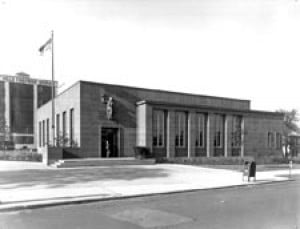
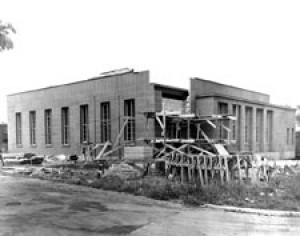
The Forest Hills post office under construction in September 1938 and completed in 1940. The topless female sculpture above the door was criticized at the time. The building behind the facility is labeled “Forest Hills Fireproof Storage.” Courtesy of Ron Marzlock, Queens Chronicle Historian
 
test4A post office deemed risque 2
Forest Hills Post Office in September 1938 - Courtesy of Ron Marzlock, Queens Chronicle Historian
2007 photo courtesy of Greg Godfrey
The Forest Hills Post Office is currently the only building in Forest Hills on the State & National Register of Historic Places, making it eligible for federal tax credits and state-matching grants for preservation-friendly upgrades & restoration work. Rego-Forest Preservation Council is currently documenting the Forest Hills Post Office's history and authentic features for a good cause, so imagine how we felt when we discovered the building in the 8/4 edition of the Queens Chronicle's "I Have Often Walked" column, written by Historian Ron Marzlock:

Queens Chronicle: A Post Office Deemed Risque

In the 1930s, most post offices in Queens were little candy store-type buildings housing only a few letter carrier routes in a leased building.

In June 1936, the Emergency Construction Program Act was passed. Politically strong Forest Hills was able to arrange the construction of a federal building to house a post office, at 106-28 Queens Blvd.

The new building was to be a showpiece of the area, topped off with a sculpture called “The Spirit of Communication.” The Art Deco-style work, a bare-breasted woman holding a clock and dove, was denounced by conservative 1938 Forest Hills as bad art in bad taste. But sculptor Sten Jacobson’s creation was valued at more than $150,000 in 1990, and is protected today and cared for by the General Services Administration.

Most other buildings of the era put up by the Works Progress Administration got a painting for artwork. Forest Hills got real sculpture. The other fortunate areas of Queens to secure WPA buildings for a post office were Jackson Heights, Woodhaven, Far Rockaway and Flushing. All of them are protected by landmark status.

Today, the fine 71-year-old structure facing MacDonald Park is dwarfed by the highly-concentrated apartment houses which have since engulfed so much of Forest Hills. At least it’s not one of the five post offices in Queens the United States Postal Service is considering closing.

"The Spirit of Communication" adorns the terra-cotta facade. Recent photos courtesy of Michael Perlman, Chair of Rego-Forest Preservation Council

Polished brass doors bear Art Deco handles

The Forest Hills Post Office made the grade on the 10th annual walking tour of Downtown Forest Hills in September 2010 by Historian Jeff Gottlieb, President of the Central Queens Historical Association.

Admiring the verticals and cubism of an International Style/Art Moderne Federal building. Most other post offices designed in the 1930s & prior were of (Georgian) Colonial design in Queens. This design would be found in a 1939 World's Fair pavilion, but this predated it! A patriotic mark is made upon Queens Boulevard!

Monday, June 7, 2010

From Homes To Art Deco Shops, 63rd Dr, Rego Park, Spring 1949

Homes Yield to shops on 63rd Drive in Rego Park

By Historian Ron Marzlock, Queens Chronicle & Rego-Forest Preservation Council Blog contributor
From June 3, 2010 "I Have Often Walked" column


Art Deco shops which took the place of private homes on 63rd Drive between Booth and Saunders streets, in the spring of 1949.

In Rego Park, 63rd Drive was the shopping district that was never meant to be, but was in the end. It and 66th Avenue, formerly White Pot Road, are the two oldest roads in Rego Park, dating to Revolutionary War days. What’s now 63rd Drive, had been known as Remsen Lane, named for the family of Col. Jeromus Remsen, who won fame during the Revolution at the Battle of Long Island, also known as the Battle of Brooklyn. The patriots lost that 1776 melee, leaving the British in control of New York City for the rest of the conflict. The descendants of the Remsen family still owned property on 63rd Drive as late as 1900. 

There were 10 different Remsen streets, roads and avenues scattered throughout Queens until 1913, when the borough largely changed over to numbered streets. Remsen Place in Maspeth still exists.

When Rego Park was originally developed in 1925, 63rd Drive was planned to be a quiet residential street. A row of 10 homes was built on its west side between Booth and Saunders streets. The shopping district was on Eliot Avenue and Queens Boulevard. But it was announced as early as 1942 that the Queens Midtown Highway, later named the Long Island Expressway, would be coming directly through the spot where the stores were. Their destruction began in 1954. 

Anticipating the need for a replacement strip, Robert E. Hill, Inc. of the Bronx wisely bought the homes on 63rd Drive in 1947 to build stores in their place. One house that escaped, just visible on the left of this photo, was demolished later. The strip has been a major shopping mecca for Rego Park residents ever since. 

History of Duggan's Pond, Rego Park

From A Filthy Swale To A Swell Spot To Rest

By Historian Ron Marzlock, Queens Chronicle & Rego-Forest Preservation Council Blog contributor
From May 20, 2010 "I Have Often Walked" column


The former Duggan’s Pond at Woodhaven Boulevard and 63rd Drive, Rego Park in October 1938, after the city cleaned it up.

Duggan’s Pond — not really a pond at all but a trash-filled mud hole — was located at the corner of 63rd Drive and Woodhaven Boulevard. It occupied an oddly shaped triangle at a corner where Rego Park meets Middle Village. The so-called pond filled up when it rained and also was used as a popular dumping spot.

The city had acquired the site on Nov 11, 1920 from the Matawok Land Company for use by the Parks Department. It went downhill from there.

On May 27, 1931 the Rego Park Democratic Club sent a letter to the Queens health commissioner requesting that the depression be filled up immediately due to safety and health hazards. The city complied, leveling the ground and leaving the hundreds of discarded bottles at the bottom sealed up forever.

In 1938, only 18 years after the city originally purchased the site, it was finally graded, planted, and provided with study park benches for the local residents. The benches looked across the street just a few feet to the Horseshoe Barbecue Restaurant, which looked like a circular rocket ship prop out of Buck Rogers. That spot later became a Carvel, then a Westsons, Nathan’s and finally Dunkin’ Donuts. The triangle remains, well-appreciated as a safe haven to sit, rest, read, or just watch the day go by.

Thursday, February 18, 2010

Remsen Cemetery: A Forest Hills/Rego Park Landmark!

Kudos to Historian Ron Marzlock, contributing writer to the Queens Chronicle and the Rego-Forest Preservation Council blog for covering an earliest extant landmark of the Forest Hills/Rego Park vicinity, known as Remsen Cemetery, which extensively predates Forest Hills and Rego Park, and is an undiscovered enclave for some. It is located at Alderton St & Trotting Course Lane, adjoining 69-43 Trotting Course Lane. Remsen Cemetery was officially designated by the NYC Landmarks Preservation Commission on May 26, 1981, after perserverance by Historian Jeff Gottlieb and local advocates, and the designation report is as follows: http://www.remsenpark.com/RemsenParkLandmarkReport.pdf  It is one of 2 official local landmarks, considering the other is the Ridgewood Savings Bank, designated on May 30, 2000 (which will be a future blog posting).

This is the Remsen Cemetery photoset by Chair Michael Perlman of Rego-Forest Preservation Council: http://www.flickr.com/photos/8095451@N08/sets/72157622952179919/

Remsen Cemetery and Alderton St, 1950
Now onto Ron Marzlock's historic research, published in his I Have Often Walked column in the Queens Chronicle on Feb 11, 2010.....

With the rapid growth of Queens County in the 1920s, old farms that had been in families for generations were falling one by one. Growing crops was no longer profitable with the sudden rise in real property taxes, and farmers were forced to sell their land.


Many Queens County families had opted to be buried on their own private land. As the years went on public disregard and disinterest allowed many of those cemeteries to be bought up by developers.

But the Queens Borough President’s Office recognized that history was vanishing before our eyes and commissioned the borough’s chief engineer, a Mr. Powell, to study the private cemeteries. He found in 1932 that there were still 22 private family graveyards in Queens. The oldest legible tombstone was dated to 1718. The beep’s office published a book based on the survey.

As Queens entered the second part of the 20th century preservationists discovered that one of the sites spared by developers was Remsen Cemetery, located in a 2.5-acre triangle bounded by Alderton Street, Trotting Course Lane and Metropolitan Avenue. It’s still there today.

In the 1932 survey the propertywas called Hopedale. Due to changes in postal zones it is technically located today in Rego Park, not Forest Hills as it sometimes is referred to.

It’s no secret that during the American Revolution Queens County was “Tory,” backing the British. But the cemetery’s namesake, Colonel Jeromus Remsen, was a true American patriot and hero at the Battle of Long Island, also known as the Battle of Brooklyn.

Thanks to the Remsen Park Coalition, the cemetery was assigned to the Department of Parks and Recreation in 2003. In 2008 the department agreed to buy the abutting land, owned by The American Legion, for $50,000 to help complete the plan to make the Remsen site a park.
 

Sunday, December 20, 2009

Filming in Forest Hills 1921: Sentimental Tommy


I Have Often Walked: Filming in Forest Hills, 1921
by Queens Historian Ron Marzlock

Members of the Hasselriis family of Forest Hills Gardens walk up the hill on 66th Road toward the movie set for “Sentimental Tommy,” in 1921.

Due to the movement of stone and soil during the last great ice age, Forest Hills sits atop of a glacial moraine, then the land dips down sharply to where the Grand Central Parkway now runs.

The very steep 66th Road didn’t offer the best land for building homes back in the 1920s. But for Astoria Studios of Long Island City, the upward climb toward Queens Boulevard was perfect.

That’s where Astoria constructed the set for “Sentimental Tommy,” a silent film made in 1921. From 102nd Street — where Forest Hills Hospital, the former LaGuardia Hospital, now sits — to 110th Street the studio transformed 66th Street in the style of an old European village. With no other apartment houses obstructing the view, the Forest Hills Inn tower could be seen in the distance, as in this photo.

Hollywood was just developing in the early ’20s, and movie production had not yet relocated west. Queens County was ideal for making movies due to its rural state. Shortly after the filming “Sentimental Tommy,” Astoria came back to Forest Hills to use the original Cord Meyer Building (which was torn down in 1967) on Queens Boulevard, successfully passing it off as a college in a movie.

Today these great silent films in which Queens County was used are rapidly being lost due to the unstable nitrate film base they were shot on.
 
Source: http://www.zwire.com/site/news.cfm?newsid=20396452&BRD=2731&PAG=461&dept_id=575602&rfi=6

Friday, December 4, 2009

Rego Park & Its Superstitious Old Farmers by Historian Ron Marzlock

Queens Chronicle - I Have Often Walked
12/3/09


Farming and building near Queens Boulevard and 63rd Avenue in Rego Park, July 1925

Rego Park was founded and built on the old 27-acre Thomson farm. The agricultural operation had been willed through the family to a daughter, one Mrs. Howard, who left it to her son John Howard. He sold the land to the Rego Construction Company in 1923.

The Rego Construction Company — Rego being short for “real good,” hence the mural below the trestle on 63rd Drive — was a group of German Americans who operated out of an office on Fresh Pond Road in Ridgewood. The firm was headed by President Henry Ludwig Schloh, whose partners were Charles Hausmann, Franz Muller and Herman Timmerman.

During the big building boom on Booth, Wetherole and Austin streets, Rego Park was just a real estate term. The original deeds to the properties read Elmhurst.

As development progressed, the community and media became aware that farming was soon going to be extinct in the area. In July 1925, local newspapers tried to do a story on the Chinese farmers still working the land south of Queens Boulevard and west of 63rd Avenue. The superstitious farmers attacked the photographers and drove them away with farm implements, believing their souls would be taken by the camera when their image was put down on film. This photo, in which some of the farmers are barely visible behind the billboard, was one of the few shots the lensmen managed to get.

Today, a great many people in rapidly growing China have cameras. But even now there are some elderly Chinese who believe that photographers capture not just images, but souls.

Origin: http://www.zwire.com/site/news.cfm?newsid=20393026&BRD=2731&PAG=461&dept_id=575602&rfi=6
Featured with permission