 |
| Courtesy of Michael Perlman |
Please sign, post a comment, & circulate the petition to landmark & restore the Forest Hills Tennis Stadium & Clubhouse of the West Side Tennis Club:
http://www.petitiononline.com/FHtennis/petition.html
 |
| Courtesy of Peter Dutton |
 |
| Courtesy of Peter Dutton |
 |
| Courtesy of Peter Dutton |
 |
| Courtesy of Peter Dutton |
 |
| Courtesy of Peter Dutton |
 |
| Courtesy of Peter Dutton |
 |
| Courtesy of Pat Lannan |
PETITION TEXT
To: NYC Landmarks Preservation Commission, NY State Historic Preservation Office, Councilmember, Congressmember, Mayor, State Senator, Assemblymember, Queens Borough President, Public Advocate (elected official at time of petition serving Forest Hills, NY)
The Forest Hills Tennis Stadium & Clubhouse of the West Side Tennis Club (1 Tennis Place, Forest Hills, NY) has architectural, cultural, and historical significance, and it is of the utmost to designate this complex, inclusive of grounds and interiors, as an official Landmark on city, state, & federal levels. In addition to preserving and commemorating an iconic site for future generations, landmarking will open the door to funding (i.e. grants and tax credits) for a restoration and historically-sensitive upgrades. Mixed-use creative revitalization of the Stadium would hold great potential for the economic benefit of the West Side Tennis Club and greater community, and a 21st century cultural destination would enhance our quality of life.
HISTORY
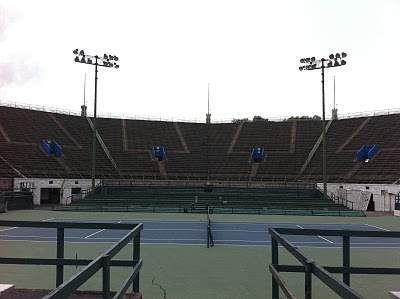
The Forest Hills Tennis Stadium is an American and International icon, situated in the earliest planned garden community countrywide, the Forest Hills Gardens. The Stadium embodies firsts in tennis, music, architectural, and social history, and was referred to as the "World Capital of Tennis." Designed by award-winning public building architect Kenneth M. Murchison, and built by The Foundation Co. in 1923, it was the first concrete tennis stadium in the U.S. The Stadium features eagles, terra-cotta shields bearing the West Side Tennis Club logo, archways, simplified cornice detail, flagpoles, authentic grandstands seating 14,000, etc. The Stadium was the 1st home of the US Open (through 1978), & was also home to singles championships, the Davis Cup, Wightman Cup, etc. It hosted tennis greats such as Bill Tilden, Helen Jacobs, Billie Jean King, Roger Federer, and Arthur Ashe & Althea Gibson who broke the racial color barrier. The Stadium also played cinematic roles, as it featured key scenes of Alfred Hitchcock's "Strangers On A Train." The annual Forest Hills Music Festival and concerts took ground in the late 1950s - late 1990s, featuring the likes of The Beatles, Frank Sinatra, Bob Dylan, Ella Fitzgerald, Diana Ross, The Monkees, The Who, Johnny Mathis, Barbra Streisand, Simon & Garfunkel, Trini Lopez, Peter, Paul, & Mary, etc. The Stadium & Clubhouse and its history has long-influenced our cultural possessions and media, including records & CDs, films, maps, the Forest Hills tennis racquet, clothing, postcards, (news) photos, videos, news, matchcovers, ads, etc. The Tudor-style Clubhouse dates to 1913, and was designed by famed architect Grosvenor Atterbury & John Almay Tompkins. The West Side Tennis Club was established in 1892, & first operated courts on Manhattan's Upper West Side. The West Side Tennis Club helped establish the sport of tennis in the US. Forest Hills is known for tennis, and tennis helped place Forest Hills on the map. In MIT's Nov. 1922 "The Technology Review," an ad referred to the stadium as "America's Tennis Stadium," and history has proven how it was built for the greater public.
STATUS
On May 3, 2011, local to international landmark supporters of the Forest Hills Tennis Stadium received a letter from the Landmarks Preservation Commission stating that "after a careful review of the current condition and architectural integrity of the above-referenced property, a senior staff committee of the Landmarks Preservation Commission found that the building does have some historic significance related to cultural and historic events that have taken place at the site, and does retain intact architectural features. At this time, however, the property will not be recommended to the full Commission for further consideration as an individual New York City landmark. The reason not to recommend further consideration is due to the deteriorated state of the building’s architectural features."
Rego-Forest Preservation Council feels that for the Landmarks Preservation Commission to not calendar a public hearing for the Forest Hills Tennis Stadium, is a neglect of public duty and of the architectural & cultural provisions of the Landmarks Law. We believe the Landmarks Law does NOT reference a site's condition as a means for rejecting a public hearing. Despite, there have been buildings in other boroughs needing major repairs and in worse condition, which have been calendared, heard, and landmarked, and have been restored or are now undergoing restoration. Some case studies are The Windermere, West Park Presbyterian Church, & Coignet Stone Co. This represents a double standard.
On behalf of Rego-Forest Preservation Council, Chairman Michael Perlman launched a grassroots campaign on July 23, 2010 by submitting a Request For Evaluation form with 50 pages of primary sources to the NYC Landmarks Preservation Commission, recommending the Stadium, Clubhouse, grounds, & interiors for NYC Landmark status. Perlman also met with local politicians. A landmark letter campaign and offline petition drive to the LPC & elected officials was launched, & was greatly supported by local to international residents & organizations. On October 7, 2010, Cord Meyer Development's proposal to build condos and demolish the majority of the stadium was rejected by West Side Tennis Club members, after not receiving a 2/3 vote to approve a sale.
Mixed-use creative revitalization of the Forest Hills Tennis Stadium (as opposed to condos) would most likely yield a greater economic return in the long-run, and could feature tennis matches, concerts, weddings, graduations, exhibits, school trips, charity events, music and art festivals, etc. The Stadium has the potential to be a 21st-century family destination, bring Queens & citywide communities closer together, boost tourism, convey historic pride, educate our children, help local businesses through tough economic times, and be an incentive for newer businesses i.e. on the Austin St corridor. Without landmarking, restoration, and creative reuse, it could be demolished, and would be a preservation travesty along the lines of Pennsylvania Station's historic loss.
FLICKR PHOTOS: http://bit.ly/ForestHillsTennisStadium
BLOG: http://regoforestpreservation.blogspot.com
FACEBOOK GROUP, "S.O.S. (Save Our Stadium!)" http://on.fb.me/SaveOurStadium
 |
| All historic photos courtesy of Michael Perlman |




 Posts
Posts


I. Limits some alterations and demolition of historic sites, which would otherwise inhibit the harmonious architectural character of a property, properties, and potentially reduce property values and economic benefits of a site &/or neighborhood.
II. Conveys prestige and neighborhood pride, and helps bond the generations on the basis of a property or properties’ architectural, cultural, & historical merit.
III. Grant eligibility: While Landmarking increases property recognition, it will increase the likelihood of acquiring grants. A sampling of several programs which make funding available, are as follows:
- The NY Landmarks Conservancy is a preservation non-profit that provides funding via grants/tax credits to property owners and religious institutions wishing to rehabilitate and restore their buildings, and offers technical assistance. The NY Landmarks Conservancy’s website is http://www.nylandmarks.org, which includes various programs.
- In conjunction with Landmarking via the NYC Landmarks Preservation Commission, placement on the State & National Register of Historic Places is also significant for the commemoration and acquisition of state and federal grants for historically-sensitive upgrades and restoration work. The State Historic Preservation’s Office’s State & National Register of Historic Places can also assist property owners with their needs, by utilizing federal tax benefits associated with the purchase or rehabilitation of properties on state & national levels: http://www.nysparks.state.ny.us/shpo/
The West Side Tennis Club board and members should realize that regardless of the percentage that is granted through a combination of city, state, and federal incentives, funding can also be acquired from independent individual and organizational donors. The WSTC does not have to drain their pockets. The multi-faceted fundraising aspect, and the long-term economic benefit of a creatively mixed-use historic icon for the greater American public, as initially envisioned and proven throughout nearly a century of the Forest Hills Tennis Stadium, should be considered.