Showing posts with label Olivia Park. Show all posts

Thursday, July 2, 2020

Patriotism Forest Hills Style, July 5, 1920

By Michael Perlman

Forest Hills Gardens town crier
Back in 1914, the annual Independence Day festival was launched in the Forest Hills Gardens. This set off a tradition where committees, residents, and friends participated in a day-long program for all generations and interests in an exquisitely decorated and uniquely illuminated Station Square, as well as the Forest Hills Inn and Tea Garden, Olivia Park, and along Greenway Terrace. A most historical Forest Hills event was on July 4, 1917, when Colonel Theodore Roosevelt delivered his “One Hundred Percent American” unification speech at the LIRR Station to address WWI. Today, patriotism and tradition continue to echo in a modified form through Children’s Day at Flagpole Green in June. Let’s turn back the clock to July 5, 1920, which marked the 144th anniversary of America’s independence.

The ceremony on Village Green now Flagpole Green
Keeping in mind that the 1919 celebration cost $3,057.90, Dr. Thompson Tyler Sweeny, who served as the Chair of the 1920 celebration, requested that every Gardens family contribute an average of $10. It was anticipated as the greatest of Independence Day celebrations yet! The Forest Hills Gardens Bulletin published, “Not only were the birds singing cheerily to arouse the villagers from morning slumbers, but through the streets early on July 5 came the Town Crier calling lustily to all to come to the Green for the Flag-raising at 9:30.” The ceremony featured members of American Legion Post 630 and Boy Scouts Troop 2 under the direction of Harvey Warren, who served as Post president and scoutmaster. Uniformed servicemen and Boy Scouts assembled in Station Square and began marching to Village Green. After Warren played the part of a Colonial Town Crier, he changed into military garb. The flag was raised and a patriotic prayer was made. A chorus sang patriotic tunes under guidance of the famed Glee Clubs leader Bruno Huhn, with piano accompaniment by Mrs. Charles H. Scammell, who was considered “the foster mother of all good singing of Forest Hills Gardens.”

Children were ready to play games in Station Square at 10 AM, thanks to the direction of Dr. W. F. Seybolt.. The publication read, “There are between fifty and sixty very happy boys and girls who are wearing bronze and silver badges, won at the children’s games in canvas-covered Station Square between 10 and 12 o’clock.” It continued, “With kiddie car races, pillow fights, sack and relay races, a whole program of fun, speed, and skill was carried out.” The lineup also included games for adults such as a baby carriage race, football kicking and ball tossing, tilting matches, tug-of-war between easterners and westerners.

 
At 2 PM, Hawthorn Park became a baseball field where the “Inn Warriors” (the Inns) clashed with the “Station Square Cohorts” (the Outs). An umpire appeared in armor, while a batter wore petticoats. The Daily Star reported, “There will be no tennis this year, the committee having decided that tennis is so integral a part of the life of the community as to make a baseball game a greater diversion.” The Forest Hills Gardens Bulletin stated, “The Outs came nobly from the rear and put the winning run over the plate to the accompaniment of the deafening plaudits of the assembled throng.” It later read, “It was a dashing game, and the narrow margin of one run by which the Outs won their victory shows how closely it was played.” The Inns’ captain was Ray Bell whereas Edmund O’Shea led the Outs. 


By 4 PM, attendees were in tune for opera at Olivia Park, a natural amphitheatre. Milton Aborn directed a company which performed “Pagliacci” by Ruggero Leoncavallo (1892) and “Cavalleria Rusticana” by Pietro Mascagni (1889). The Metropolitan chorus featured 24 vocalists and the Metropolitan orchestra featured 17 members. Scenery was minimal to maximize on the park’s charming ambiance.

Between 5 and 7 PM, festivities included a home-cooked supper by the Women’s Guild of the Church-in-the-Gardens social room for $1, where the proceeds would benefit the Community House fund.

At 7:30 PM, they made their way back to Station Square for a band concert and the community Choral Club that performed several patriotic airs comprised of nearly 75 vocalists. Another highlight was music at twilight by the Regiment Band of the 22nd Corps of Engineers, a 40-piece band under Master George Briegel. The evening continued with dancing in Station Square at 9 PM, lasting until midnight. The Forest Hills Gardens Bulletin read, “The dance on Station Square, lighted by myriads of red, white, and blue incandescents, will fittingly close a happy family and community patriotic day – the Independence Day of 1920, long to be remembered”… “The decorations will consist of myriads of American flags interspersed with those of the Allies, all placed to produce the best effect.” It also stated, “All the lads and lassies, maids and matrons and escorts danced on the canvas covering until – well, why tell the hour – for the music was the best and the night balmy.” Over 3,000 people were in the audience and among the dancers, and Chairman Henry W. Hirschberg was commended for this final feature.

The festival offered a humanitarian aspect. Proceeds from the refreshment booth, which served ice cream cones, lemonade, iced tea, sandwiches, and cake, benefited the Big Sisters of Queens Borough. Based on the prior year’s partnership, the Big Sisters received over $200 and assisted seven children who would have traditionally ended up in institutions, and ultimately helped them find suitable homes. 

Reflecting on the festival’s success, the publication stated, “Our friends and relatives were here in such numbers that it was apparent that our village is growing, and that everyone likes ‘our party,’ as Dr. Sweeny, the chairman, called it.” It continued, “The most impressive and appropriate part of the program, in the humble opinion of the editor, was in the Flag raising and the singing of the newly christened Choral Club.”

A similar version was featured in Michael Perlman's Forest Hills Times column: http://foresthillstimes.com/view/full_story/27760129/article-1920s-patriotism--Forest-Hills-style


Wednesday, November 6, 2019

Unsolved Mystery: The Fountain of Piping Pan

By Michael Perlman

Fountain of Piping Pan, Olivia Park circa 1915, Courtesy of Michael Perlman
“There is a mystery on our hands!” Decades ago, the “Fountain of Piping Pan,” also known as “Olivia Fountain,” a focal point of the one-acre Olivia Park bounded by Markwood Road and Deepdene Road in Forest Hills Gardens, mysteriously vanished despite restrictive covenants which have long-preserved the Gardens’ historic beauty. Now the community wants answers, with a vision of rediscovering or rebuilding the fountain.

This attractive, tranquil, and environmentally beneficial feature consisted of a young male cherub playing a pipe which overlooked a bird fountain alongside the right-hand pathway as residents would walk from Markwood Road. In 1915, The Sun published, “The presiding genius of the fountain is a small nude boy in plaster playing a pipe and the water tumbles over the stones at his feet down into a miniature lake, where the birds may disport themselves as in one of nature’s own sylvan retreats.” In response to The Bird Club of Long Island which formed that summer to safeguard bird life, the publication stated, “From Brooklyn to Montauk Point, branch clubs are being formed, bird refugees and sanctuaries are bring created, and other steps are being taken to make the bird population multiply, and the insect horde decrease.” The membership numbered 300 and spanned 40 communities.

On July 4, 1915, with a local chapter of the Audubon Society on site, the bird fountain designed by Underwood Road resident Beatrix Forbes-Robinson Hale (later Women’s Suffrage Club of Forest Hills president) and presented by the Russell Sage Homes Company, was dedicated to Margaret Olivia Slocum Sage, who was praised for her passion for birds. As a case in point, she purchased Marsh Island to transform it into a bird sanctuary. Also part of her acclaim was her establishment of the Russell Sage Foundation, which sought to improve the social and living conditions in the United States. The park was originally named in her honor, and her vision was realized as it served as a natural amphitheatre due to its sloping topography and acoustics. 

Forest Hills Gardens resident Elma Rae who unveiled Fountain of Piping Pan, 1915, Courtesy of Michael Perlman
 A woodthrush began to sing, a hidden orchestra played “Morning” by Grieg, and an elf emerged from the forest, drank from a fairy spring, and offered a libation to nature. Irmgard, Baroness von Rottenthal performed five interpretative dances at the fountain’s dedication ceremony. The repertoire also consisted of “Anitra’s Dance” by Grieg, where the pagan girl carried garlands of flowers and expresses joy in living, “Eve” by Tchaikovsky, “The Butterfly” by Chaminade, and “The Bird Basket” by Lacombe, where a Dresden China Shepherdess abandoned her flock to feed the birds which she calls from the trees. The New York Tribune read, “The entire village of merrymakers surged around the natural amphitheatre in their brilliant costumes as she emerged from cover to worship the beauty on every side.” Operatic singer Vivian Holt performed “Hark, Hark The Lark” by Schubert. Then the fountain was unveiled by a young Gardens resident, Elma Rea, who dedicated it “to the birds in recognition of their services and charm.” The program also read, “It is at the same time given to the people of the Gardens, to whom this park belongs.” 

Olivia Park is one of the most serene and private Forest Hills Gardens settings, where stately homes minimally meet the eye. A 1918 edition of “Country Life on Long Island” read, “It was especially desired to shut this park off almost entirely from the street and to give it the restfulness and seclusion of a remote piece of woodland, and yet to make the interior more inviting, if possible, than the original valley. The long stone steps and bright gravel walks invite the passerby to enter, while the smooth green grass within temps him to stop and rest beneath the shade of the Dogwood and the Wild Cherry trees.”

Among the locals who value preservation and restoration is Tony Barsamian, who called the fountain fascinating, and is hopeful to solve the mystery. As a member of the Forest Hills Gardens Corporation Board of Directors and an active community participant, he said, “I have always believed that it is crucial to preserve and maintain the historic integrity of our unique community. People buy into the Gardens knowing that the homes cannot be arbitrarily changed architecturally and stylistically. Our process is designed to withstand the whimsical fashion dujour and trendy applications, which is why Forest Hills Gardens appears as it has looked for over a hundred years; a stunningly beautiful neighborhood in the midst of New York City.”

Another Forest Hills Gardens Corporation board member, Elizabeth Haberkorn, takes pride in how the park was used as an amphitheatre, historically for dances and performances by the Garden Players. Now she is working with FHGC to develop a plan to upgrade parks including Olivia Park. She said, “We are in the planning stage, and will work with landscape architects and residents to keep the parks holistically consistent and historically accurate, while making them more attractive and useful to residents.” 

Olivia Park in 2015, Photo by Michael Perlman
She also admires the park’s wildlife, trees, and its potential for recreation. “I have often watched woodpeckers and other birds in the trees. It is also beautiful in the fall with various colors of leaves. My son and I have sledded in the park for years. I recall one blustery winter day when two NYC cops joined in and raced down the hill.” 

As an avid gardener, she coordinated with FHGC nearly five years ago to plant naturalizing narcissus and daffodils along the wooded edges, and her son and other children also volunteered. Over the years, thousands of bulbs were planted. “Last year, at the suggestion of a resident, a renowned architect and landscape architect, we added 1,000 hyacinthoides hispanica, small blue woodland flowers among the earlier plantings.”

A similar version of this feature appears in Michael Perlman's Forest Hills Times column: http://foresthillstimes.com/view/full_story/27677679/article-The-mystery-of-the--Fountain-of-Piping-Pan


Tuesday, July 3, 2018

A Forest Hills Tribute To July 4, 1918

By Michael Perlman

Chairman Eckman of 4th of July Celebration introducing Senator Calder, Station Square, 1918

Originating in 1914, the Forest Hills Gardens coordinated annual Independence Day festivals in exquisitely decorated Station Square with activities at the Forest Hills Inn and Tea Garden, Olivia Park, and along Greenway Terrace. One of the most communicated events was on July 4, 1917, when Colonel Theodore Roosevelt, the 26th U.S. president, delivered his “One Hundred Percent American” unification speech at the LIRR Station, pleading for a single standard of patriotism and loyalty to the America of George Washington and Abraham Lincoln, to address WWI.

Now it is time to turn back the clock to the 1918 festivities, which were also meaningful, but yet, long-forgotten. Today, patriotism and tradition continue to echo locally in a modified form, particularly through Children’s Day at Flagpole Green in early June, although a century ago large-scale Independence Day celebrations were held on the actual day. 


Flag raising ceremony on Village Green, July 4, 1918

A flag raising ceremony proceeded on Village Green (now Flagpole Green), and Reverend Joseph McLaughlin of Our Lady Queen of Martyrs delivered an address. H.E. Conway read excerpts of Secretary Franklin Lane’s address and patriotic songs were recited. Tennis matches were played on courts that once occupied the site of The Inn Apartments, and the Obstacle Race was an attraction among the popular children’s games feature in Station Square. In Olivia Park, students of the noted Louis H. Chalif dance school at 165 West 57th Street performed the Twilight Symphony, an interpretative dance. 


Samuel W. Eckman, who served as Chairman of the Fourth of July Celebration, introduced Senator William M. Calder, who delivered an eloquent address resulting in rounds of applause by several hundred attendees throughout Station Square. His speech consisted of “The country owes a debt of gratitude to General Leonard Wood and Colonel Theodore Roosevelt for their work in stirring up the sentiment on every hand,” and “We are a long way from success, but we mean to fight it out to the last man, and we must all be ready to answer the call and to stand behind the government.” As a native Long Islander, he felt that Forest Hills was especially delightful, and he praised our community spirit.

Senator Calder felt that one of our most important achievements was passing the draft. He explained that “it put all men, the rich and poor alike, on terms of equality.” He established confidence for our future, based on the success of achievers including Harold Davies (WWI veteran) and Charles Schwab, the famed steel magnate.

Senator Calder discussed America’s conditions in its early days such as the Civil War, and pointed out our fight to free a portion of the human race. “We are now as never before a united people,” he said. “This is a war for justice to nations and to men, and when it is over, the treaties of peace must have a clause in then which should assure to all nations a just and complete peace. We must never forget our obligations to France in the time of the Revolution – how they helped us then and how we should help them now.”

He continued, “While America welcomes the oppressed of every nation to her shores, they must when they come join heartily in building up the honor and glory of the United States. We should here today consecrate ourselves anew to the cause of America and to the just war that she is engaged in.”

The agenda continued with “The Spirit of Play,” a masque presented by children, and character and patriotic dancing followed. Evening festivities consisted of dancing in Station Square, in addition to Camp Upton soldiers performing musical numbers. At the Church-In-The-Gardens, wounded soldiers and sailors of WWI were guests of honor at a dinner.

A great success resulted from the collaboration of various committees such as “Soldiers and Sailors” chaired by L.M. Burt, “Printing” by the prolific American type designer and printer Frederic W. Goudy, “Posters” by famed artist Herman Rountree, “Red Cross” by Mrs. Leon D’Emo, “Entertainment and Program” by John M. Demarest of the Sage Foundation Homes Company, and “Dances and Music” by W. Leslie Harriss.

A similar version has been published in Michael Perlman's Forest Hills Times column:
www.foresthillstimes.com/view/full_story/27581231/article-A-Forest-Hills-Tribute-on-July-4--1918?

Saturday, November 21, 2015

Help Solve Forest Hills Gardens Mysteries & Rediscover Relics


Copyright Michael Perlman
Forgotten Past of The Forest Hills Gardens by Michael Perlman

- Why did the handprint & footprint concrete slabs featuring celebrities outside the Forest Hills Inn, once known as "Celebrity Walk" vanish?
- Why are the 2 concrete eagles at the base pedestals of the Forest Hills Tennis Stadium nowhere to be seen?
- Why is the only remnant of the Sun Dial on Village Green a 4-hole pedestal?
- Why & when did the historic Fountain of Piping Pan in Olivia Park vanish?
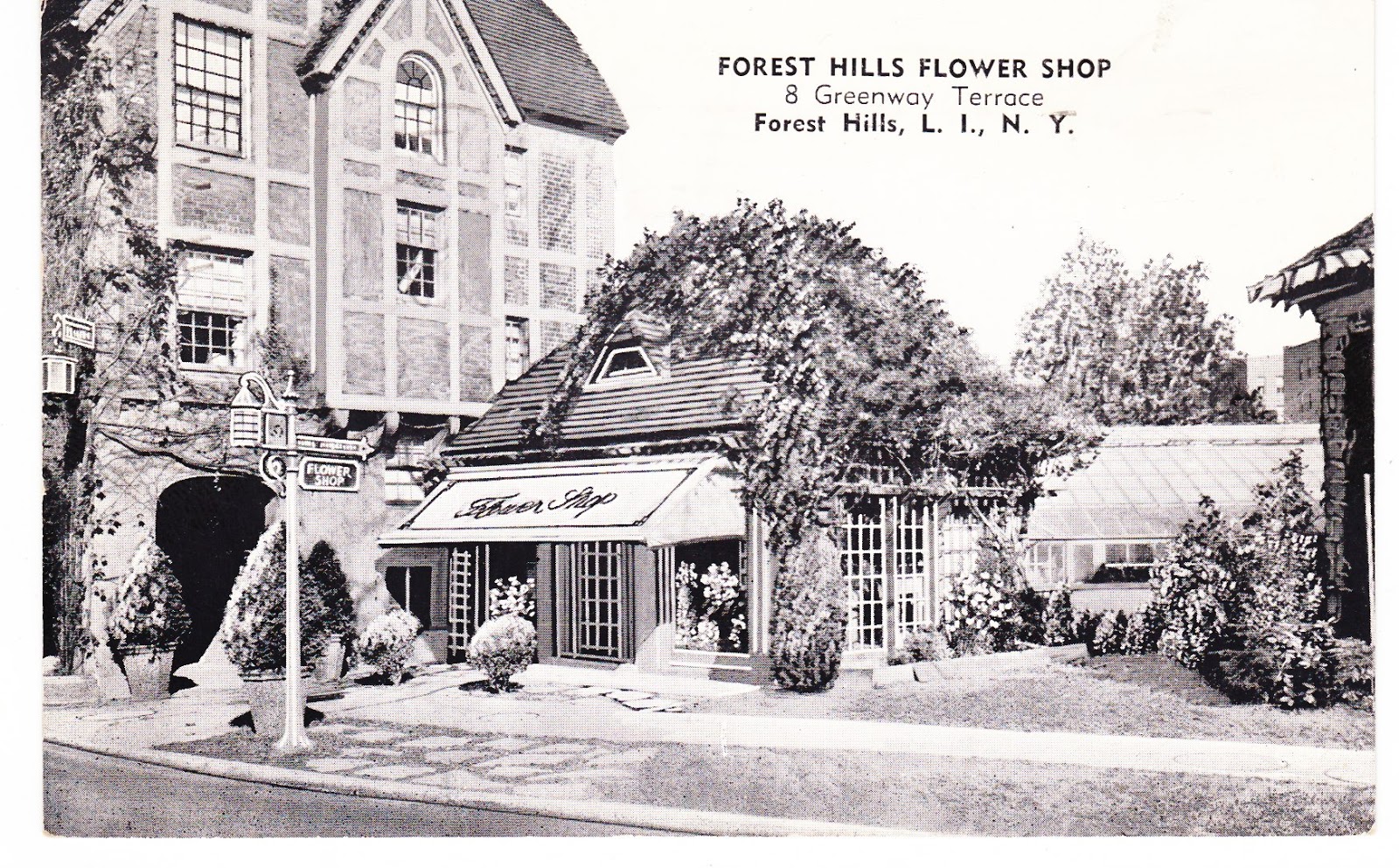
- Why is 8 Greenway Terrace, which  contains a greenhouse that once belonged to the popular Forest Hills Flower Shop left vacant in the exclusive Forest Hills Gardens for approximately 15 years?
- Will the Tea Garden see new light?
- Is the Forest Hills Gardens' standalone stone mailbox post the last of its kind locally?

Forgotten relics and some mysteries are very much alive in our backyard, and such is the case in the Forest Hills Gardens.

Established in 1909 as America's earliest planned garden community, Tudor and Arts & Crafts homes on winding streets featuring lush landscapes add up to a predominant preservation success story, thanks to restrictive covenants administered by the Forest Hills Gardens Corporation.

Principal architect Grosvenor Atterbury and urban planner Frederick Law Olmsted, Jr. would generally be content, despite the few features that have vanished.
Copyright Michael Perlman, 2015
On Village Green, situated along Greenway Terrace, one comes upon a pea gravel pedestal with four holes. Affixed to the top was once the “Sun Dial.” The pathways which extend from the pedestal are symbolic of the sun’s rays providing contrast from the lawn.

Back in 1915, it was boasted by The Newtown Register as “a very attractive feature which was depended upon as giving the correct time when the sun shines.”

Copyright Michael Perlman, 2015
Olivia Park offers a most intimate setting, but a tranquil and functional feature once known as the Fountain of Piping Pan has long vanished. In 1915, The Sun published, “The presiding genius of the fountain is a small nude boy in plaster playing a pipe and the water tumbles over the stones at his feet down into a miniature lake, where the birds may disport themselves as in one of nature’s own sylvan retreats.”

On July 4, 1915, with a local branch of the Audubon Society on scene, the fountain, designed by Beatrix Forbes-Robinson Hale, was dedicated to Margaret Olivia Slocum Sage, who was kindly regarded for her passion to birds.

Also part of her acclaim was her establishment of the Russell Sage Foundation, which sought to improve the social and living conditions in the United States.

Her vision was realized as this park often served as a natural amphitheater, where Irmgard, Baroness von Rottenthal performed interpretative dances at the ceremony to the sounds of Grieg and Tchaikovsky.

Copyright Michael Perlman, 2015
At 8 Greenway Terrace stands an Old English single-story Forest Hills Flower Shop with an adjoining greenhouse that opened in the 1920s as florist and landscape contractors, but shuttered around 1998.

“The florist John J. Loguercio ran the shop for many years, and would employ some of the local teens as delivery boys, including one that became an M.D. Andre, who now owns Forest Hills Flowers & Blossoms on Metropolitan Avenue, began working for John,” recalled Forest Hills native Maria Swanson.

“It was a beautiful spot with climbing roses and window displays,” added Kew Gardens resident Eileen Mahoney, who was raised at 14 Greenway Terrace. “Everyone in the neighborhood had him provide flowers for their weddings. Neighborhood Christmas trees and wreathes were purchased there.”

Copyright Michael Perlman
“It saddens me that some of these unique features have disappeared,” said Swanson, who recalled concrete slabs in front of the Forest Hills Inn, which consisted of Forest Hills’ Celebrity Walk.

On site were entertainers’ handprints and footprints. They included Frank Sinatra, Barbra Streisand, Sammy Davis, Jr. and likely Buddy Hackett, The Beatles, The Marx Bros, Betty Davis, Charlie Chaplin and John Wayne.

“They were possibly removed in the late 1970s,” she continued.

Former Forest Hills resident Steven Grimando was on scene at the time the slabs were salvaged during a construction project.

“They were framed in wood and placed on dollies, two at a time,” he said. “Under the Forest Hills Inn, there’s a ramp with doors, and the slabs were then placed deep within a series of catacombs.”


Copyright Michael Perlman
As the Inn was a center of a classy social life prior to its residential conversion in 1967, the Tea Garden, nestled behind the Inn was in full swing. Opened in 1912, it was once the site of afternoon teas, weddings, dances, and productions by The Gardens Players that took inspiration from the natural setting.

Guests would dine to the Inn Trio’s performance of Nevin’s “A Day in Venice” and Dvorak’s “Humoresque.” Today, behind an ornate gate on Greenway Terrace stands majestic trees and a defunct central brick fountain, but the cascading wall fountain has vanished. Now plans are underway to restore the Tea Garden.
Copyright Michael Perlman
On a stroll among forgotten spots, locals can stop at presumably the last pea gravel mailbox post on Ascan Avenue and Greenway South, which bears a 1938 inscription. The mounted miniature mailbox is long gone, but to its right is a more familiar 1950s-era blue mailbox.
The long gone eagle & Bill Tilden in 1937 at Forest Hills Tennis Stadium
And a couple of concrete eagles have mysteriously gone missing from the Forest Hills Tennis Stadium, which was designed as America’s first tennis stadium in 1923 by architect Kenneth Murchison and built by The Foundation Company.

Bea Hunt, former vice president of the West Side Tennis Club, noticed the pair in photos through the 1950s, but then examined a Rolling Stones concert photo marked July 2, 1966, where the eagles were missing.

“Today there are 11 concrete eagles at the upper façade overlooking the amphitheater, but originally an eagle stood on each pedestal at the lower ends of the horseshoe,” she said.


Source: Queens Ledger - Forgotten Past of The Forest Hills Gardens 


Wednesday, July 4, 2012

4th of July: Forest Hills Edition

4th of July 1917, Station Square costume dance
This is Michael Perlman's article, "4th of July: Forest Hills Edition," published in the Forest Hills Times/Queens Ledger on July 4, 2012. Please feel free to comment & share:
http://www.queensledger.com/view/full_story/19208316/article-4th-of-July--Forest-Hills-Edition

Patriotism and tradition echo in Forest Hills. In recent times, on the weekend following Memorial Day, Forest Hills Gardens organizes a celebration known as Children’s Day at Flagpole Green, which features decorations, face painting, cotton candy, hot dogs, raffles, and games.

Historically, music has played a significant role in Forest Hills Gardens celebrations, so attendees can expect to rejoice to the sounds of John Philip Sousa, a late American composer, who is noted for his patriotic and military marches.

Stepping back in time, Forest Hills Gardens witnessed the light of very elaborate 4th of July commemorations on the actual date. The teens are nearly a century ago, so let’s place our modern minds into the shoes our ancestors walked, and stand in the footsteps of triumph in our country’s earliest planned garden community. Station Square, Village Green, and Olivia Park were classic sites of rich tradition, and exist in a pristine state to this very day.


July 4, 1914 marked the Gardens’ first annual Independence Day celebration. Since the population of the community was minimal, and Forest Hills at large was a small town, the first celebration was noted for its camaraderie.

Greenway Terrace became an al fresco dancing pavilion, which signified the first step of solidarity. A highlight of the second celebration in 1915 was the Pageant of Colonial Times in Station Square, the dedication of the Piping Pan bird fountain (cherub blowing a flute) in Olivia Park with Baroness von Rottenthall’s interpretative dancing, and the Fourth of July Committee’s acquisition of a silver cup for annual tennis matches, which began that year.


 The Forest Hills Gardens Bulletin defined the success of teamwork through organizations and residents in 1916, which read, “The Fourth of July Celebration at the Gardens is primarily, yes wholly, a community affair. It is the people’s day – a memorial of the first great test of unity in this country, and it is interpreted here in the Gardens as an expression of organized community effort.”

That same year, attendees participated in the dedication of a 108-foot flagpole on Village Green, with an inscribed bronze collar at the base. The official flag of the Forest Hills Gardens was first to be raised on the 4th of July.


An allegory called The Happy Stranger was presented in the natural amphitheater-style Olivia Park. The Red Cross Society generated proceeds by selling ice cream, Cracker Jacks, lemonade, peanuts, popcorn, and lollipops under the Square’s archways.


 In great anticipation, Gardens residents decorated their homes, and the Committee on Decorations and Illuminations applied their touch to Station Square and Village Green. The iconic Forest Hills Inn offered special menus and decorations. The Inn’s Tea Garden was boasted as a particular attraction, since children of the entire community were treated as guests to a party of their own.


 One of Forest Hills’ most notable 4th of July moments took place atop the steps of Station Square’s Long Island Railroad Station in 1917, where onlookers heard Colonel Theodore Roosevelt’s One-Hundred Percent American Speech. He pleaded for allegiance to the America of Washington and Lincoln, and thousands cheered in response.


A miniature Greek temple was erected in Olivia Park, which functioned as a stage setting for attendees witnessing the light of Ralph Renaud’s The Masque of Liberty.


A 1918 highlight was U.S. Senator Calder’s speech in Station Square. That year had a more sacred feel, since wounded soldiers and sailors of WWI were honored over dinner at the Church-In-The-Gardens. Students of Louis Chalif’s famed dance school performed in Olivia Park.


 The success of the U.S. and her allies played a pivotal role in the 1919 commemoration. An excerpt from the Forest Hills Gardens Bulletin captured the spirit.

“Nothing was more impressive than the raising of the Flag by a member of the old Rifle Corps while the people assembled sang the Star-Spangled Banner, and nothing was more skillfully done than the reading of the Independence Day Proclamation of the Citizens by the Town Crier, Harvey Warren, in old New England costume. Captain Horace F. Pomeroy, chairman of the celebration committee, spoke of the history of the old Rifle Club – the first military organization of Forest Hills – and then introduced the Rev. Rowland S. Nichols, Chaplain of the Rifle Club who spoke briefly and offered prayer.”

The Forest Hills Rifle Club was the first case of loyalty locally, and its revival for the celebration was integral.

Beginning at 9:30 a.m., Village Green hosted flag-raising exercises, the Community Chorus sang patriotic airs, and the Rifle Club reunion took place. Station Square hosted political addresses at 11 a.m. Tennis matches took place at the Forest Hills Inn Courts at 12:30 p.m., which featured the Inns vs. the Outs. The Inns lived in the Forest Hills Inn, and the Outs lived throughout the Forest Hills Gardens.


At 1 p.m., attendees enjoyed children’s games, as well as the French Doll Dance, where female dancers were assisted by the Boy Scouts. Games included yard dashes for children, grand tilting matches for parents, a kiddie car race, a paper fight, a sack race, a baby carriage race for fathers, a pillow fight, an optic contest for adults, a half-mile relay, and dressing and obstacle races.

At 4:30 p.m., The Golden Day allegory by Ralph Renaud took stage at Olivia Park, where locals and talented students of the Chalif Normal School of Dancing performed in a sylvan setting. The play featured the harmonious Butterfly Dance, The Dances of The Summer Nocturne, and The Song of The Birds. The setting was complemented by an orchestra of strings and a vocal interlude.

At 7:30 p.m., under incandescent lights and electric streamers with flags and pennants, nearly 3,000 attendees would enjoy the 9th Coast Artillery Band Concert in Station Square, followed by the flamboyant Costume Dance at 8:30 p.m. Popular costumes were the Pierrot, Pierrette and Yama Yama.

Artists designed highly stylized 4th of July posters annually. Herman Rountree’s 1916 poster depicted a clown and a mule with astonished children in period clothing in the backdrop. It read, “Yes Mule – It’s The Greatest Show on Earth.”


B. Hooper’s “Coming July 4th” poster from 1916 depicted a clown-like child rejoicing on a circus elephant bearing a humanly expression of wisdom and holding high a 4th of July flag.

Rountree’s 1917 poster depicted the Forest Hills Inn and Station Square as the backdrop of Village Green, where bystanders witnessed the raising of the flag. That same year, another one of Rountree’s posters captured the masquerade feel of Station Square with the train station in the backdrop. On various levels of creativity, beauty was indeed in the detail!


A typical celebration called for glorious expression, as in the case of Gertrude Knevels’ Station Square – A Fourth Of July Impression, which read:

Old Glory from the Tower looks down. 
To bless the folly of the town,
Lights, laughter, color everywhere –
Wise folks like happy children there,
At play in Station Square.
Far over all the clear night sky
Spreads tender hands – What hurries by? – 
It is the train that grumbling goes,
Bearing the world and all its woes
Away from Station Square!