Showing posts with label Celebrity Walk. Show all posts

Thursday, August 22, 2019

A Forest Hills Mystery... "Celebrity Walk"

By Michael Perlman


Every community has forgotten relics which either survive or have been concealed, demolished, or carted away and awaiting rediscovery. The latter is the case with “Celebrity Walk,” a collection of handprints and signatures in cement slabs which existed in the 1960s and 1970s along the perimeters of the lawns in front of one of Forest Hills Gardens’ most historic and storied buildings, the Forest Hills Inn. It evoked the ambiance of Grauman’s Chinese Theatre’s forecourt’s footprints and handprints feature.

“I loved coming up with press-generating ideas, including the creation of a Celebrity Walk in front of the hotel’s sidewalk cafe. Marketing seemed to come easily to me,” said Mark H. Fleischman, former owner of the famed Studio 54 nightclub and author of “Inside Studio 54” which features a memoir of his life. From 1965 to 1968, he co-owned the Forest Hills Inn and served as executive director, although he retained stock in the company that sold to the co-op and rented the restaurants.

Fleischman explained, “It was a real coup when we got Frank Sinatra to put his handprints into a block of wet cement when he headlined the Forest Hills Music Festival at the nearby tennis stadium. As soon as other celebrities heard about Sinatra’s handprints and signature, they agreed to be included in our Celebrity Walk when they performed.”

Other celebrities who followed included Barbra Streisand, Trini Lopez, Woody Allen, and Buddy Hackett. On August 17, 1965, locals picked up the Long Island Star-Journal and read, “The Forest Hills Inn has Frank Sinatra’s and Barbra Streisand’s handprints imbedded on their sidewalk pavement, but it had to get them the hard way. Both stars agreed to make the imprint, but refused to do it at the sidewalk. So wet cement was sent to both stars, the imprints made, and the hardened blocks were then inserted in the pavement.”

The same publication read that on July 8, 1966, Sammy Davis, Jr. was expected at the Forest Hills Inn to place his handprints in the hotel’s “celebrity sidewalk.” Fleischman reminisced, “I was also able to get tennis stars playing for the U.S. Championship to participate in our Celebrity Walk, including Rod Laver, Arthur Ashe, John Newcombe, and my hero from Spain where I attended summer courses at the University of Madrid, Manuel ‘Manolo’ Santana.”

In May 1965, the 300-room Forest Hills Inn and the adjoining apartments were sold for over $1 million to Martin Fleischman, who owned the Skyway Hotels at Kennedy Airport, and his son Mark Fleischman, a 1962 graduate of Cornell University’s School of Hotel Administration. At the time, it offered an English pub, cocktail lounges, a formal dining room known as the Windsor Room, a sidewalk cafe, what was originally named “The Tea Garden,” and four social function rooms accommodating 400 guests. “The Inn was a venerable hotel that looked like an English country manor,” explained Mark Fleischman. A draw was also its location in an upscale community and the proximity to Forest Hills Stadium, but yet it was in foreclosure. “I focused my energies with absolute determination and belief in my ability to revive the Forest Hills Inn, while also still committed to my duties as a Naval officer,” he reminisced.

Fleischman said, “Reviving the Inn involved more than just upgrading the food in the formal restaurant, the Windsor Room, and bringing in a new maître d’. I had to change the stuffy attitude of the staff as well and went head to head with the Hotel/Restaurant Workers’ Union.” He hired some new personnel and transformed the Tournament Grill into the Three Swans, an authentic English pub that became a neighborhood success. At the grand opening, local VIPs and politicians attended, including Mayor John Lindsay.

Some local residents recall the existence of a tunnel with a series of catacombs, which may have connected the inn’s basement to the Clubhouse of the West Side Tennis Club. Rumor has it that a sidewalk construction project led to the relocation of the handprints, which may have been placed in the inn’s basement in a potentially concealed tunnel for safekeeping, possibly in the mid to late 1970s.

“I am unsure what happened to the slabs of cement, and my partner in charge of construction passed away many years ago, so I wouldn't know who to ask,” lamented Fleischman. In 2015 and 2017, a search began to rediscover and potentially resurrect the handprints at a secure location to be determined, to educate the public and commemorate diverse celebrities while celebrating Forest Hills history. A small but ambitious committee ventured into the Forest Hills Inn’s basement with flashlights and camera equipment, but on both occasions, the search yielded no results.

George Hoban, president of the board of the Station Square Inn Apartments Corporation is a member of the committee that began searching for the handprints. “I’ve personally looked through the bowels of the Forest Hills Inn for the infamous handprints and came up empty every time. I’ve never found photographic proof that they actually existed.” At one point, he said, “I’m beginning to think that the handprints may be an urban legend like ‘Bigfoot’ or the ‘Loch Ness Monster.’”

“It was an honor to be invited by this columnist, Michael Perlman, to explore the basement of the Forest Hills Inn to look for the signature and handprint slabs,” said Bea Hunt, co-chair of West Side Tennis Club Archives Council. “We searched every nook of the basement and learned much of the Inn's rich history. Unfortunately, we did not find any slabs, but I am confident that the search will continue. The West Side Tennis Club is extremely fortunate to have one slab in our archive.” It features the signatures and handprints of three famous tennis players from various decades, Jack Kramer, Bill Talbert, and Manolo Santana.

Upon viewing a photo of the sole cement slab that turned up in the West Side Tennis Club’s archives in more recent times, Hoban said, “The fact that Celebrity Walk existed is a testament to the rich history of the Forest Hills Inn, and we proudly honor that history as we continue to restore the Inn.” He is in favor of resurrecting Celebrity Walk in some form, if many slabs resurface. “We would need the approval and support of the Forest Hills Gardens Corporation and Friends of Station Square.” 

An alternate form of this article has been published in Michael Perlman's Forest Hills Times column:  http://foresthillstimes.com/view/full_story/27660871/article-A-Forest-Hills-Mystery--Celebrity-Walk

Saturday, November 21, 2015

Help Solve Forest Hills Gardens Mysteries & Rediscover Relics


Copyright Michael Perlman
Forgotten Past of The Forest Hills Gardens by Michael Perlman

- Why did the handprint & footprint concrete slabs featuring celebrities outside the Forest Hills Inn, once known as "Celebrity Walk" vanish?
- Why are the 2 concrete eagles at the base pedestals of the Forest Hills Tennis Stadium nowhere to be seen?
- Why is the only remnant of the Sun Dial on Village Green a 4-hole pedestal?
- Why & when did the historic Fountain of Piping Pan in Olivia Park vanish?
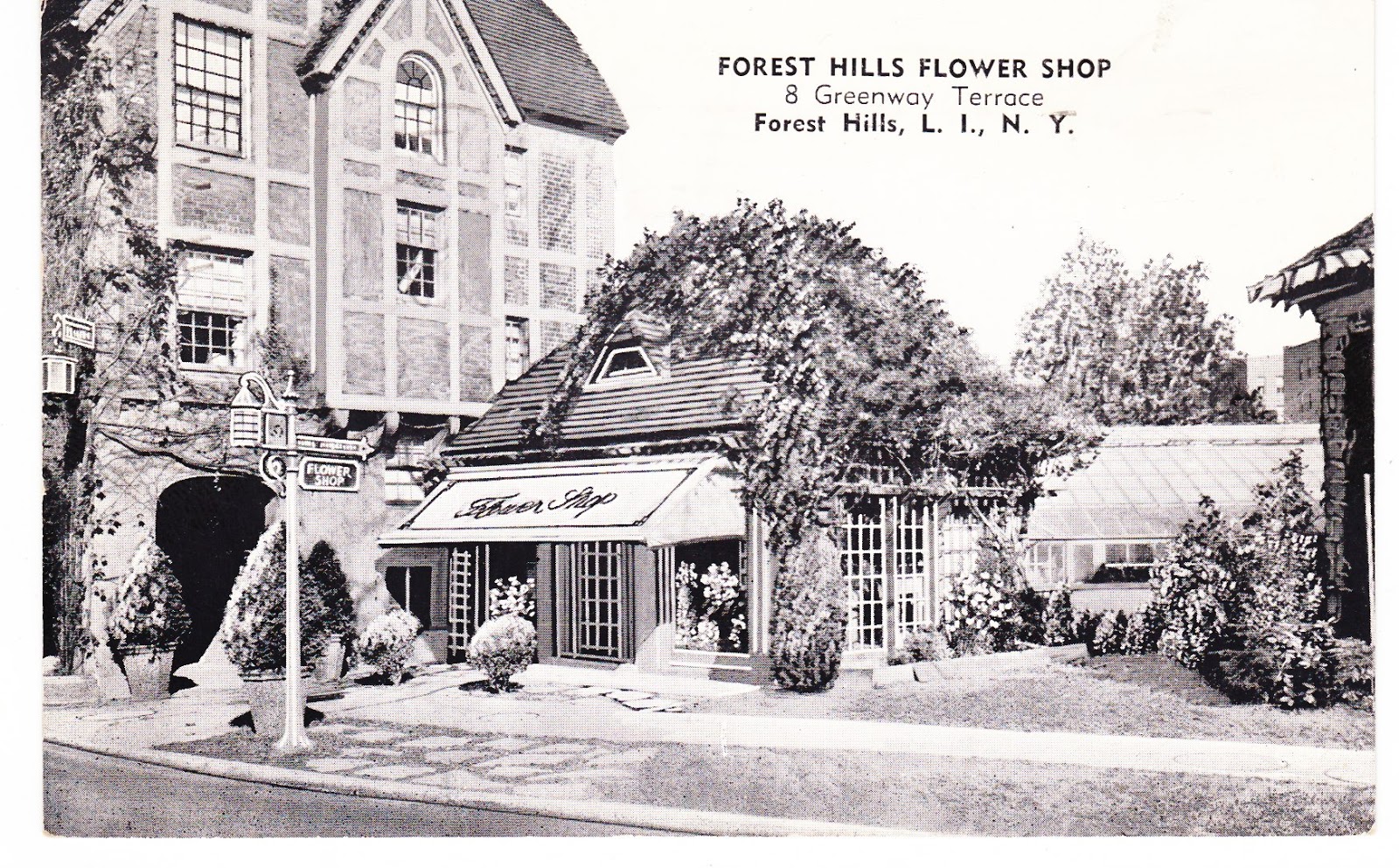
- Why is 8 Greenway Terrace, which  contains a greenhouse that once belonged to the popular Forest Hills Flower Shop left vacant in the exclusive Forest Hills Gardens for approximately 15 years?
- Will the Tea Garden see new light?
- Is the Forest Hills Gardens' standalone stone mailbox post the last of its kind locally?

Forgotten relics and some mysteries are very much alive in our backyard, and such is the case in the Forest Hills Gardens.

Established in 1909 as America's earliest planned garden community, Tudor and Arts & Crafts homes on winding streets featuring lush landscapes add up to a predominant preservation success story, thanks to restrictive covenants administered by the Forest Hills Gardens Corporation.

Principal architect Grosvenor Atterbury and urban planner Frederick Law Olmsted, Jr. would generally be content, despite the few features that have vanished.
Copyright Michael Perlman, 2015
On Village Green, situated along Greenway Terrace, one comes upon a pea gravel pedestal with four holes. Affixed to the top was once the “Sun Dial.” The pathways which extend from the pedestal are symbolic of the sun’s rays providing contrast from the lawn.

Back in 1915, it was boasted by The Newtown Register as “a very attractive feature which was depended upon as giving the correct time when the sun shines.”

Copyright Michael Perlman, 2015
Olivia Park offers a most intimate setting, but a tranquil and functional feature once known as the Fountain of Piping Pan has long vanished. In 1915, The Sun published, “The presiding genius of the fountain is a small nude boy in plaster playing a pipe and the water tumbles over the stones at his feet down into a miniature lake, where the birds may disport themselves as in one of nature’s own sylvan retreats.”

On July 4, 1915, with a local branch of the Audubon Society on scene, the fountain, designed by Beatrix Forbes-Robinson Hale, was dedicated to Margaret Olivia Slocum Sage, who was kindly regarded for her passion to birds.

Also part of her acclaim was her establishment of the Russell Sage Foundation, which sought to improve the social and living conditions in the United States.

Her vision was realized as this park often served as a natural amphitheater, where Irmgard, Baroness von Rottenthal performed interpretative dances at the ceremony to the sounds of Grieg and Tchaikovsky.

Copyright Michael Perlman, 2015
At 8 Greenway Terrace stands an Old English single-story Forest Hills Flower Shop with an adjoining greenhouse that opened in the 1920s as florist and landscape contractors, but shuttered around 1998.

“The florist John J. Loguercio ran the shop for many years, and would employ some of the local teens as delivery boys, including one that became an M.D. Andre, who now owns Forest Hills Flowers & Blossoms on Metropolitan Avenue, began working for John,” recalled Forest Hills native Maria Swanson.

“It was a beautiful spot with climbing roses and window displays,” added Kew Gardens resident Eileen Mahoney, who was raised at 14 Greenway Terrace. “Everyone in the neighborhood had him provide flowers for their weddings. Neighborhood Christmas trees and wreathes were purchased there.”

Copyright Michael Perlman
“It saddens me that some of these unique features have disappeared,” said Swanson, who recalled concrete slabs in front of the Forest Hills Inn, which consisted of Forest Hills’ Celebrity Walk.

On site were entertainers’ handprints and footprints. They included Frank Sinatra, Barbra Streisand, Sammy Davis, Jr. and likely Buddy Hackett, The Beatles, The Marx Bros, Betty Davis, Charlie Chaplin and John Wayne.

“They were possibly removed in the late 1970s,” she continued.

Former Forest Hills resident Steven Grimando was on scene at the time the slabs were salvaged during a construction project.

“They were framed in wood and placed on dollies, two at a time,” he said. “Under the Forest Hills Inn, there’s a ramp with doors, and the slabs were then placed deep within a series of catacombs.”


Copyright Michael Perlman
As the Inn was a center of a classy social life prior to its residential conversion in 1967, the Tea Garden, nestled behind the Inn was in full swing. Opened in 1912, it was once the site of afternoon teas, weddings, dances, and productions by The Gardens Players that took inspiration from the natural setting.

Guests would dine to the Inn Trio’s performance of Nevin’s “A Day in Venice” and Dvorak’s “Humoresque.” Today, behind an ornate gate on Greenway Terrace stands majestic trees and a defunct central brick fountain, but the cascading wall fountain has vanished. Now plans are underway to restore the Tea Garden.
Copyright Michael Perlman
On a stroll among forgotten spots, locals can stop at presumably the last pea gravel mailbox post on Ascan Avenue and Greenway South, which bears a 1938 inscription. The mounted miniature mailbox is long gone, but to its right is a more familiar 1950s-era blue mailbox.
The long gone eagle & Bill Tilden in 1937 at Forest Hills Tennis Stadium
And a couple of concrete eagles have mysteriously gone missing from the Forest Hills Tennis Stadium, which was designed as America’s first tennis stadium in 1923 by architect Kenneth Murchison and built by The Foundation Company.

Bea Hunt, former vice president of the West Side Tennis Club, noticed the pair in photos through the 1950s, but then examined a Rolling Stones concert photo marked July 2, 1966, where the eagles were missing.

“Today there are 11 concrete eagles at the upper façade overlooking the amphitheater, but originally an eagle stood on each pedestal at the lower ends of the horseshoe,” she said.


Source: Queens Ledger - Forgotten Past of The Forest Hills Gardens