http://bit.ly/2012TreeGiveaway4BNPA
Tuesday, May 22, 2012
May 20 Tree Giveaway A Blooming Success In Forest Hills!
Enjoy
the flickr set for the May 20, 2012 Four Borough
Neighborhood Preservation Alliance Tree Giveaway Event, which was held
in MacDonald
Park in Forest Hills. The 4BNPA teamed up with New York Restoration
Project and volunteers from Rego-Forest Preservation Council to donate
245 trees to private property
owners. The flickr set documents the event, the adoptees, and
some of the trees which found new homes:
http://bit.ly/2012TreeGiveaway4BNPA
Saturday, May 12, 2012
May 20th Tree Giveaway Event In Forest Hills' MacDonald Park, 1 PM - 3 PM - Adopt-A-Tree!
http://www.queensledger.com/view/full_story/18516513/article-Adopt-a-tree--make-your-nabe-greener
| Proud tree adopters line up in MacDonald Park for the 1st Annual Four Borough Neighborhood Preservation Alliance Tree Giveaway Event in June 2011, Photo by Michael Perlman |
| Volunteers haul trees into the center of MacDonald Park for the much-anticipated tree giveaway in June 2011 |
| Michael Perlman with a sun-driven Cherry Plum tree |
Queens is about to become a little greener thanks to the Four Borough Neighborhood Preservation Alliance’s Second Annual Tree Giveaway Event on Sunday, May 20, from 1 to 3 PM in Forest Hills.
Citywide residents will have the chance of adopting one of 245 trees in MacDonald Park on Queens Boulevard and 70th Avenue. To make this event possible, Four Borough Neighborhood Preservation Alliance (4BNPA) partnered with MillionTreesNYC and New York Restoration Project (NYRP). Toyota is a lead sponsor, and lead partners include PlaNYC, and NYC Parks.
Adopted trees are required to be planted on private property in the five boroughs. To tie into environmental history, 4BNPA is offering some unique native tree species. Native species will be Eastern Redbud, Florida Dogwood, Northern Red Oak, and Bald Cypress.
Serviceberry and Sargent Crabapple are hybrids, but can be classified as natives, in regard to their environmental benefits. Japanese Maple and Amur Maackia will also be available, but are not native.
Some trees are flowering, and their maturity heights will vary. Potted trees will be 6 to 10 feet tall, and will come with planting and maintenance handouts. Tree adoption certificates designed by Forest Hills resident Steve Goodman will be distributed, so adopted trees can acquire a sense of identity and education. Trees will be named after former Forest Hills notables, historic street names, and landmarks.
There is a great need to plant more native species citywide, Mike Mitchell, Community Initiatives Coordinator of New York Restoration Project said.
“Native trees are amazing and integral to providing a stable ecology along the coast for both migrating and non-migrating wildlife,” he explained. “It is important to understand that New York City’s ecology is in a constant state of flux, and we need a flexible plant palate to meet the city’s ecological needs.”
This spring, NYRP in partnership with citywide community groups is donating 5,000 trees at 30 giveaway events, with ten in Queens. NYRP began coordinating giveaways in 2008, and has since coordinated over 50 events non-inclusive of this season.
Inspiration stemmed from the understanding that MillionTreesNYC was focused on greening public spaces, but private homes, religious institutions, and community gardens also represent a great portion of the city, and therefore merit tree-planting.
On September 16, 2010, parts of Queens, Brooklyn, and Staten Island experienced a rare macroburst. Joseph Bruno of the NYC Office of Emergency Management reported 3,113 fallen trees in Queens alone. As Queens vice president of 4BNPA and a native Forest Hills resident, I documented the devastation locally, and sent a proposal to NYRP and developed a bond. 4BNPA agreed to host its first tree giveaway event on June 12, 2011, and donated 100 trees to property owners.
With the volunteerism of its members and Rego-Forest Preservation Council, this helped restore the natural and historic beauty of Forest Hills, as well as beyond. Following last year’s success, I decided to coordinate another tree giveaway event this spring.
Many people did not realize the benefits of our trees until some of which were a century-old succumbed in seconds. Trees convey life, beauty, contribute to environmental sustainability, and enhance property values. MacDonald Park was selected as the event site, in order to shed light upon a concentrated space that lost sixty mature trees during the tornado, and to initiate memories of a productive community event.
New York City needs to preserve its existing tree canopy and plant more trees. However, some property owners degrade neighborhood aesthetics and environmental benefits by cutting down trees in the name of development-related “progress.” For example, lawns have been paved over with cement, contributing to inadequate runoff.
“It is well-known that each square foot of impervious surface which covers the city, contributes to the growing stormwater management issues in New York City,” said Mitchell. “The consequence of pouring concrete is that our beaches, bays, and estuaries are significantly comprised of human waste throughout the entire year. Our water is so over-polluted, that bivalves, the group of animals responsible for filtering out the pollution in the ocean, are unable to survive.
”Concrete and concrete-like materials also absorb radiation, and hold onto it for long periods of time,” he added. “This warmer ‘urban heat island’ creates odd conditions, including increasing temperatures and reducing the effectiveness of the city’s green space.”
“The event last year was a huge success, as judged by the overflow crowd which arrived two hours early, with many people not being able to get a tree,” said James Trent, president of 4BNPA. “Four Borough's involvement is a great event, since our mission is to preserve and improve the quality of life for low-density neighborhoods. Some trees may end up in highly dense neighborhoods, but that is not a problem, since none of us live in a vacuum. Trees improve air quality and beautify the city for all.”
On May 20, those who wish to adopt a tree should line up in MacDonald Park before 1 PM in front of either an online reservation table or a first-time registration table. The first 50 percent of applicants can reserve their tree online at www.nyrp.org/queenstrees
Friday, May 11, 2012
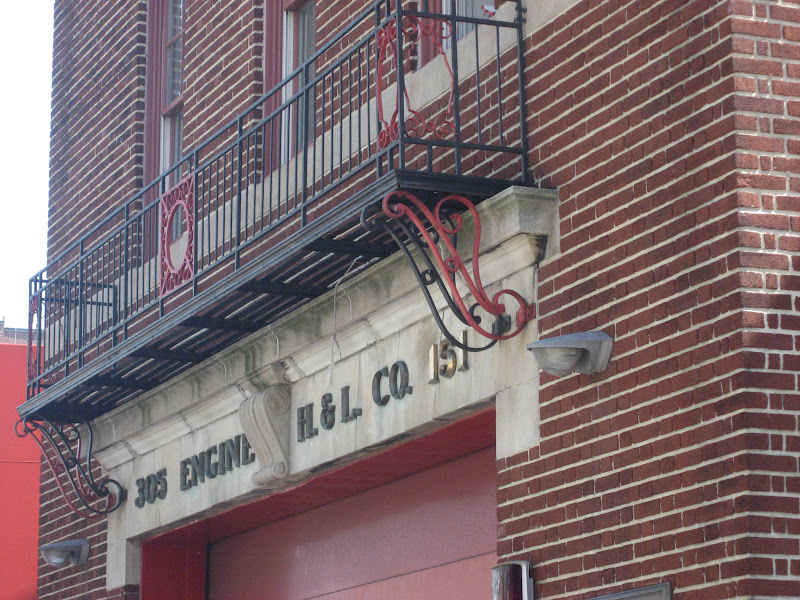
Forest Hills Firehouse Landmark Hearing on May 15th - Please Testify In Support
The NYC Landmarks Preservation Commission will hold a public hearing on Tues, May 15th from 10:30 AM - 10:40 AM at the Municipal Building at 1 Centre St, 9th Floor, NYC. Please either email testimony or testify in person, in favor of Individual Landmark status for Engine Company 305/Hook & Ladder Company 151. This historic firehouse is at 111-02 Queens Boulevard, Forest Hills. Anyone can testify. The firehouse will be public hearing item #5: http://www.nyc.gov/html/lpc/downloads/pdf/calendar/05_15_12.pdf
- Landmarks Preservation Commission Hearing Comments: comments@lpc.nyc.gov
- Director of Intergovernmental Affairs Jenny Fernandez: jfernandez@lpc.nyc.gov
- Chairman Robert Tierney: rtierney@lpc.nyc.gov
- Director of Research Mary Beth Betts: mbetts@lpc.nyc.gov
- Rego-Forest Preservation Council Chairman Michael Perlman: unlockthevault@hotmail.com
For historic information as part of your letter of support, please visit Michael Perlman's feature in the Forest Hills Times/Queens Ledger:
http://www.foresthillstimes.com/view/full_story/18433020/article-Forest-Hills-firehouse-may-become-landmark
Pictured from left to right are
Dan Trabucchi, Lieutenant John Gleave, Henry "Hank" Rider, Anthony
Quinones, and John Cabrera.
|
On April 17, Engine Company 305/Hook & Ladder Company 151 at 111-02 Queens Boulevard was scheduled for a May 15th hearing by the Landmarks Preservation Commission (LPC), offering temporary protection from significant alterations.
The next step is a public hearing, where citizens, preservationists, and elected officials can testify. A public meeting will then follow, when the LPC will announce its decision.
According to Rego-Forest Preservation Council’s Freedom of Information Law request and an LPC visit in 2008, it was determined that the LPC's Survey Department conducted a Community Board 6 Survey in January 1990, comprised of Forest Hills and Rego Park.
The firehouse was one property recommended as a potential landmark, among a few hundred pages referencing other potential individual landmarks and historic districts. However, it is unknown why no designations were pursued at that time.
In recent years, architecturally and culturally significant sites - which offer a one-of-a-kind history - such as Eddie’s Sweet Shop, the Forest Hills Tennis Stadium, the Trylon Theater, and Bank of America (originally Metropolitan Industrial Bank, 99-01 Queens Boulevard), have not been given a public hearing by LPC, although some of those sites have been recommended for landmarking by earlier commission staff members.
Some sites were rejected, despite apparently meeting the LPC’s landmark provisions, based upon a site’s 30-year age requirement and architectural and cultural significance.
Queens residents hope that landmarking the firehouse will signify more designated buildings in Forest Hills and Rego Park at large. In 2000, the façade of the Ridgewood Savings Bank was landmarked, and the Remsen Family Cemetery was landmarked in 1981.
If the firehouse is landmarked, it would be the first Forest Hills property designated under LPC Chairman Robert Tierney's tenure.
LPC Communications Director Lisi de Bourbon would not comment on whether other Forest Hills properties have been surveyed by the commission due to policy issues, but did say, “The proposed designation of Engine Co. 305 is part of a wider effort to preserve New York City’s great municipal architecture.”
Mitchell Grubler, Chair of Queens Preservation Council, explains, “While we applaud the LPC for calendaring a Forest Hills building, this is a poor attempt at LPC recognition of the many deserving, but undesignated areas and buildings in Forest Hills,” said Mitchell Grubler, chair of the Queens Preservation Council.
“This is a case of picking-off the lowest-hanging fruit,” he continued. “It is a city-owned building, with no owner opposition. Landmark designation of city-owned buildings is advisory, since city agencies abide by LPC as a courtesy. This also seems to be somewhat of a thematic calendaring, in that a couple of Bronx firehouses were calendared at the same LPC meeting.”
During a time when the Bloomberg Administration has proposed firehouse closings due to budget cuts, Engine Company 305 has proudly served the community for nearly 90 years.
Built circa 1922-1924 and designed by John R. Sliney, it offers a distinctive and rare Neo-Medieval presence on Queens Boulevard. The firehouse has harmony with nearby Forest Hills Gardens, and its height and ecclesiastical nature is unique in the face of New York City firehouse architecture.
LPC’s statement of significance explains that the firehouse was “intended to serve the growing population of Forest Hills, which had seen a boom in residential construction following WWI.”
It then explains it is “clad in red brick laid in a Flemish bond, and enlivened with decorative limestone details and subtle patterned brickwork. The asymmetrical massing of the building is accentuated by steep gables clad with copper standing-seam roofs, two prominent square towers featuring round-arched window openings, and a slender chimney rising nearly a story above the western elevation.”
“It is exciting to know that the firehouse can be held to landmarking standards,” said FDNY spokesman Jim Long. “If it follows through, we will do everything in cooperation with the landmark guidelines, and adhere to requests and requirements.”
Commitment to the community is abundant. John DePierro is a senior firefighter who has been with Engine Co. 305 since 1969.
“What makes work enjoyable is the great camaraderie,” said firefighter John Cabrera. “This helps when we respond to a fire. There’s no emergency we don’t respond to, and no one has been shooed away from us. Some people knock on our door.
“There’s an officer who received a medal for saving a community resident,” he added. “We received Christmas cards and cakes from the community, and really appreciate their support.”
On September 11, Engine Co. 305 witnessed casualties. Peter Nelson was a senior firefighter who began his career with Engine 305, was transferred to Ladder 151, and then perished at Rescue 4. Joe Hunter worked up to a year at Engine 305, and also perished.
“I thought it was landmarked already,” said Lieutenant John Gleave. “There’s no other firehouse quite like it.”
Twelve-year Forest Hills resident James Griffin is a retired teacher and a volunteer photo archivist of the American Museum of Natural History.
“The firehouse is a noble expression of civic values, and a beautiful building gracing Queens Boulevard,” he said.
"Forest Hills and Rego Park have numerous iconic buildings that contribute greatly to the cultural history of our community,” said Assemblyman Andrew Hevesi. “This well-known structure should be given landmark status, which would preserve its integrity and value for many generations to come.”
Photos courtesy of Michael Perlman: http://www.flickr.com/photos/8095451@N08/sets/72157623132704134
Friday, March 30, 2012
The Tea Garden: A Long-Lost Treasure Meets Controversy
This
is Michael Perlman's feature story on the classic yet abandoned Tea Garden in the Forest Hills Times/Queens Ledger. Will
a century-old Forest Hills Gardens enclave which once hosted weddings,
afternoon teas, plays, and dinners to the sounds of cellos and violins
rise again?
Please
feel free to
post a
comment on the article link, & share it with your friends:
http://www.foresthillstimes.com/view/full_story/18044815/article-The-Tea-Garden--A-Long-Lost-Treasure-Meets-Controversy
Forest Hills Gardens holds a secret awaiting a new lease on life.
The back of the century-old Forest Hills Inn at 1 Station Square is home to a long-lost treasure known as the Tea Garden, of which the majority of Forest Hills is unaware.
Situated on Greenway South behind an ornate gate, a fantasy-like enclave would open in 1912 to the delight of Inn guests and residents. In 1909, Station Square was the center of social life in a planned garden community, with Grosvenor Atterbury as the Gardens’ principal architect, and Frederick Law Olmsted, Jr. as the landscape architect for public spaces and parks.
The Forest Hills Inn’s Tea Garden played host to numerous weddings, performances, and dinner dances, in addition to afternoon tea. Today, it is a shell of its former glory, and is prone to controversy between residents who wish to see it revitalized for social functions versus those who prefer restoring it as a private garden.
The Tea Garden borders the Forest Hills Inn and 20 Continental Ave, both of which are co-ops.
Nature has caused the monumental trees to flourish, but nature also cast a toll on the garden’s decorative features. The cascading fountain and pool has vanished. The “Ring For Tea” stand and rocking chairs, which were replaced with tables and umbrellas, have also vanished.
The central brick fountain is non-operational, the flagstone tiles are faded and cracked, and a gazebo bears rust. Upon first glance is a sad reality, but then the magic of what was and what could be resurrected becomes evident.
It is difficult to grasp how an integral feature could fall into abandonment and disarray, but not entirely surprising. In 1967, the Forest Hills Inn became apartments, which went co-op in the 1980s.
In 1977, it was announced that the U.S. Open would move from the nearby Forest Hills Tennis Stadium to Flushing Meadows Park. And music festivals in Forest Hills reached their peak in the 1960s.
With the change of occupancy of the Forest Hills Inn, and fewer tennis and music celebrities visiting Forest Hills, the Tea Garden was forgotten.
The July 12, 1924, edition of The Forest Hills Bulletin read, “The Tea Garden of the Forest Hills Inn is a veritable fairyland, when lighted with Japanese lanterns, with the trickling fountain heard in the background, and a new moon shining overhead. There is no more delightful place in Greater New York for one to spend the dinner hour.”
During the warmer months, every evening between 6:30 and 9 p.m. a delectable dinner was served, to the music of the Inn Trio, featuring selections such as Dvorak’s “Humoreske” and Albeniz’ “A Night In Seville.”
Ballroom dancing was featured on Saturday evenings, and the Tea Garden also hosted early performances of the Garden Players.
In a circa mid-1950s brochure uncovered in the Forest Hills Inn’s Historic Committee’s archives, the Tea Garden was then referred to as the Patio-Garden, and its glory continued. It offered “a bubbling fountain, candlelight, large umbrellas, and tall trees” with “violin strings in the spring and summer.”
Jade Eatery & Lounge holds a lease at the Forest Hills Inn, and the Tea Garden sits outside their back space.
“Many younger generations asked when the Tea Garden is opening, since they want to hold their weddings here like their ancestors,” explains manager Raymond Taylor. “We also want to hold community events, and allow the Inn and 20 Continental Ave to use the space as a common area. Jade has met some resistance from residents.”
Taylor visualizes “an authentic restoration of the garden, with possible outside funding.”
“If the fountain is approved in the plans, we would be delighted to resurrect such a tranquil piece of history,” he adds.
“Nothing can bring back the gentility of the Tea Garden,” says Martin Levinson, co-chairman of the One Station Square Historical Committee. “Instead of cellos and violins, the current era includes amplified music, liquor served to boisterous patrons, and people screaming on cell phones.”
He feels Jade’s public Tea Garden is “a security risk for those who live in the back of the Inn, since their apartments can be accessed by pranksters via terraces, trellises, air ducts, drain pipes, and roofs.” That said, Levinson does not mind a private garden.
George Hoban, co-chairman of the One Station Square Historical Committee favors re-implementing the Tea Garden, but states, "We need to communicate with our neighbors first, since its future involves them,” he says. “We are in litigation to determine who has use of the Tea Garden, which could be for Jade, our tenants, or both. We’re hopeful we will have all or partial use, since we plan to restore it."
“We are open to grants, and won’t allow work which doesn’t keep its integrity and historic character,” he adds. “Some work would be conducted off-site, to minimize on-site construction and noise. In summer 2011, we cleaned up the Tea Garden for optics purposes.”
An aesthetic and functional restoration can co-exist, with the establishment of bylaws and security measures, to appease Jade’s patrons and residents of the Forest Hills Inn and 20 Continental Ave.
Saturday, March 24, 2012
ABC News: Queens Tennis Club Considers Next Move For The Historic Forest Hills Tennis Stadium
ABC Eyewitness News: This is a piece on the historic Forest Hills Tennis Stadium by reporter Lisa Colagrossi, featuring interviews by Michael Perlman of Rego-Forest Preservation Council, & Councilman Domenic M. Recchia, Jr, Chair of the City Council Finance Committee. It features its status, since proposals are under review for the site, memorabilia, and positions of Rego-Forest Preservation Council & the Councilman, as well as the Stadium Arts Alliance proposal to restore & creatively reuse the stadium year-round: http://abclocal.go.com/story?section=news/local/new_york&id=8592355
Please share this interview with your colleagues and friends. If you know of anyone who could assist the cause, please email unlockthevault@hotmail.com
Saturday, March 17, 2012
Alberto: A Classic Culinary Survivor In A 2012 Economy
This is Michael Perlman's feature story on Alberto, a mom & pop restaurant of Forest Hills, which is surviving in a 2012 economy due to its classic recipe. It also makes a great case of adaptive reuse, since it is rumored to have been Forest Hills' knitting mill in 1928. Please feel free to post a comment on the article link, & share it with your friends:
http://www.queensledger.com/view/full_story/17867340/article-Alberto--a-culinary-survivor-in-a-2012-economy
| Passionate co-owner Silvana Chiappelloni in front of a salvaged stained glass masterpiece |
![]() |
| Alberto echoes Metropolitan Avenue's charming scale & spirit |
Alberto: A Classic Culinary Survivor In A 2012 Economy
In an age of corporate chains that make some New York City neighborhoods
a mirror image of each other and cause some small businesses to close
shop in a harsh economy, Forest Hills retains few old-time mom-and-pop
favorites.
These businesses offer classic style and have
passionate owners who personalize their patrons’ experience. They make a
commitment to community, and embrace longevity and “beauty is in the
detail.”
As the owners of Alberto at 98-31 Metropolitan Avenue,
brother and sister duo Roberto and Silvana Chiappelloni provide those
ingredients in abundance. Alberto offers fine northern Italian cuisine
in an elegant ambiance, befriends its patrons, and adapts to tastes old
and new.
Roberto attended culinary school in Italy and worked in
stages in Italy, Geneva, London, and then aboard the Holland America
Line. He visited a relative in Brooklyn, who encouraged him to open a
restaurant. As a 23 year-old tennis buff, he visited Forest Hills and
had a vision.
Meanwhile, Silvana worked for a golf club in Geneva, where her family ran a famed restaurant.
Alberto
has been in operation since 1975, but began where Da Silvana once sat
on Yellowstone Boulevard. In 1977, it moved to a larger space on
Metropolitan Avenue. Formerly a stark white pizzeria, over the years the
Chiappelloni's went antiquing.
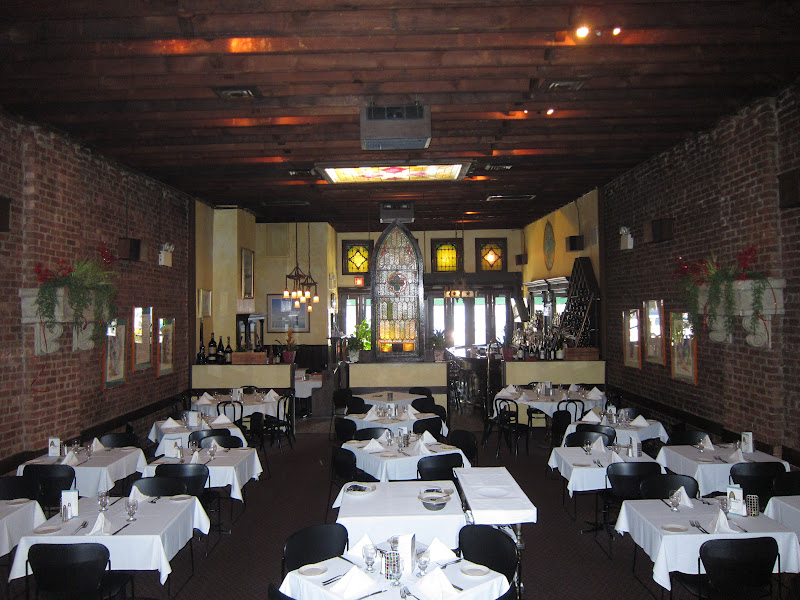
A carved wooden bar took the place of an ice cream counter, and an elegant wood front replaced generic aluminum, and chandeliers rumored to have come from the Criminal Courthouse in Brooklyn were hung from the ceilings. What would later become the Alberto logo is a Gothic stained glass window rescued from a dismantled church.
It is a suspended focal element that separates the front bar area from the spacious table-clothed dining room. Two decades ago, the Chiappellonis exposed rustic brick walls and lifted the dropped ceiling to reveal rare 3x12 wood rafters, most remarkably from the site’s rumored knitting mill days circa 1928.
| Did you expect to enjoy your homemade northern Italian cuisine in a knitting mill? |
![]() |
| Salvaged architectural features from NYC buildings live on at Alberto |
Succeeding
in business is Alberto’s only option. Fortunately, Alberto owns the
real estate, so self-serving landlords who raise the rent is not an
obstacle.
“Competition is the best form of advertising,” says
Silvana. “If you have a great product, people will return. Our clientele
chooses us during the toughest economic times, on the basis of our
quality of food and experience."
“Enormous joy keeps me in
business against the odds,” she continues. “You must love what you do.
We give up all holidays, and spend 12 to 15 hours per day at work. I
want to encourage young people to have passion, which starts with a
dream. There are so many unemployed, so work hard, since it’s great
being your own boss.”
Dedication and passion are part of the Chiappelloni recipe.
“What
drives me is joy and feedback from customers,” explains Silvana. “When I
see beautiful families, it eliminates all negative energy. I have seen
four generations celebrating life. We live in a world where everything
is changing, but if you have a good foundation of family, the new
generation improves, and carries on values, passion, and love.”
Commitment
is evident in authenticity, customization, and variety. Alberto offers
dishes inspired by the Lombardy, Liguarian, and Emilio-Romagna
provinces, with approximately 175 award-winning wines.
Alberto’s clientele is widespread. “When
Alberto first opened in the 1970s, not too many people knew of
Metropolitan Avenue, but now it is ‘restaurant and antiques row,’” says
Silvana. “In the last decade, there’s lots of young people and diverse
ethnic groups, and longtime customers.”
Alberto is popular for
private parties, and 30-plus patrons are accommodated according to their
financial needs. Frequent celebrations are baptisms, baby & bridal
showers, birthdays, and anniversaries. OpenTable reservations are made
online. Birthday card promos and gift certificates are also available.
To
survive in a harsh economy, small businesses always need to take
customer feedback, and create beyond basic business models. Alberto is a
place where soul lives in its food and personality, and is a
cornerstone for generations.
Alberto's hours of operation are
Monday, Wednesday, and Thursday from 5 to 10:30 PM; Friday and
Saturday from 4 to 11:30 PM; and Sunday from 4 to 10:30 PM. For more
information, call (718) 268-7860, visit Albertorestaurant.com, or “like”
their Facebook page.
Sunday, March 11, 2012
Forest Hills Inn's 100th Anniversary Marked By Restoration & Historic Committee
This
is Michael Perlman's feature story on the Forest Hills Inn's 100th anniversary in the Queens Ledger/Forest Hills Times. Please feel free to post a
comment on the link & share it with your friends. Let's take part in
this historic moment:
http:// www.foresthillstimes.com/view/ full_story/17799132/ article-Scaffolds-come-down--re veal-Forest-Hills-history
![]() |
| Circa early 1920s postcard of the Forest Hills Inn towering over Station Square |
| The Inn as of August 2009 amidst scaffolding |
![]() |
| The Inn as of March 2012 |
Scaffolds Come Down & Reveal Forest Hills History
This prominent Forest Hills Gardens tower’s scaffolding and netting, which was erected circa 2004, is now at ground level at Station Square and Greenway South, and the repaired façade can once again be appreciated for its Tudor and Arts & Crafts appeal.
The Forest Hills Inn officially opened on May 1, 1912, making its restoration timely for its 100th anniversary.
Forest Hills Gardens originated in 1909. The Russell Sage Foundation appointed Grosvenor Atterbury as the Gardens’ principal architect, and Frederick Law Olmsted, Jr. as the landscape architect for public spaces and parks.
Inspired by Ebenezer Howard's Garden City Movement of England, this is our country's earliest planned garden community. It is a highly recognized model of urban planning, with Old English mansions tastefully situated on classically named private winding streets with lush landscape.
The board of Forest Hills Inn meets with contractors monthly to plan the restoration. The roof and facades of all three buildings have not been restored for at least the same number of decades, but now repairs on the Inn’s tower are complete.
Terra-cotta roof tiles were falling, and the pebble stucco finish on the façade became porous. This affected the metal structure underneath, allowing water into the apartments. Also weathered were top-floor terraces bearing gargoyles, which serve as drainage features.
“While examining the façades, we kept noticing weathered features, needing restoration,” explains Martin Restituyo, president of the One Station Square, Inc. co-op board. “Our five-year capital improvement plan, estimated at $3.5 million, will soon address all remaining restoration, which encompasses the Inn Apartments (of the Forest Hills Inn), the Raleigh, and the Marlboro. Restorations are funded through shareholder assessments. Unlike the past, we have appropriate plans and funds.”
“Restorations are funded through shareholder assessments,” he adds. “Unlike the past, we have appropriate plans and funds.”
Before Martin Restituyo’s presidency in December 2008, the previous board erected scaffolding around the Inn in 2004, without obtaining Forest Hills Gardens Corporation approval. The board felt it was essential due to emergency repairs, but the Gardens Corporation referenced restrictive covenants that protect the Gardens’ historic character.
By March 2009, the legal dispute between the Forest Hills Gardens Corporation and the Inn’s board was settled, and the tower’s repairs were completed in a year’s time.
Restoration of Station Square is costly, but possible with commitment. Friends of Station Square vice president Suzanne Parker explains the non-profit’s mission. “To protect, beautify, and educate the community about Station Square, Forest Hills, and its environs,” she says.
As a case in point, she cites re-installing a restored lantern to a corner of Burns Street after raising approximately $20,000, but that the majority of the eight remaining lanterns from 1910 are in deterioration. “Friends of Station Square embraced these whimsical icons of the prevailing Arts & Crafts style of the Square as an ongoing project, and continues its fundraising efforts,” notes Parker.
In the Inn’s early years, the Sage Foundation Homes Company distributed an illustrated 25-page prospectus to new residents and guests, establishing why the Inn and the Gardens is unique.
“Forest Hills Inn is a delightful all year round home for the busy man or woman who must spend the day in the city, but appreciates every minute saved for outdoor living and recreation amid wholesome and aesthetic surroundings,” read the brochure.
Station Square was conceived as a town center with the Inn, apartments, connected shops and the train station, which took locals to Penn Station in 13 minutes. The 150-room Inn’s rates were $14 - $18 per week, including meals. References were required. Guests were welcomed to socialize at the Inn’s reception and smoking rooms on a vine-screened loggia overlooking the square. Guests enjoyed dinner overlooking the Greenway and Tea Garden, which hosted weddings. Tennis courts, golf, billiards, and a squash court were other fine amenities.
Before Martin Restituyo’s presidency in December 2008, the previous board erected scaffolding around the Inn in 2004, without obtaining Forest Hills Gardens Corporation approval. The board felt it was essential due to emergency repairs, but the Gardens Corporation referenced restrictive covenants that protect the Gardens’ historic character.
By March 2009, the legal dispute between the Forest Hills Gardens Corporation and the Inn’s board was settled, and the tower’s repairs were completed in a year’s time.
Restoration of Station Square is costly, but possible with commitment. Friends of Station Square vice president Suzanne Parker explains the non-profit’s mission. “To protect, beautify, and educate the community about Station Square, Forest Hills, and its environs,” she says.
As a case in point, she cites re-installing a restored lantern to a corner of Burns Street after raising approximately $20,000, but that the majority of the eight remaining lanterns from 1910 are in deterioration. “Friends of Station Square embraced these whimsical icons of the prevailing Arts & Crafts style of the Square as an ongoing project, and continues its fundraising efforts,” notes Parker.
In the Inn’s early years, the Sage Foundation Homes Company distributed an illustrated 25-page prospectus to new residents and guests, establishing why the Inn and the Gardens is unique.
“Forest Hills Inn is a delightful all year round home for the busy man or woman who must spend the day in the city, but appreciates every minute saved for outdoor living and recreation amid wholesome and aesthetic surroundings,” read the brochure.
Station Square was conceived as a town center with the Inn, apartments, connected shops and the train station, which took locals to Penn Station in 13 minutes. The 150-room Inn’s rates were $14 - $18 per week, including meals. References were required. Guests were welcomed to socialize at the Inn’s reception and smoking rooms on a vine-screened loggia overlooking the square. Guests enjoyed dinner overlooking the Greenway and Tea Garden, which hosted weddings. Tennis courts, golf, billiards, and a squash court were other fine amenities.
The 100th anniversary of the Inn is marked by the board’s establishment of a Historic Committee, co-chaired by Martin Levinson and George Hoban, who is collecting memorabilia for preservation’s sake, while telling a most significant chapter of Forest Hills history.
![]() |
| "The Innside Story" on a super-sized matchbook cover, circa 1950s |
![]() |
| The social heart of Forest Hills! Amazing how the matches were embellished with an artist's touch. |
![]() |
| If we were able to journey back in time, which space(s) should define your day? |
![]() |
| One of many matchbooks from the Forest Hills Inn's hotel days under Knott Management |
| Station Square has a traditional yet renewed sense as the seasons change |
| The banner on the right boasts the Forest Hills Gardens Centennial in 2009, but the Forest Hills Inn opened in 1912. |
![]() |
| Forest Hills train station |
![]() |
| Wide perspective on the Forest Hills train station |
| Fall 2009 photo: Friends of Station Square planned on restoring 1 of 8 Arts & Crafts lanterns designed by Grosvenor Atterbury. |
| View from Greenway Terrace towards the Forest Hills Inn at Station Square, March 2012 |
Subscribe to:
Posts (Atom)