Showing posts with label West Side Tennis Club. Show all posts

Tuesday, June 1, 2021

Greener Horizons at Iconic West Side Tennis Club

By Michael Perlman

Tennis Captain Ed Flamos, tennis legend Virginia Wade, & WSTC President Monika Jain - Ribbon cutting, Photo by Michael Perlman

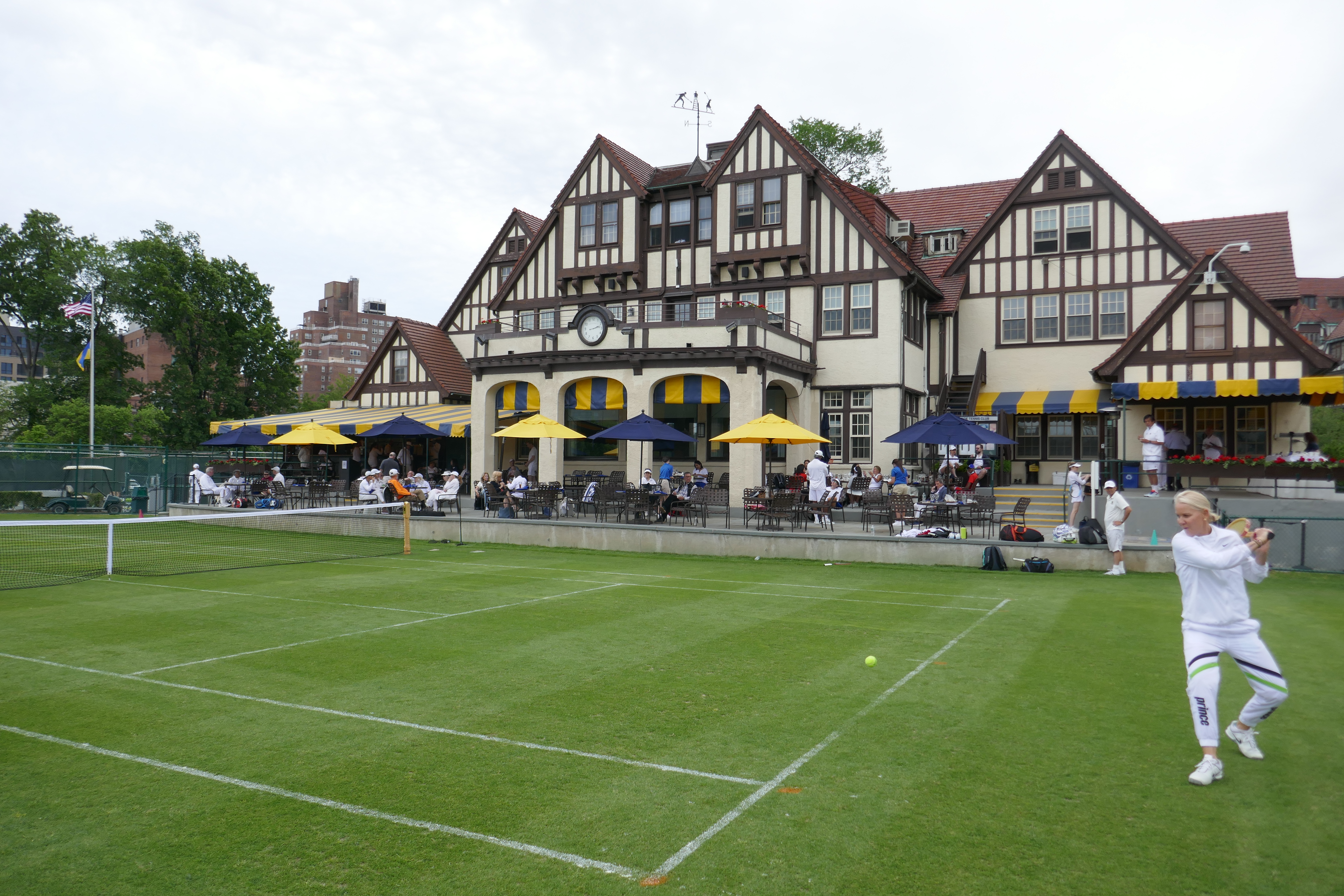
It was history-in-the-making for the West Side Tennis Club on May 28. The sun seemed to shine even brighter, as West Side Tennis Club members and guests were first to play in traditional white attire on the newly resurfaced field of eight state-of-the-art grass courts between a stately Tudor clubhouse (1913) and Forest Hills Stadium, America’s first tennis stadium (1923). This was followed by a patio luncheon overlooking a ribbon-cutting ceremony featuring British number-one Virginia Wade, the first U.S. Open champion in 1968, who is now a NYC resident. It also felt like a rebirth, since events were off limits due to the pandemic.
 
Playing the new grass courts, Photo by Michael Perlman

“I am excited to be part of this amazing event, and I’ve felt so welcomed by every member,” said Jason Weir-Smith, the new director of racquet sports who led the ceremony.

“To have been able to take on successfully a transformational upgrade of our grass courts at this moment in time,” said WSTC President Monika Jain, “is a testament to our Board of Governors, our playing members, and our commitment to our mission.” The Grass Court Committee was chaired by Chip Smith and Sarah Mannion. She credited a team effort in the works for over two years. “We want to offer the best racquet sports experience in New York.”

Tennis legend Virginia Wade, Club CEO Mario DiPreta, Dir of Racquet Sports Jason Weir-Smith, President Monika Jain, Photo by Michael Perlman


Virginia Wade was a guest of honor. “I had a real Déjà Vu watching all these good players out today. I know what good grass is like, and grass technology is so sophisticated these days, and the way that they can produce turf for all sports. It’s so exciting that this club chose to have advice from Wimbledon.” She told attendees, “All you good people, keep hitting the ball in the middle. Make sure that you’re very strict about the courts by the shoes that you wear, since we don’t want to damage these precious courts. One day I will manage to come out here and test it for myself.”

She also explained, “The WSTC lawns will become the envy of every tradition-loving club and player, and for those lucky enough to play on them, it will be a blissful experience.”

A ribbon was held across the net by President Monika Jain and Tennis Captain Ed Flamos, where Wade cut it with what Weir-Smith humorously portrayed as “a small pair of scissors.” That led to a champagne toast.

Celebrating the occasion, Photo by Michael Perlman

After the WSTC relocated from the Bronx to Forest Hills in 1913, grass was laid for seven courts, and by the following August, a Davis Cup match would attract an audience of over 12,000, transforming tennis. The hallowed WSTC grounds were where legends including Bill Tilden, Bobby Riggs, Ken Rosewall, Althea Gibson, Arthur Ashe, Billie Jean King, and Chris Evert made their mark.

Tennis greats Virginia Wade & Rennae Stubbs, Photo by Michael Perlman

In more recent times, the courts were considered past their prime with spongy and bent grass, and its overhaul would follow a decade of success stories with the revitalization of Forest Hills Stadium, two new European-style red clay courts, the renovation of one hard court for pickle ball, the upgrading of three platform tennis courts, and significant membership growth.

After Newport’s International Hall of Fame resurrected its turf venue, it inspired the WSTC leadership to examine its feasibility, which would cost $650,000 and deliver improved playability and consistency. The project was designed by Tom Irwin Advisors, a Massachusetts-based firm under Ian Lacy, the former head of Great Britain’s Institute of Groundsmanship Professional Services. Test pits were dug to evaluate layers of soil, and Lacy and his colleagues recommended a plan to replace the grass, upgrade the irrigation system, enhance the underlying dirt by adding a sand mixture for playability and durability, and regrade the courts. The scientific grass is a modern blend of three varieties of rye, and is now consistent with Wimbledon, the Newport Hall of Fame, and London’s Queens Club. Part of the upgrades were attractive Wimbledon-style wooden tennis posts with brass winder mechanisms and “West Side Tennis Club” etchings, and tennis net center straps.

The West Side Tennis Club etchings on new traditional wooden posts, Photo by Michael Perlman

Rennae Stubbs, 2nd from left, Photo by Michael Perlman

“My favorite surface in the whole world is grass,” said Rennae Stubbs, a legendary Australian tennis player, coach, and Racquet Magazine podcast host who was among the special guests. “It was the first time I ever played here, and it was great to be part of opening the courts for the first time this year. You just have to look around to know you’re in a historic tennis club. It’s nice to have Virginia Wade, such a great champion, to cut the ribbon and enjoy the day with.”

Enjoying the occasion, Photo by Michael Perlman


WSTC members in traditional white, Photo by Michael Perlman

Christian Kilrain Carter Coleman said, “It’s not only a WSTC historical moment, but one in my life, since it is the first time I played on grass. This is my new standard and where it all begins for me.” He continued, “It’s amazing to see Virginia Wade, one of my tennis idols. I remember when she won in 1977 at Wimbledon, when I was just a kid, getting into tennis. It’s also amazing to see Rennae Stubbs, a four-time Grand Slam champion (women’s doubles), and people from Racquet Magazine. Everyone here adds to the equation, and brings together a beautiful tennis community.”

Longtime WSTC member Dr. Juan Reyes said, “The new grass courts are much better, since the ball bounces higher and we can rally and really enjoy it. Before the ball would hardly bounce.” He called it a step in the right direction and a reason for delivering value to the membership. “It is nice to see the old-timers and the younger generations remembering them,” he continued.

WSTC executives alongside tennis legend Virginia Wade, Photo by Michael Perlman

“This is one of the most revered sites, as the first home of the U.S. Open, along with a great history of players such as Billie Jean King and Virginia Wade, who really put women’s tennis on the map,” said Frank Milillo, a pickleball ambassador. “The courts have always been top notch, and it’s exciting to see how well the Club improved it with a new lawn. This is where the sport grew, and now it’s coming back to its roots.”
Rennae Stubbs testing the new grass courts, Photo by Michael Perlman


Thursday, August 22, 2019

A Forest Hills Mystery... "Celebrity Walk"

By Michael Perlman


Every community has forgotten relics which either survive or have been concealed, demolished, or carted away and awaiting rediscovery. The latter is the case with “Celebrity Walk,” a collection of handprints and signatures in cement slabs which existed in the 1960s and 1970s along the perimeters of the lawns in front of one of Forest Hills Gardens’ most historic and storied buildings, the Forest Hills Inn. It evoked the ambiance of Grauman’s Chinese Theatre’s forecourt’s footprints and handprints feature.

“I loved coming up with press-generating ideas, including the creation of a Celebrity Walk in front of the hotel’s sidewalk cafe. Marketing seemed to come easily to me,” said Mark H. Fleischman, former owner of the famed Studio 54 nightclub and author of “Inside Studio 54” which features a memoir of his life. From 1965 to 1968, he co-owned the Forest Hills Inn and served as executive director, although he retained stock in the company that sold to the co-op and rented the restaurants.

Fleischman explained, “It was a real coup when we got Frank Sinatra to put his handprints into a block of wet cement when he headlined the Forest Hills Music Festival at the nearby tennis stadium. As soon as other celebrities heard about Sinatra’s handprints and signature, they agreed to be included in our Celebrity Walk when they performed.”

Other celebrities who followed included Barbra Streisand, Trini Lopez, Woody Allen, and Buddy Hackett. On August 17, 1965, locals picked up the Long Island Star-Journal and read, “The Forest Hills Inn has Frank Sinatra’s and Barbra Streisand’s handprints imbedded on their sidewalk pavement, but it had to get them the hard way. Both stars agreed to make the imprint, but refused to do it at the sidewalk. So wet cement was sent to both stars, the imprints made, and the hardened blocks were then inserted in the pavement.”

The same publication read that on July 8, 1966, Sammy Davis, Jr. was expected at the Forest Hills Inn to place his handprints in the hotel’s “celebrity sidewalk.” Fleischman reminisced, “I was also able to get tennis stars playing for the U.S. Championship to participate in our Celebrity Walk, including Rod Laver, Arthur Ashe, John Newcombe, and my hero from Spain where I attended summer courses at the University of Madrid, Manuel ‘Manolo’ Santana.”

In May 1965, the 300-room Forest Hills Inn and the adjoining apartments were sold for over $1 million to Martin Fleischman, who owned the Skyway Hotels at Kennedy Airport, and his son Mark Fleischman, a 1962 graduate of Cornell University’s School of Hotel Administration. At the time, it offered an English pub, cocktail lounges, a formal dining room known as the Windsor Room, a sidewalk cafe, what was originally named “The Tea Garden,” and four social function rooms accommodating 400 guests. “The Inn was a venerable hotel that looked like an English country manor,” explained Mark Fleischman. A draw was also its location in an upscale community and the proximity to Forest Hills Stadium, but yet it was in foreclosure. “I focused my energies with absolute determination and belief in my ability to revive the Forest Hills Inn, while also still committed to my duties as a Naval officer,” he reminisced.

Fleischman said, “Reviving the Inn involved more than just upgrading the food in the formal restaurant, the Windsor Room, and bringing in a new maître d’. I had to change the stuffy attitude of the staff as well and went head to head with the Hotel/Restaurant Workers’ Union.” He hired some new personnel and transformed the Tournament Grill into the Three Swans, an authentic English pub that became a neighborhood success. At the grand opening, local VIPs and politicians attended, including Mayor John Lindsay.

Some local residents recall the existence of a tunnel with a series of catacombs, which may have connected the inn’s basement to the Clubhouse of the West Side Tennis Club. Rumor has it that a sidewalk construction project led to the relocation of the handprints, which may have been placed in the inn’s basement in a potentially concealed tunnel for safekeeping, possibly in the mid to late 1970s.

“I am unsure what happened to the slabs of cement, and my partner in charge of construction passed away many years ago, so I wouldn't know who to ask,” lamented Fleischman. In 2015 and 2017, a search began to rediscover and potentially resurrect the handprints at a secure location to be determined, to educate the public and commemorate diverse celebrities while celebrating Forest Hills history. A small but ambitious committee ventured into the Forest Hills Inn’s basement with flashlights and camera equipment, but on both occasions, the search yielded no results.

George Hoban, president of the board of the Station Square Inn Apartments Corporation is a member of the committee that began searching for the handprints. “I’ve personally looked through the bowels of the Forest Hills Inn for the infamous handprints and came up empty every time. I’ve never found photographic proof that they actually existed.” At one point, he said, “I’m beginning to think that the handprints may be an urban legend like ‘Bigfoot’ or the ‘Loch Ness Monster.’”

“It was an honor to be invited by this columnist, Michael Perlman, to explore the basement of the Forest Hills Inn to look for the signature and handprint slabs,” said Bea Hunt, co-chair of West Side Tennis Club Archives Council. “We searched every nook of the basement and learned much of the Inn's rich history. Unfortunately, we did not find any slabs, but I am confident that the search will continue. The West Side Tennis Club is extremely fortunate to have one slab in our archive.” It features the signatures and handprints of three famous tennis players from various decades, Jack Kramer, Bill Talbert, and Manolo Santana.

Upon viewing a photo of the sole cement slab that turned up in the West Side Tennis Club’s archives in more recent times, Hoban said, “The fact that Celebrity Walk existed is a testament to the rich history of the Forest Hills Inn, and we proudly honor that history as we continue to restore the Inn.” He is in favor of resurrecting Celebrity Walk in some form, if many slabs resurface. “We would need the approval and support of the Forest Hills Gardens Corporation and Friends of Station Square.” 

An alternate form of this article has been published in Michael Perlman's Forest Hills Times column:  http://foresthillstimes.com/view/full_story/27660871/article-A-Forest-Hills-Mystery--Celebrity-Walk

Thursday, August 30, 2018

A Tribute To 126 Years of Tennis History at the West Side Tennis Club

By Michael Perlman

Dinner on the lawn facing the stately Clubhouse, Photo by Michael Perlman
“Heritage Day” is a newly launched tradition at the West Side Tennis Club (WSTC) in Forest Hills, which follows the success of last year’s Forest Hills Tennis Stadium Party & Sunset Dinner that commemorated 125 years. On August 25, the Club celebrated 126 years of tennis history at an elegant and festive affair on the Tudor Clubhouse’s terrace and posh lawn. 

Past WSTC President James Frangos with Mayor David Dinkins, Photo by Michael Perlman
Highlights included speeches by influential tennis figures including a surprise visit by the first African American NYC Mayor, David Dinkins. They led the unveiling of three banners which mark the 50th anniversary of the first U.S. Open Championships, and are planned to be displayed at Forest Hills Stadium. They read, “West Side Tennis Club – Home of The First U.S. Open, 1968,” “Virginia Wade, First U.S. Open Women’s Singles Champion, 1968, U.S. Open Women’s Doubles Champion 1973, 1975,” and “Arthur Ashe, First U.S. Open Men’s Singles Champion, 1968.” 

Unveiling of banners commemorate US Open's 50th anniversary, Photo by Michael Perlman
Live music then filled the air and guests enjoyed a multi-course dinner buffet and mingled at candlelit tables, complete with tennis balls. Topping off the night was dancing to tracks by a DJ who played everything from today’s pop tunes to Sinatra.

On April 22, 1892, thirteen initial members organized the WSTC and rented ground on Central Park West between 88th and 89th Streets, which was followed by a move to 117th Street between Amsterdam Avenue and Morningside Heights (1902 – 1914) and 238th Street and Broadway (1908 – 1914), prior to acquiring its Forest Hills home from the Russell Sage Foundation at $77,000 in 1913. The Clubhouse was designed by Grosvenor Atterbury, and then ten years later, America’s first tennis stadium, Forest Hills Stadium, was designed by Kenneth Murchison, and gave birth to a number of firsts in tennis history, with the addition of its role in music history as of 1960. 

Todd Martin, Photo by Michael Perlman
Todd Martin, the CEO of the International Tennis Hall of Fame in Newport, RI, earned a Davis Cup title over Russia in 1995, and was a U.S. Open finalist and a no.4 world ranking in 1999. At the podium, he explained, “When the sport became ‘Open,’ it developed a power, and from that came a boon in the growth of the sport. It wasn’t long after the Connors, McEnroe, Borg, Agassi… started to dominate the sport. It was those steps 50 years ago that led to momentous occasions of Virginia Wade winning the first U.S. Open at Forest Hills. It was those bold steps that led to Arthur Ashe winning the first U.S. Open. It represented progress, growth, and power, and is reflected in our society today.” He continued, “Tennis before 1968 was a child, and tennis since 1968 has been in its adolescence. We have a lot of maturing to do as a sport…We have 7 governing bodies fight with each other for property, but have yet to be able to unite.” He then stated, “Be appreciative of what you have. WSTC is a spectacular historic place, and one that will be part of tennis history forever.” 

Donald Dell, Photo by Michael Perlman
Donald Dell, a 1961 quarterfinalist in Forest Hills and the only undefeated Davis Cup captain in American history, is a forerunner in pro tennis who played a major role in founding the Association of Tennis Professionals and represented legends including Arthur Ashe and Jimmy Connors. He explained,”When Arthur Ashe won that match in four sets, ironically it was on the American Davis Cup team assigned to the Davis Cup captain for that year to play, and he was an amateur, and could therefore not accept the prize money. The first prize that year was $14,500, but it went to Tom Okker.” He continued, “Arthur always believed that he was far, far more than a tennis player, and he cared a great deal about humanitarian problems. I took him to South Africa in 1973, and in 1974 he went back and visited Nelson Mandela who was in prison at the time. His spirit, his tenacity, and human values continue to live on.” 

Virginia Wade, Photo by Michael Perlman
Regarded as Great Britain’s tennis legend, Virginia Wade achieved her first Grand Slam title in 1968 at the WSTC, and accepted prize money for the first time. She won two additional Grand Slam singles titles in Australia and at Wimbledon at the time of Queen Elizabeth II’s Silver Jubilee in 1977. When a friend of hers a few days ago questioned her playing for no prize money before 1968, she responded, “We played because the game was amazing, you wanted to win, and you had esteem and glory if you did well, and determination and all those qualities are the same on the court today, except the game is different. 1968 was an amazing transformation from amateur to professional, and they gradually got the women’s prize money up even.” 

Mayor David Dinkins, Photo by Michael Perlman
Mayor David Dinkins, one of tennis’ closest friends and a past USTA director stated, “I am delighted to be here, and I’m happy to see so many friends. Tennis is a wonderful sport, and more and more children are playing these days, and I say it’s making better people because of it.”

Johnnie Ashe, brother of the late Arthur Ashe, Photo by Michael Perlman
Johnnie Ashe is the younger brother of Arthur Ashe, winner of the first U.S. Open Men’s Singles Championship in 1968. The Hall of Famer passed away at 49 from AIDS due to a blood transfusion. J. Ashe is often praised for his selfless decision to take a second tour of duty in Vietnam, so his brother’s tennis career can flourish. He stated, “I would like to thank all of you for keeping the history alive of this hallowed ground. You would be surprised how little today’s players know about this place, and the difference it made to tennis.” He continued, “The U.S. Open gave Arthur the opportunity to transition from athlete to ‘citizen of the world.’” He recalled his brother’s words after he finished playing; “I’m a champion now, and people will listen to me.” He continued, “Tennis was a vehicle to Arthur. A lot of people don’t think of it that way, but look at the number of kids that have gone to college due to a tennis racquet, and a lot of that was due to change agents Donald Dell and Arthur Ashe.” 

Todd Martin, WSTC President Angela Martin, Johnnie Ashe, Donald Dell, Virginia Wade, Photo by Michael Perlman
Virginia Wade with Johnnie Ashe & his family, Photo by Michael Perlman
Guests also felt inspired in various ways. “It’s nice that my children can witness history and see the legends in person,” said CT resident Ben Sturner, the CEO & founder of Leverage Agency. “It was very memorable how Johnnie Ashe discussed the progression of tennis, and how Forest Hills laid the groundwork for everything.”

“WSTC’s preservation of charm and character of its architectural structure is second to none,” said Manhattan resident Mindy Sue Sherry. She continued, “The heartfelt speeches from Mayor Dinkins as well as the family of Mr. Ashe touched everyone’s heart, and unveiling the banners was truly beautiful. I was also struck by the history of the many iconic photos of decades of tennis history within the hallways.”

“This event moved me to tears, since I always knew Forest Hills was special, but it is even more special to people than I realized,” said native resident Helen Fernandez Murphy. “It was amazing to be in the presence of such history, having the opportunity to listen to Johnnie Ashe’s poignant words, particularly about standing in hallowed ground, and Virginia Wade’s discussion about pay parity for women. Most intriguing was that the tournament before 1968 only involved amateurs, and how many sacrifices were made to play for the true love of the game.”

Glenn Gilliam, executive director of Strategic Partnerships for the “Althea” documentary film project, and a former Forest Hills resident, explained, “Being able to share that day, which happened to be Althea Gibson’s birthday, 8/25/1927, with other African Americans like Mayor David N. Dinkins and Arthur’s brother Johnnie Ashe was the most memorable, as we, much like Althea and Arthur, couldn’t have been members back when they won their Championships. Being able to watch that commemorative banner unveiled and share stories with some of the members, most of whom are still mostly white, is a positive sign, but there’s still a lot of work to do and barriers to break.”

Gilliam highly anticipates Heritage Day 2019. “I hope the WSTC will raise a banner to the person who broke the color barrier in tennis and golf, Althea Gibson, which will coincide perfectly with the unveiling of a commemorative statue on the grounds of the USTA Billie Jean King Tennis Center during next year’s U.S. Open.” 


Female guests pose in front of banners, Photo by Michael Perlman
To the dancefloor, Photo by Michael Perlman

A similar version of this story has been published in Michael Perlman's Forest Hills Times column: www.foresthillstimes.com/view/full_story/27595851/article-126-Years-of-Tennis-History-at-WSTC


Wednesday, April 25, 2018

Continued Evolution of Forest Hills Stadium

By Michael Perlman

The eagle-adorned Forest Hills Stadium, Photo by Michael Perlman
Forest Hills Stadium, which became America’s first tennis stadium in 1923, and operated as a restored concert and pro tennis venue since its reopening in 2013, may soon offer year-round opportunities. Madison House Presents, which is about to coordinate another concert season starring a number of legendary artists, has potential plans to introduce diverse attractions including a novelty “Grand Slam Automat” feature, a spinoff of the nostalgic Horn & Hardart Automat branches, which served an average of 800,000 patrons daily at 180 self-service cafeterias throughout New York and Philadelphia, shaping 20th century American dining and culture. 

Grand Slam Automat preliminary rendering, Courtesy of Madison House Presents & Creative Director Bill Sullivan - Note: Current text is only for theme
Winter Wonderland ice skating daytime rendering, Courtesy of Madison House Presents & Creative Director Bill Sullivan

Also part of the vision is to offer ice skating on its hallowed courts, in addition to a Christmas tree with holiday vendors as part of a "winter wonderland” carnival. “We have been dreaming about this general idea for years, and now there are a number of options that we are working on,” said Concert Manager Mike Luba of Madison House Presents, who works closely with Jason Brandt, the stadium’s general manager. “When the concepts are more fully developed, we will present the ideas to the board of the West Side Tennis Club (WSTC), and they will let us know if we have the approval to move forward,” said Luba. 

Winter Wonderland ice skating rendering, Courtesy of Madison House Presents & Creative Director Bill Sullivan  


Since a proposal has yet to be submitted, there are hopes that the vision will materialize in time for next winter. He continued, “As the WSTC has been a great partner on the stadium restoration/renovation, I am hopeful that they will continue to be supportive of ideas which are not only good for the WSTC, but for the neighborhood and Queens.”

Madison House Presents continues to keep the community and visitors on its radar, and expressed much sentiment for a historic stadium. “The stadium and its grounds are magic, pure and simple, and we are always dreaming of events that will hopefully boost the quality of life for those who get to experience them,” said Luba. 

Winter Wonderland carnival rendering, Courtesy of Madison House Presents & Creative Director Bill Sullivan
Forest Hills was once home to smaller scale Horn & Hardart Retail Shops near the stadium at 71-63 Austin Street and 116-63 Queens Boulevard, and the firm’s vice president, Frank Hardart, Jr, resided at 188 Ascan Avenue and 64 Dartmouth Street in Forest Hills Gardens. Marianne Hardart, the great-granddaughter of H&H Automat co-founder Frank Hardart, keeps the Automat’s history alive and emphasized much pride. “People always ask me about bringing back the Automat, as it held a special place in their heart and our country’s history, and it sounds like Forest Hills Stadium’s installation of Automat windows would be a beautiful tribute.” 

Horn & Hardart Retail Shop, 71-63 Austin St, Forest Hills, Courtesy of John W. Romas Collection

Courtesy of Michael Perlman & Rego-Forest Preservation Council

Horn & Hardart Automat at 1557 Broadway, 1st branch in NYC which opened in 1912 - Now Grand Slam, Courtesy of Michael Perlman & Rego-Forest Preservation Council

Marianne Hardart also explained how the H&H Automat was a forerunner from its architecture to affordability of delicious fresh food. “Those little windows sparked the imagination of diners of all ages and introduced a new way of generations of Americans by getting a handful of nickels from a thrower and then going to the windows to pick your food. It was an adventure especially for children, and was also a place that tore down barriers based on class, gender, or race, as it welcomed everyone.” 

Forest Hills Stadium Creative Director Bill Sullivan poses with his book, "Forest Hills" in front of the WSTC Clubhouse, Photo by Michael Perlman, August 2018

Bill Sullivan is an artist who serves as Forest Hills Stadium Creative Director. He has designed logos, media material, and most recognizably, colorful portrait heads and plaques celebrating the stadium’s role in tennis and music that can be found along the stadium arcade’s colonnade. In commemoration of the WSTC’s 125th anniversary in 2017, he produced banners which bear homage to historic achievements. He even authored the book “Forest Hills,” which features a large collection of his re-imagined photos that capture the evolution of tennis viewed through its players and its impact on architecture, art, and fashion. 

Architect Kenneth MacKenzie Murchison, the famed public buildings architect who designed Forest Hills Stadium, Courtesy of Murchison's descendants

Sullivan praised Stadium architect and past WSTC member Kenneth Murchison as a Renaissance man. “Murchison had a theatrical vision with a pageantry to celebrate the tennis match, and created a planned experience. Every year it changed into a slightly new form, and my book is about the element of change within the stadium’s horseshoe.”

One of the well-known Art Deco locations on 6th Ave & W 57th St in the 1930s - Now demolished, Postcard courtesy of Michael Perlman & Rego-Forest Preservation Council

Sullivan patronized one of the last Automats on West 57th Street. Looking forward, he said, “We are trying to integrate the quality and streamlined aesthetics of a very American experience, and offering a new way to serve around 10,000 people.” Concertgoers could “pick, swipe, and take” hot and cold sandwiches from the Grand Slam Automat’s compartments. The Tilden, named after tennis player Bill Tilden, could offer a Philly cheesesteak, and The Connolly, as in tennis player “Little Mo” Maureen Connolly, could serve grilled chicken. “It would have clocks with four time zones for the Grand Slam; Australian Open, French Open, Wimbledon, US Open,” said Sullivan.
The vision does not end there. “A new scoreboard would celebrate tennis and music’s past,” said Sullivan. Some upcoming concerts include Robert Plant & The Sensational Space Shifters on June 13, Roger Daltrey performs The Who’s “Tommy” with The New York Pops on June 17, Boy George & Culture Club on July 28, and David Byrne on September 15. The expansive lineup continues with the first-ever food festival, “The Infatuation’s EEEEEATSCON” on October 6, and New York radio station WFUV creating an on-site experience within a dedicated space, the “FUV Clubhouse,” to broadcast select shows live on air. The complete lineup which includes comedy is at www.foresthillsstadium.com At the public’s request, plans continue with new gender-inclusive permanent restrooms on its main concourse, which will minimize wait time for a more enjoyable concert experience.

Sullivan called Jason Brandt a chess master of today’s space, and explained, “Jason often talks about ‘creating discoverable experiences,’ and we always want people to think there’s something new and interesting around the corner in Forest Hills. We are the caretakers of this cathedral of American tennis and music, which is unlike any place in the world, but there was a lost past at Forest Hills Stadium. Now people are rediscovering how the stadium and its grounds were built.”

Dadras Architects, a firm led by partners Robert Dadras and Victor Dadras, who founded the Downtown Revitalization Group, which specializes in historic preservation, urban design, and adaptive reuse, is well-acquainted with Forest Hills, and also expressed much enthusiasm for the stadium’s future. “The idea of bringing back an Automat is innovative, and I also suggest events for the diverse audiences that live in Forest Hills would be very much appreciated,” said Robert Dadras. He referenced the stadium and Forest Hills as superb examples of urban planning and architecture accomplished correctly. “Anything that can help preserve and restore Kenneth Murchison’s iconic structure would be a positive thing, since it stands as a rare example in today’s world of what can be achieved if folks collaborate to produce a quality place to live, work, and play.” 

Forest Hills Tennis Stadium as America's Tennis Stadium in Ad, The Technology Review November 1922, Courtesy of  Michael Perlman

A similar version appears in Michael Perlman's Forest Hills Times column: www.foresthillstimes.com/view/full_story/27564281/article-The-Continued-Evolution-of-Forest-Hills-Stadium

Friday, September 30, 2016

Forest Hills Tennis Archive, Library, & Maybe A Museum?


Reminiscing & Building Tennis History in Forest Hills


by Michael Perlman, Historian, Preservationist, Author

The stately Tudor style Clubhouse
Forest Hills Tennis Stadium: First in America
Significant achievements in recent West Side Tennis Club (WSTC) history include the comeback of world-class concerts in 2013 and pro tennis in 2016, and now the club is considering the development of a public tennis library and archive, and perhaps a museum on the property.

On August 27, 2016, the historic clubhouse became the grounds of a seminar and dinner, where national and international members of Tennis Collectors of America (TCA) and WSTC members gathered to help shape the future of the club. A day earlier, the club hosted a tennis antiques trade show.


Vintage tennis publications on display
The TCA, a non-profit, was founded in 2003 to promote tennis collecting and tennis history through the TCA website, published media, and an annual meeting at varying locations throughout America. The seminar was attended by WSTC members. It featured a WSTC history slide show by 45-year member and chair of the archives committee member Bea Hunt, plans for the tennis history library by Alan Edelman, and memories of the US Open among tournaments by panelists Linna Hunt, Nancy Crabill, Ray Fitzmartin, and Jim Sheridan, and moderator Jack Leibler (past WSTC president). Edelman and B. Hunt both joined TCA last year. 


Memories committee panelists: Linna Hunt, Nancy Crabill, Ray Fitzmartin, Jack Leibler, Jim Sheridan
TCA & WSTC members gather
The WSTC was founded in 1892 on Manhattan’s West Side, and leased land at Central Park West and 89th Street, Amsterdam Avenue and 117th Street, and Broadway and 238th Street before calling Forest Hills home in 1913 and developing America’s first tennis stadium in 1923. Bea Hunt explained, “Originally, there were 13 charter members, who organized our club as a men’s tennis club, but that same year, we held our first club championship for men and women. By the end of our first season, we had 5 tennis courts and 43 members.”


Forest Hills Tennis Stadium as "America's Tennis Stadium" - MIT's The Technology Review, November 1922
Today, Forest Hills offers a stately Tudor clubhouse designed by Grosvenor Atterbury, but attendees were hard-pressed to learn that the first clubhouse was a shanty with cold showers. Hunt emphasized how far the club has come, and said, “In 124 years, Angela Martin is our first woman president, but I am disappointed to say that we didn’t have one earlier.” Throughout its history, numerous pivotal moments included the Wightman Cup featuring the first international team match for women on the stadium’s opening day, breaking racial color barriers when Althea Gibson became the first African American to win a US national tennis title in 1957, and the birth of the US Open, where Billie Jean King played the first “open” match in 1968.


Alan S Edelman addressing his audience 
Baltimore resident Alan Edelman is much of an inspiration to the WSTC and largely a reason for their expansion plans, as well as WSTC member James Wilson. Nearly two years ago, Edelman was seeking a New York venue to play tennis, visited the WSTC, and met Wilson. He reminisced, “One of the first things I was told, which was shocking, was that West Side doesn’t have much of an archive. I consider this the most important tennis institution in the United States, and I really couldn’t believe they wanted my collectibles.” That consisted of over 500 magazines featuring WSTC history from 1953 until the late 1980s.


Time capsule: WSTC tin   
The site of pivotal moments!
Wilson suggested that they create a public archive extending beyond the club’s membership. Edelman said, “It became apparent that most institutions don’t have archives. If we can accumulate an encyclopedic history of all of tennis, it will be a very important thing for the tennis world.”


Bea Hunt with Alan S Edelman
Part of the archive will document members’ memories. During the US Open, Nancy Crabill escorted players to center court from 1975 to 1977 and carried male player racquets, which she called glamorous, but there was one time she escorted female players. She said, “Jimmy Connors approached me and asked if I was going to escort Chris Evert onto court. He asked if I would give her a message (although they were not together then), and said to tell her that I love her and wish her luck.”

During the US Open, Linna Hunt once sold tennis merchandise in the pro shop under the stadium and distributed passes to tennis players. She recalled her experience with Patricio Cornejo, a Chilean tennis player who made it to the men's doubles finals in 1974. “On the day of the tournament, his favorite racquet was still being strung and he told me to please bring it out, even if the game was starting. I was shy in front of an audience, but ran out, gave him his racquet and got a standing ovation. That was the high point in my tennis life.”

Jim Sheridan, now an honorary member and consultant to the club, has been a familiar face at the WSTC for 52 years. In 2014, he was presented with a plaque in recognition of his dedicated service as assistant through head groundskeeper, which was built on the legacy of his father Owen Sheridan, who began tending the grounds in 1932. Sheridan reminisced The Beatles concert in 1964, when they landed in a helicopter. “No one thought about the wind screen, and it blew the fences down,” he said. Fans throwing jelly beans at Ringo was a common sight. “There was grass at that time at the stadium, and jelly beans were stuck in the grass for some time since it rained.”

Ray Fitzmartin worked the US Open for nearly 50 years, officiating various matches and tournaments. “As an umpire in Forest Hills, we had to show up at 9 AM every day. If the match ran 3 hours, you had to stay that long with no bathroom breaks. You had to wear a blazer and a long sleeve shirt and tie, no matter what the weather was.” In contrast to the US Open in Flushing Meadows, he said, “Here the atmosphere was warm, and players would ask if they could join you for lunch or dinner.”


Jim Sheridan signing "Legendary Locals of Forest Hills & Rego Park" by Michael H Perlman for TCA President Becky Desmond
WSTC Foundation President Roland Meier addressing the dinner party
After the seminar, TCA members further expressed their support for an archive. President Becky Desmond, a founding member who resides in Downingtown, PA, has been teaching tennis since 1967. One of her earliest collectibles took a creative spin, when she acquired a tennis motif button depicting two Edwardian ladies on each side of the net with a dog, and transformed it into a ring while maintaining its integrity.

Desmond said, “I look forward in seeing how the TCA can help the WSTC, and it’s wonderful that this venture will take place on the historic site and memorabilia will not be locked up in a closet somewhere.” She may even donate her 1970s era personal photos of Chris Evert and Jimmy Connors walking the grounds, and another of Connors and Ilie Năstase cleaning the lines on court after the rain.


Michael Perlman & Jeanne Cherry: Two authors come together
Santa Monica, CA resident Jeanne Cherry, another TCA founder, is the author of “Tennis Antiques & Collectibles.” “I searched for books on tennis memorabilia, but after finding none, decided to write the first book on this topic,” she said. Her tennis collection consists of everything from trophies and paintings to letters to and from players and greater than 600 racquets. Eyeing the future, she said, “I am writing a pictorial biography of Helen Wills, who won the women’s singles national championships at Forest Hills seven times in the 1920s and 1930s, and I will be glad to donate a copy.”


Archives committee chair Bea Hunt, WSTC President Angela Martin, WSTC Foundation President Roland Meier, TCA President Becky Desmond, Photo by Michael Perlman


Caitlyn & Elise Carpenter host WSTC trivia
At the dinner, the youngest attendees were two sisters, 11-year-old Caitlyn and 10-year-old Elise Carpenter of Mamaroneck, who have been playing tennis for 7 years and volunteered to become speakers for 2 rounds of WSTC tennis history trivia. “If you bring forward a sport, you need to preserve its origins, so you can learn from it,” said Caitlyn. Elise then added, “I thought it was really cool how they got everyone to put out their antiques for others to see.” Both sisters expressed interest in becoming TCA members someday by saying “yes” with a smile.


Step into the future of the WSTC, beginning with the Clubhouse's Hall of Fame

Tennis memorabilia display
WSTC Certificate of Subscription toward the Stadium, July 20, 1923


1931 & 1923 Lawn Tennis magazines 
1935 & 1968 tennis publications


WSTC Centennial plate, 1892 - 1992