Saturday, March 17, 2012

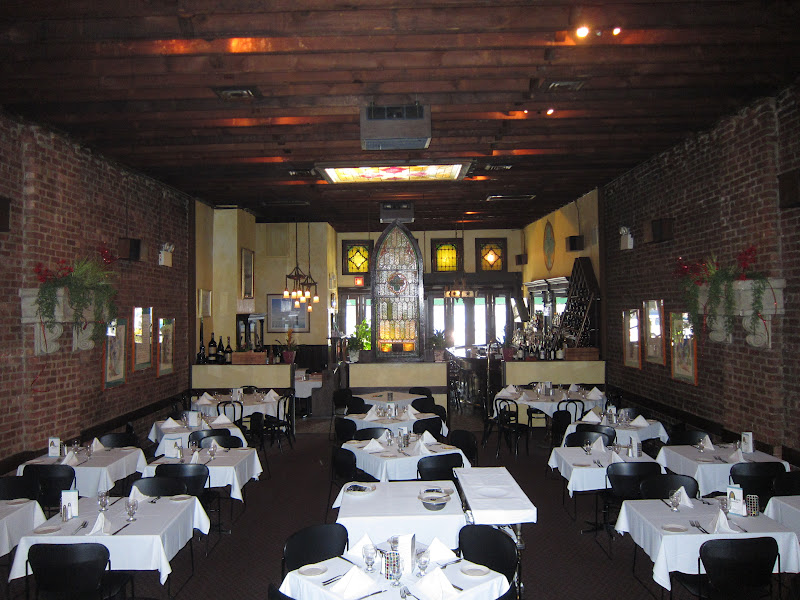
Alberto: A Classic Culinary Survivor In A 2012 Economy

This is Michael Perlman's feature story on Alberto, a mom & pop restaurant of Forest Hills, which is surviving in a 2012 economy due to its classic recipe. It also makes a great case of adaptive reuse, since it is rumored to have been Forest Hills' knitting mill in 1928. Please feel free to post a comment on the article link, & share it with your friends:
 http://www.queensledger.com/view/full_story/17867340/article-Alberto--a-culinary-survivor-in-a-2012-economy
Passionate co-owner Silvana Chiappelloni in front of a salvaged stained glass masterpiece
Alberto echoes Metropolitan Avenue's charming scale & spirit
 Alberto: A Classic Culinary Survivor In A 2012 Economy
In an age of corporate chains that make some New York City neighborhoods a mirror image of each other and cause some small businesses to close shop in a harsh economy, Forest Hills retains few old-time mom-and-pop favorites.

These businesses offer classic style and have passionate owners who personalize their patrons’ experience. They make a commitment to community, and embrace longevity and “beauty is in the detail.”

As the owners of Alberto at 98-31 Metropolitan Avenue, brother and sister duo Roberto and Silvana Chiappelloni provide those ingredients in abundance. Alberto offers fine northern Italian cuisine in an elegant ambiance, befriends its patrons, and adapts to tastes old and new.

Roberto attended culinary school in Italy and worked in stages in Italy, Geneva, London, and then aboard the Holland America Line. He visited a relative in Brooklyn, who encouraged him to open a restaurant. As a 23 year-old tennis buff, he visited Forest Hills and had a vision.

Meanwhile, Silvana worked for a golf club in Geneva, where her family ran a famed restaurant.

Alberto has been in operation since 1975, but began where Da Silvana once sat on Yellowstone Boulevard. In 1977, it moved to a larger space on Metropolitan Avenue. Formerly a stark white pizzeria, over the years the Chiappelloni's went antiquing.
A carved wooden bar took the place of an ice cream counter, and an elegant wood front replaced generic aluminum, and chandeliers rumored to have come from the Criminal Courthouse in Brooklyn were hung from the ceilings. What would later become the Alberto logo is a Gothic stained glass window rescued from a dismantled church.
It is a suspended focal element that separates the front bar area from the spacious table-clothed dining room. Two decades ago, the Chiappellonis exposed rustic brick walls and lifted the dropped ceiling to reveal rare 3x12 wood rafters, most remarkably from the site’s rumored knitting mill days circa 1928.
Did you expect to enjoy your homemade northern Italian cuisine in a knitting mill?
Salvaged architectural features from NYC buildings live on at Alberto
Succeeding in business is Alberto’s only option. Fortunately, Alberto owns the real estate, so self-serving landlords who raise the rent is not an obstacle.

“Competition is the best form of advertising,” says Silvana. “If you have a great product, people will return. Our clientele chooses us during the toughest economic times, on the basis of our quality of food and experience."
“Enormous joy keeps me in business against the odds,” she continues. “You must love what you do. We give up all holidays, and spend 12 to 15 hours per day at work. I want to encourage young people to have passion, which starts with a dream. There are so many unemployed, so work hard, since it’s great being your own boss.”

Dedication and passion are part of the Chiappelloni recipe.

“What drives me is joy and feedback from customers,” explains Silvana. “When I see beautiful families, it eliminates all negative energy. I have seen four generations celebrating life. We live in a world where everything is changing, but if you have a good foundation of family, the new generation improves, and carries on values, passion, and love.”

Commitment is evident in authenticity, customization, and variety. Alberto offers dishes inspired by the Lombardy, Liguarian, and Emilio-Romagna provinces, with approximately 175 award-winning wines.

Alberto’s clientele is widespread. “When Alberto first opened in the 1970s, not too many people knew of Metropolitan Avenue, but now it is ‘restaurant and antiques row,’” says Silvana. “In the last decade, there’s lots of young people and diverse ethnic groups, and longtime customers.”

Alberto is popular for private parties, and 30-plus patrons are accommodated according to their financial needs. Frequent celebrations are baptisms, baby & bridal showers, birthdays, and anniversaries. OpenTable reservations are made online. Birthday card promos and gift certificates are also available.

To survive in a harsh economy, small businesses always need to take customer feedback, and create beyond basic business models. Alberto is a place where soul lives in its food and personality, and is a cornerstone for generations.

Alberto's hours of operation are Monday, Wednesday, and Thursday from 5 to 10:30 PM; Friday and Saturday from 4 to 11:30 PM; and Sunday from 4 to 10:30 PM. For more information, call (718) 268-7860, visit Albertorestaurant.com, or “like” their Facebook page.

Sunday, March 11, 2012

Forest Hills Inn's 100th Anniversary Marked By Restoration & Historic Committee

This is Michael Perlman's feature story on the Forest Hills Inn's 100th anniversary in the Queens Ledger/Forest Hills Times. Please feel free to post a comment on the link & share it with your friends. Let's take part in this historic moment:
 
http://www.foresthillstimes.com/view/full_story/17799132/article-Scaffolds-come-down--reveal-Forest-Hills-history
Circa early 1920s postcard of the Forest Hills Inn towering over Station Square
The Inn as of August 2009 amidst scaffolding
The Inn as of March 2012
Scaffolds Come Down & Reveal Forest Hills History
Passersby and residents of the historic Forest Hills Inn at 1 Station Square can see the light of day, and even more so in the near future with planned restorations of adjacent buildings.

This prominent Forest Hills Gardens tower’s scaffolding and netting, which was erected circa 2004, is now at ground level at Station Square and Greenway South, and the repaired façade can once again be appreciated for its Tudor and Arts & Crafts appeal.

The Forest Hills Inn officially opened on May 1, 1912, making its restoration timely for its 100th anniversary.

Forest Hills Gardens originated in 1909. The Russell Sage Foundation appointed Grosvenor Atterbury as the Gardens’ principal architect, and Frederick Law Olmsted, Jr. as the landscape architect for public spaces and parks.

Inspired by Ebenezer Howard's Garden City Movement of England, this is our country's earliest planned garden community. It is a highly recognized model of urban planning, with Old English mansions tastefully situated on classically named private winding streets with lush landscape.

The board of Forest Hills Inn meets with contractors monthly to plan the restoration. The roof and facades of all three buildings have not been restored for at least the same number of decades, but now repairs on the Inn’s tower are complete.

Terra-cotta roof tiles were falling, and the pebble stucco finish on the façade became porous. This affected the metal structure underneath, allowing water into the apartments. Also weathered were top-floor terraces bearing gargoyles, which serve as drainage features.

“While examining the façades, we kept noticing weathered features, needing restoration,” explains Martin Restituyo, president of the One Station Square, Inc. co-op board. “Our five-year capital improvement plan, estimated at $3.5 million, will soon address all remaining restoration, which encompasses the Inn Apartments (of the Forest Hills Inn), the Raleigh, and the Marlboro. Restorations are funded through shareholder assessments. Unlike the past, we have appropriate plans and funds.”
 

“Restorations are funded through shareholder assessments,” he adds. “Unlike the past, we have appropriate plans and funds.”

Before Martin Restituyo’s presidency in December 2008, the previous board erected scaffolding around the Inn in 2004, without obtaining Forest Hills Gardens Corporation approval. The board felt it was essential due to emergency repairs, but the Gardens Corporation referenced restrictive covenants that protect the Gardens’ historic character.

By March 2009, the legal dispute between the Forest Hills Gardens Corporation and the Inn’s board was settled, and the tower’s repairs were completed in a year’s time.

Restoration of Station Square is costly, but possible with commitment. Friends of Station Square vice president Suzanne Parker explains the non-profit’s mission. “To protect, beautify, and educate the community about Station Square, Forest Hills, and its environs,” she says.

As a case in point, she cites re-installing a restored lantern to a corner of Burns Street after raising approximately $20,000, but that the majority of the eight remaining lanterns from 1910 are in deterioration. “Friends of Station Square embraced these whimsical icons of the prevailing Arts & Crafts style of the Square as an ongoing project, and continues its fundraising efforts,” notes Parker.

In the Inn’s early years, the Sage Foundation Homes Company distributed an illustrated 25-page prospectus to new residents and guests, establishing why the Inn and the Gardens is unique.

“Forest Hills Inn is a delightful all year round home for the busy man or woman who must spend the day in the city, but appreciates every minute saved for outdoor living and recreation amid wholesome and aesthetic surroundings,” read the brochure.

Station Square was conceived as a town center with the Inn, apartments, connected shops and the train station, which took locals to Penn Station in 13 minutes.
The 150-room Inn’s rates were $14 - $18 per week, including meals. References were required. Guests were welcomed to socialize at the Inn’s reception and smoking rooms on a vine-screened loggia overlooking the square. Guests enjoyed dinner overlooking the Greenway and Tea Garden, which hosted weddings. Tennis courts, golf, billiards, and a squash court were other fine amenities.

The 100th anniversary of the Inn is marked by the board’s establishment of a Historic Committee, co-chaired by Martin Levinson and George Hoban, who is collecting memorabilia for preservation’s sake, while telling a most significant chapter of Forest Hills history.

"The Innside Story" on a super-sized matchbook cover, circa 1950s
The social heart of Forest Hills! Amazing how the matches were embellished with an artist's touch.
If we were able to journey back in time, which space(s) should define your day?
One of the earliest postcards depicting the Forest Hills Inn circa 1912. Note the long-vanished fountain in the center of Station Square, which has been replaced not long after with a center island with traffic control booths & a landscaped sitting area.

One of many matchbooks from the Forest Hills Inn's hotel days under Knott Management
The July 4, 1919 carnival poster in front of the Forest Hills LIRR train station. Two years earlier, President Theodore Roosevelt delivered his famed Unification Speech atop the station steps to the crowds at Station Square.
Station Square has a traditional yet renewed sense as the seasons change
The banner on the right boasts the Forest Hills Gardens Centennial in 2009, but the Forest Hills Inn opened in 1912.

Forest Hills train station
Wide perspective on the Forest Hills train station

Fall 2009 photo: Friends of Station Square planned on restoring 1 of 8 Arts & Crafts lanterns designed by Grosvenor Atterbury. 
March 2012 photo: Friends of Station Square succeeded in restoring 1 of 8 Arts & Crafts lanterns designed by Grosvenor Atterbury. This marks a case study of "steep" commitment towards the restoration & beautification of Station Square.

View from Greenway Terrace towards the Forest Hills Inn at Station Square, March 2012

Friday, March 2, 2012

Restoring Civic Virtue


Michael Perlman's feature story in the Queens Ledger/Forest Hills Times on March 1, 2012. Please share & consider commenting on the Queens Ledger website: 


http://queensledger.com/view/full_story/17821254/article-Restoring-Civic-Virtue


Civic Virtue, west of Queens Borough Hall at Queens Blvd & Union Turnpike

Civic Virtue at its original home of City Hall Park, NYC circa 1930

Art is open to interpretation, and an artist's vision is bound for misinterpretation.

It a shame how the true meaning of Civic Virtue – the statue that stands near Borough Hall - is frequently misinterpreted and devalued in political discourse.

At a February 2011 press conference, ex-Congressman Anthony Weiner proclaimed this work of public art “sexist.” He called for a public work to be privatized and removed, posted it for sale on Craigslist, and explained that if it cannot be removed, it needs to be concealed with a tarp. Since then, an influx of art defenders and preservationists have emerged.

Situated on the boundary of Forest Hills and Kew Gardens on Queens Boulevard, Civic Virtue has been keeping an eye on passersby since 1941. The classically designed 22-foot, stone-and-marble sculpture has a commanding presence in a serene setting amidst urbanization.

Civic Virtue was designed in 1920 by renowned sculptor Frederick William MacMonnies, and sculpted by the Piccirilli Brothers. Frederick MacMonnies was the last major American Beaux Art sculptor, and was the first American to win a Gold Medal at the Paris Salon.

He also designed other famous works across America and Europe, including Nathan Hale in City Hall Park, Truth and Beauty outside the 42nd Street Library, and three statuary groupings on the Soldiers and Sailors Arch in Grand Army Plaza.

Civic Virtue depicts a muscular nude Hercules with a sword in his right hand behind his neck, and stands over (but not on top of) two mermaid-like sirens depicting vice and corruption.

Controversy ensued since Civic Virtue’s origins. In 1922, Civic Virtue watched park-goers and elected officials as it stood centrally in Manhattan’s City Hall Park. Shortly after, because some people felt it disrespected women, it earned the nicknames “Tough Guy” and “Fat Boy.”

In January 1941, Robert Moses announced a contract of $21,720 for the statue's transport, and on May 29, 1941, the 24-ton statue was placed in a wooden container, meticulously packed with sand and attached to a 35-ton crane. At 2 mph, it made its cross-town parade on a 16-wheeled haulage truck with stout timbers to Kew Gardens in a four-hour commute. 

On May 31, 1941, Mayor Fiorello LaGuardia, who famously hated the fountain because its naked backside could be viewed from his office, said “Oh, it’s gone at last. Now I won’t have to look at that virtuous back anymore.” Alongside Queens Borough Hall, Civic Virtue would once again be in a landscaped setting, but not “turn its back” on government.
 
   On October 7, 1941, City Council President Newbold Morris presented Civic Virtue to Borough President George Harvey, who advocated for its rescue. He said, “For 12 years, Queens has really had civic virtue, but has never been able to prove it. We can, now!” There were 50 invited guests including Adolph Weimann and A.F. Brinkerhoff of the National Sculptors Society, as well as 200 onlookers who cheered.

Civic Virtue has not been maintained for decades; with an inoperable fountain, a weathered sculpture, and cracked steps. On September 7, 2011, as chairman of Rego-Forest Preservation Council, I nominated Civic Virtue for the State & National Register of Historic Places, so the statue can be commemorated and eligible for funding incentives, to help restore this public masterpiec
e.

On December 13, 2011, it was determined “National Register-Eligible” by Specialist Daniel McEneny of the New York State Historic Preservation Office. The next step is for the city to endorse the eligibility statement.
 

On February 6, 2012, Queens BP Helen Marshall held a budget hearing at Queens Borough Hall. Architect Glenn Urbanas of Richmond Hill, testified at the hearing. He suggested “a modest sum which might be as little as $25,000 - $30,000 to be allocated in next year’s budget, so Request For Proposals can be prepared for accredited stone conservators, who can provide a detailed scope of work including estimates of materials, labor, and procedures for a phased project of cleaning, conservation, and restoration.” Marshall said she found it very disturbing that the statue degrades women. After Urbanas’ presentation, he explained its allegorical nature. “Marshall seemed to have softened her resistance towards conserving the sculpture,” said Urbanas.
 

Mary Ann Carey, district manager of Community Board 9, also testified, and since then, Marshall has expressed interest in meeting with the board. “We have a work of art that’s crumbling and corroding due to pigeon droppings and the elements,” Carey said. “If it was in Italy, Civic Virtue would be a revered statue. We want it cleaned and conserved.”

On February 7, 2012, NYC Parks Department Commissioner Adrian Benepe explained “We have expressed our support to improve and restore the Civic Virtue statue. We suggest working with potential donors to find the funding for any necessary restoration to this monument.”

We must not let our cornerstones fall by the wayside by abandoning them for decades. Preserving existing infrastructure should be addressed before new development.

We should embrace and cultivate our art and architecture, which establishes who we are as a community and nation, and inspires more creative works in contrast to some modern lackluster developments. Restoration will also promote walking tours and tourism, since Queens is often underrepresented.

Let’s incorporate public art and preservation into our school curriculum, and take inspiration from historic sites. Considering the extent of politicians ousted from public office in recent years, New York City needs more civic virtue, not less. 


Wednesday, February 22, 2012

Richmond Hill Video Narrative By The Late Great Nancy Cataldi, & The Absent Landmarks Preservation Commission - We Need A Richmond Hill Historic District ASAP!


Our Beloved Nancy Cataldi
This is a historic Richmond Hill narrative by the late great Historian Nancy Cataldi in 2007. She was a friend of mine and a very dedicated community leader. It was very sad and shocking when she passed away in 2008 in her mid 50s. Nancy Cataldi was the founder and president of the Richmond Hill Historical Society, and a resident of the neighborhood. Her walking tour narrative is a primary source, and now stands as a great tribute to her remarkable legacy. 


* Michael Perlman's Memoir of Nancy Cataldi, A Community Leader We Can All Take Inspiration From, Nov 2009: http://regoforestpreservation.blogspot.com/2009/11/memoir-of-historian-nancy-cataldi.html

What May Be No More Without City & Continued Community Intervention
March 12, 2006 Rally of Queens residents, preservation, & civic organizations coming together on the steps of the Richmond Hill Republican Club, to call upon the Landmarks Preservation Commission to designate a Richmond Hill Historic District. Historian Nancy Cataldi stands in the front center, wearing a black jacket, & Councilman Tony Avella is to her right.
 It is disturbing that our NYC Landmarks Preservation Commission has ignored the community & the Richmond Hill Historical Society's numerous requests for a Historic District, & they will not grant a public hearing since the society's first proposal in 1997, numerous letters from Queenswide preservationists and elected officials, petitions, and rallies. The LPC even visited the wrong series of blocks at one point. They claim the proposed Historic District is too altered. 
 On the contrary, a Victorian mecca is rare in Queens, and much of its historic integrity remains. This fine assemblage of homes also includes Italianate and Craftsman homes. Besides homes, the neighborhood is home to the Church of The Resurrection, the Andrew Carnegie-funded Richmond Hill Library, the Richmond Hill Republican Club, and the RKO Keith's Richmond Hill Theatre. Sadly, the early 1920s Jahn's Ice Cream Parlor shuttered in 2008, to be gutted for a generic fast food restaurant, which has since closed up. This is the Richmond Hill Historical Society's Historic District proposal with boundary lines: http://www.richmondhillhistory.org/district.html
  Where is our Democracy? No public hearing at the Landmarks Preservation Commission? Rather than seeing our Queen Anne gems demolished for the sake of Richmond Hill, the NYC Landmarks Preservation Commission needs to be restructured from the bottom up. They typically turn their back on garden communities, such as many found in Queens, with the exception of a Jackson Heights Historic District and Sunnyside Gardens Historic District. 
As time does not stand still, it is quite possible that a few of the Victorian homes showcased in Nancy Cataldi's 2007 video are not standing today, and will continue to fall without Historic District designation, which would be an asset to our quality of life, character, history and art, education, and property values. The downzoning that went into effect a number of years ago is not solid enough to preserve architectural character and the physical cultural history, but only limits the stories and size of new construction.
When a district in Manhattan gets calendared, heard, and designated every other week, and not the same in a borough outside Manhattan, that is a double-standard of our city government. It is a failure of public duty. Our city should pursue a Historic District in the name of the great Nancy Cataldi and her tireless efforts, and on the basis of Richmond Hill's outstanding architectural and cultural history. 
How You Can Help
*** To advocate for the preservation of Richmond Hill and learn more about its influential history, please visit the website of the Richmond Hill Historical Society. Their mission is Preserving the past & promoting the future of Richmond Hill, NY: http://www.richmondhillhistory.org

Friday, February 17, 2012

Tale of 2 Libraries: Rego Park Edition


We are proud to feature an intriguing chapter of our neighborhood history by Historian Ron Marzlock....

Queens Chronicle, I Have Often Walked, "(Unintended) Book Burning"
Feb 16, 2012

The Rego Park Library at 91-34 63 Drive, left, with The Tavern on its right, and the expanded library, which grew after a fire at the bar. The library itself burned down years later.

Today’s Rego Park Library is not the same one that was first built, but sits right across the street from the original.

With the big buildup of apartment houses in the 1940s and 1950s, Rego Park found its schools overcrowded, and even worse, it had only a storefront library, established in 1938, according to Queens Library records. Then in 1956, the community got a branch library, located at 91-34 63rd Drive between Austin Street and the Long Island Rail Road tracks.

Directly next to the library was a bar named The Tavern. In 1960, after a fire at the bar, its second in several years, the library expanded into the space it had occupied. The branch had a very high circulation rate, and was managed by Aldona Grabuskas, who later transferred to the Richmond Hill Library to be closer to home. She passed away while still on the job. a few weeks before her 50th anniversary with the library.

But the 1959 fire wasn’t the only one to hit the short block on the east side of 63rd between Austin and the LIRR trestle, and to impact the library’s history. A bigger blaze engulfed the entire strip of storefronts, including the library on Feb. 20, 1972, destroying it. It was a major disaster for school children who depended on the facility, long before the age of the computer and Internet.

After a time with only a bookmobile serving Rego Park, the city bought the Shell gas station across the street, a mainstay of the neighborhood since the 1930s, and erected a new library in its place. The old location is now home to the Shalimar Diner. The library underwent major renovations in 1989, and remains a branch with high circulation figures.

Friday, February 10, 2012

One-Stop Lunch By A Choo-Choo in Rego Park - The Hamburger Train!

Click to view full size image
 ============== 
Queens Blvd Storefront
The front of the Hamburger Train restaurant. Probably one of the most 
recognizable store fronts in Rego Park, right by the 63rd Drive subway.
Polished stainless steel slanted front in the Art Deco style, with a red & black terrazzo checkered floor. Peeking inside, one can see a large Hamburger Train animated sign , booths along the left, & a traditional counter on the right, where patrons were served hamburgers & other favorites on a toy train. Photo courtesy of http://hamburgertrain.com

Who remembers eating at the Hamburger Train in Rego Park, and being served your meal from a mechanical toy train which operated on tracks from the kitchen to the counter? The ambiance was Art Moderne, and patrons sat elbow to elbow at a counter or at a booth. Some of you are too young or too new to the neighborhood to be offered this experience, but in a virtual world, you can hop aboard the Hamburger Train in spirit: http://hamburgertrain.com

The website boasts the Hamburger Train as A NYC legendary luncheonette experience from the late 1950s through the early 1970s...the Hamburger Train. The website was conceived by the son of one of one of the original owners, Stephen Robert Lewis, in order to pay tribute to his legacy in a novelty family business. Hamburger Train was at 96-58 Queens Blvd, which today is the Photosonic custom framing shop near the subway entrance on the south side of Queens Blvd, 5 doors to the east of Ben's Best Deli; another famed institution which lines Queens Blvd since 1947.  Another location of the Hamburger Train was in Greenwich Village.


Click to view full size image
 ============== 
Where the cargo was loaded!
Feeding the masses, the train picks up it's delicious cargo hot off the 
grill. This is where it all happened! :-)
The spot where history was made! The train tracks by the grill sure accounts for fast food! Craving crisp French fries at $.30? Image courtesy of http://hamburgertrain.com


Those were the days when "fast food" was fast but less commercialized. I have been in Forest Hills ever since I opened my eyes (1982), so it is before my time, but as someone who grew up in the neighborhood & takes pride in history, it's always fascinating to hear who has memories of yesteryear, which are very much alive today. 


Click to view full size image
 ============== 
The Menu
The Rego Park menu. Egg Cream... 20 cents! Anyone remember that?
Today, ordering a few meals from this menu wouldn't break your budget. Does The Train Beefburger & a treat from the Ice Cream Parlor Car fancy your appetite? Image courtesy of http://hamburgertrain.com


In Forest Hills, an eatery which operated under the train delivery concept existed as Hamburger Express, is now the Austin House Diner at 72-04 Austin St, which has the same red terrazzo floors today. This outside of the box concept, coupled with the ice cream soda fountains & counters in pharmacies, made Forest Hills & Rego Park a more close-knit, creative, & personalized neighborhood in our heyday. Soda fountains existed at Sutton Hall Pharmacy on Austin St & Ascan Ave (Sutton Hall Apts), the Midway Pharmacy on the north side of Queens Blvd & 67th Dr corner, Woolworth's on Continental Ave & Austin St (2 entrances) as well as Queens Blvd & 63rd Dr, and at McCrory's at Queens Blvd & 63rd Dr (2 entrances).


Getting back to the Hamburger Train, anyone interested in reopening this intriguing eatery in Rego Park, and entertaining children of a new generation? E-mail unlockthevault@hotmail.com

Thursday, February 2, 2012

Forest Hills Tennis Stadium Has Local To National Merit - Stadium Determined Eligible For State & National Register of Historic Places

 
Extra! Extra! Op-Ed by Michael Perlman, featured in the Queens Ledger on Feb 2, 2012. Please share & consider commenting here: Queens Ledger newspaper link


Golden potential at America's first concrete tennis stadium, Photo by Michael Perlman

 The legendary Forest Hills Tennis Stadium was almost sold for development, but now it is steps closer to being preserved.

On January 5, 2012, the Forest Hills Tennis Stadium and Clubhouse, and other historic features of the West Side Tennis Club property has been declared "NR-Eligible," or eligible for inclusion on the State & National Register of Historic Places by State Historic Preservation Office Specialist Daniel McEneny.

As Chairman of Rego-Forest Preservation Council, I nominated the property in summer 2011 on behalf of our membership, and a vast coalition of preservation, civic, tennis and music enthusiasts from the local to national level.

If the WSTC signs off on this opportunity, the office can move forward, and the property can be placed on the State & National Register of Historic Places. Besides commemoration, the Register would open the door to economic incentives for restoration and historically sensitive upgrades.

In addition, the New York Landmarks Conservancy non-profit, which is accredited as one of the largest preservation grant awardees, has a number of funding programs that a property may be eligible for upon placement on the Register. This would benefit the WSTC and a potential preservation-friendly partner.

Backtracking, a string of promising events has transpired since the stadium's endangerment in summer 2010. In October 2010, a plan to sell the stadium parcel to developer Cord Meyer to build “Anytown USA” condos was rejected by more than half of the voting-eligible WSTC members, and President Kenneth Parker expressed his disappointment.

On January 1, 2012, President Roland Meier took the seat of Kenneth Parker. President Meier has not made his views publicly known, but is believed to be pro-preservation. A case in point was when Cord Meyer Development proposed condos, and Roland Meier resigned in protest from his seat as Tennis Committee Chair in August 2010.

In November 2011, it was announced that the Stadium Arts Alliance non-profit envisions partnering with the WSTC, and restoring and revitalizing the stadium for tennis matches, periodic musical acts, and ice hockey and skating in the winter, to make the venue usable year-round for the WSTC and greater community.

The Forest Hills Tennis Stadium witnessed a series of firsts architecturally, culturally, and socially. It was the first concrete stadium in the U.S., and was designed by a foremost architect of public buildings, Kenneth Murchison.

It was also the first home of the US Open, and a plethora of tennis legends including Don Budge, Bill Tilden, Helen Jacobs, Tony Trabert, Billie Jean King, Arthur Ashe, and Althea Gibson, played there. Forest Hills Music Festivals featured the likes of Frank Sinatra, The Beatles, and Barbra Streisand. The stadium put Forest Hills on the map.

Creative reuse would signify an educational, cultural and economic boost community-wide. It would improve our quality of life, preserve a historic site, increase business in Forest Hills, and create jobs at and near the stadium, while improving finances for the club in the long term. However, selling the stadium for the highest offer would be a one-time cash generator for WSTC.

No development in place of the Forest Hills Tennis Stadium can ever equal or exceed its value. Fading photos of the stadium which grace the walls of the clubhouse could never measure up to preserving the Real McCoy. How many times have we seen tribute plaques in place of historic sites which could have still been standing proudly? Do we wish to be remembered as a society that revitalized a world icon, or one that operated under a throwaway culture mentality, which destroyed it along the lines of the late great Pennsylvania Station?