Showing posts with label Clubhouse. Show all posts

Tuesday, June 1, 2021

Greener Horizons at Iconic West Side Tennis Club

By Michael Perlman

Tennis Captain Ed Flamos, tennis legend Virginia Wade, & WSTC President Monika Jain - Ribbon cutting, Photo by Michael Perlman

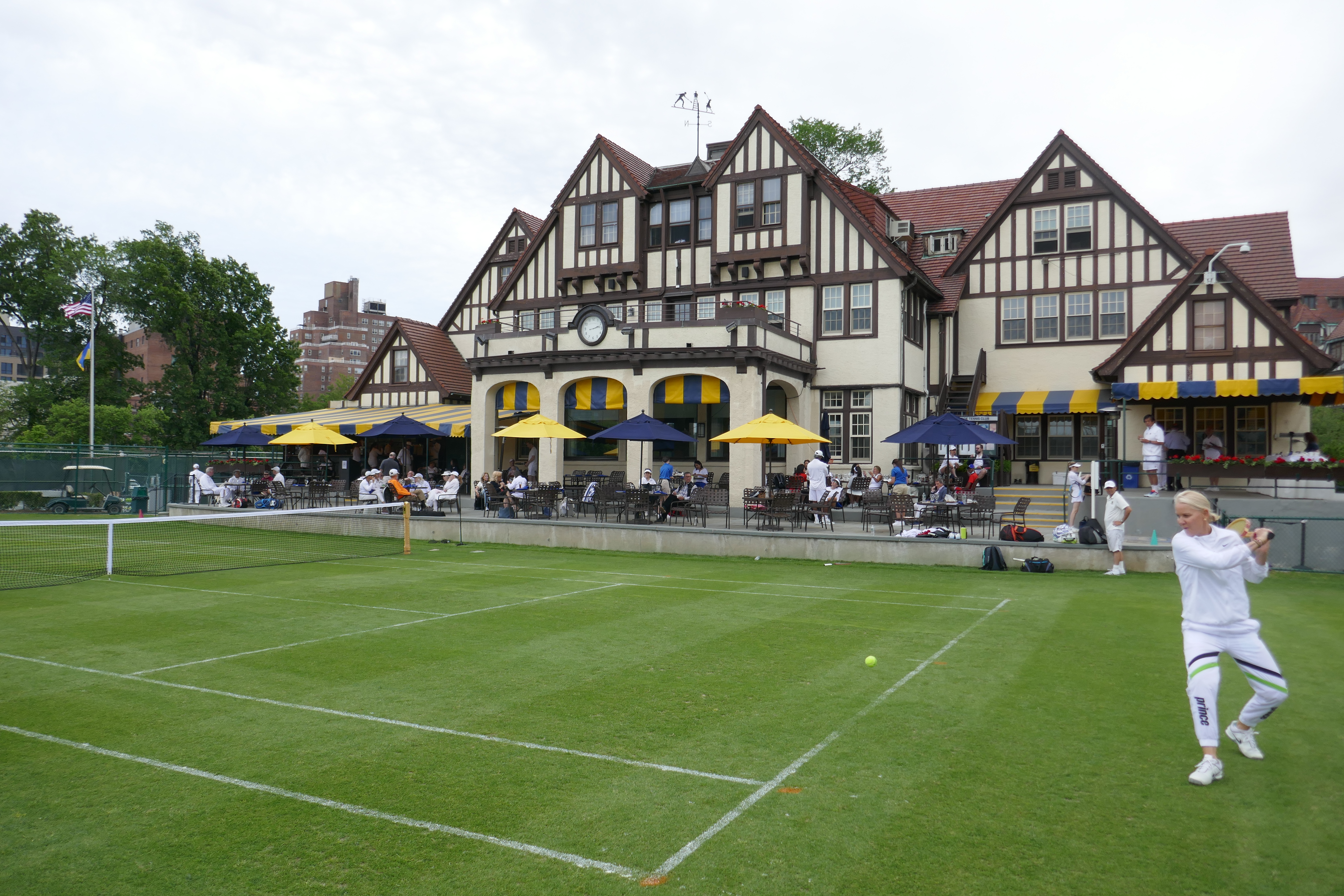
It was history-in-the-making for the West Side Tennis Club on May 28. The sun seemed to shine even brighter, as West Side Tennis Club members and guests were first to play in traditional white attire on the newly resurfaced field of eight state-of-the-art grass courts between a stately Tudor clubhouse (1913) and Forest Hills Stadium, America’s first tennis stadium (1923). This was followed by a patio luncheon overlooking a ribbon-cutting ceremony featuring British number-one Virginia Wade, the first U.S. Open champion in 1968, who is now a NYC resident. It also felt like a rebirth, since events were off limits due to the pandemic.
 
Playing the new grass courts, Photo by Michael Perlman

“I am excited to be part of this amazing event, and I’ve felt so welcomed by every member,” said Jason Weir-Smith, the new director of racquet sports who led the ceremony.

“To have been able to take on successfully a transformational upgrade of our grass courts at this moment in time,” said WSTC President Monika Jain, “is a testament to our Board of Governors, our playing members, and our commitment to our mission.” The Grass Court Committee was chaired by Chip Smith and Sarah Mannion. She credited a team effort in the works for over two years. “We want to offer the best racquet sports experience in New York.”

Tennis legend Virginia Wade, Club CEO Mario DiPreta, Dir of Racquet Sports Jason Weir-Smith, President Monika Jain, Photo by Michael Perlman


Virginia Wade was a guest of honor. “I had a real Déjà Vu watching all these good players out today. I know what good grass is like, and grass technology is so sophisticated these days, and the way that they can produce turf for all sports. It’s so exciting that this club chose to have advice from Wimbledon.” She told attendees, “All you good people, keep hitting the ball in the middle. Make sure that you’re very strict about the courts by the shoes that you wear, since we don’t want to damage these precious courts. One day I will manage to come out here and test it for myself.”

She also explained, “The WSTC lawns will become the envy of every tradition-loving club and player, and for those lucky enough to play on them, it will be a blissful experience.”

A ribbon was held across the net by President Monika Jain and Tennis Captain Ed Flamos, where Wade cut it with what Weir-Smith humorously portrayed as “a small pair of scissors.” That led to a champagne toast.

Celebrating the occasion, Photo by Michael Perlman

After the WSTC relocated from the Bronx to Forest Hills in 1913, grass was laid for seven courts, and by the following August, a Davis Cup match would attract an audience of over 12,000, transforming tennis. The hallowed WSTC grounds were where legends including Bill Tilden, Bobby Riggs, Ken Rosewall, Althea Gibson, Arthur Ashe, Billie Jean King, and Chris Evert made their mark.

Tennis greats Virginia Wade & Rennae Stubbs, Photo by Michael Perlman

In more recent times, the courts were considered past their prime with spongy and bent grass, and its overhaul would follow a decade of success stories with the revitalization of Forest Hills Stadium, two new European-style red clay courts, the renovation of one hard court for pickle ball, the upgrading of three platform tennis courts, and significant membership growth.

After Newport’s International Hall of Fame resurrected its turf venue, it inspired the WSTC leadership to examine its feasibility, which would cost $650,000 and deliver improved playability and consistency. The project was designed by Tom Irwin Advisors, a Massachusetts-based firm under Ian Lacy, the former head of Great Britain’s Institute of Groundsmanship Professional Services. Test pits were dug to evaluate layers of soil, and Lacy and his colleagues recommended a plan to replace the grass, upgrade the irrigation system, enhance the underlying dirt by adding a sand mixture for playability and durability, and regrade the courts. The scientific grass is a modern blend of three varieties of rye, and is now consistent with Wimbledon, the Newport Hall of Fame, and London’s Queens Club. Part of the upgrades were attractive Wimbledon-style wooden tennis posts with brass winder mechanisms and “West Side Tennis Club” etchings, and tennis net center straps.

The West Side Tennis Club etchings on new traditional wooden posts, Photo by Michael Perlman

Rennae Stubbs, 2nd from left, Photo by Michael Perlman

“My favorite surface in the whole world is grass,” said Rennae Stubbs, a legendary Australian tennis player, coach, and Racquet Magazine podcast host who was among the special guests. “It was the first time I ever played here, and it was great to be part of opening the courts for the first time this year. You just have to look around to know you’re in a historic tennis club. It’s nice to have Virginia Wade, such a great champion, to cut the ribbon and enjoy the day with.”

Enjoying the occasion, Photo by Michael Perlman


WSTC members in traditional white, Photo by Michael Perlman

Christian Kilrain Carter Coleman said, “It’s not only a WSTC historical moment, but one in my life, since it is the first time I played on grass. This is my new standard and where it all begins for me.” He continued, “It’s amazing to see Virginia Wade, one of my tennis idols. I remember when she won in 1977 at Wimbledon, when I was just a kid, getting into tennis. It’s also amazing to see Rennae Stubbs, a four-time Grand Slam champion (women’s doubles), and people from Racquet Magazine. Everyone here adds to the equation, and brings together a beautiful tennis community.”

Longtime WSTC member Dr. Juan Reyes said, “The new grass courts are much better, since the ball bounces higher and we can rally and really enjoy it. Before the ball would hardly bounce.” He called it a step in the right direction and a reason for delivering value to the membership. “It is nice to see the old-timers and the younger generations remembering them,” he continued.

WSTC executives alongside tennis legend Virginia Wade, Photo by Michael Perlman

“This is one of the most revered sites, as the first home of the U.S. Open, along with a great history of players such as Billie Jean King and Virginia Wade, who really put women’s tennis on the map,” said Frank Milillo, a pickleball ambassador. “The courts have always been top notch, and it’s exciting to see how well the Club improved it with a new lawn. This is where the sport grew, and now it’s coming back to its roots.”
Rennae Stubbs testing the new grass courts, Photo by Michael Perlman


Thursday, August 30, 2018

A Tribute To 126 Years of Tennis History at the West Side Tennis Club

By Michael Perlman

Dinner on the lawn facing the stately Clubhouse, Photo by Michael Perlman
“Heritage Day” is a newly launched tradition at the West Side Tennis Club (WSTC) in Forest Hills, which follows the success of last year’s Forest Hills Tennis Stadium Party & Sunset Dinner that commemorated 125 years. On August 25, the Club celebrated 126 years of tennis history at an elegant and festive affair on the Tudor Clubhouse’s terrace and posh lawn. 

Past WSTC President James Frangos with Mayor David Dinkins, Photo by Michael Perlman
Highlights included speeches by influential tennis figures including a surprise visit by the first African American NYC Mayor, David Dinkins. They led the unveiling of three banners which mark the 50th anniversary of the first U.S. Open Championships, and are planned to be displayed at Forest Hills Stadium. They read, “West Side Tennis Club – Home of The First U.S. Open, 1968,” “Virginia Wade, First U.S. Open Women’s Singles Champion, 1968, U.S. Open Women’s Doubles Champion 1973, 1975,” and “Arthur Ashe, First U.S. Open Men’s Singles Champion, 1968.” 

Unveiling of banners commemorate US Open's 50th anniversary, Photo by Michael Perlman
Live music then filled the air and guests enjoyed a multi-course dinner buffet and mingled at candlelit tables, complete with tennis balls. Topping off the night was dancing to tracks by a DJ who played everything from today’s pop tunes to Sinatra.

On April 22, 1892, thirteen initial members organized the WSTC and rented ground on Central Park West between 88th and 89th Streets, which was followed by a move to 117th Street between Amsterdam Avenue and Morningside Heights (1902 – 1914) and 238th Street and Broadway (1908 – 1914), prior to acquiring its Forest Hills home from the Russell Sage Foundation at $77,000 in 1913. The Clubhouse was designed by Grosvenor Atterbury, and then ten years later, America’s first tennis stadium, Forest Hills Stadium, was designed by Kenneth Murchison, and gave birth to a number of firsts in tennis history, with the addition of its role in music history as of 1960. 

Todd Martin, Photo by Michael Perlman
Todd Martin, the CEO of the International Tennis Hall of Fame in Newport, RI, earned a Davis Cup title over Russia in 1995, and was a U.S. Open finalist and a no.4 world ranking in 1999. At the podium, he explained, “When the sport became ‘Open,’ it developed a power, and from that came a boon in the growth of the sport. It wasn’t long after the Connors, McEnroe, Borg, Agassi… started to dominate the sport. It was those steps 50 years ago that led to momentous occasions of Virginia Wade winning the first U.S. Open at Forest Hills. It was those bold steps that led to Arthur Ashe winning the first U.S. Open. It represented progress, growth, and power, and is reflected in our society today.” He continued, “Tennis before 1968 was a child, and tennis since 1968 has been in its adolescence. We have a lot of maturing to do as a sport…We have 7 governing bodies fight with each other for property, but have yet to be able to unite.” He then stated, “Be appreciative of what you have. WSTC is a spectacular historic place, and one that will be part of tennis history forever.” 

Donald Dell, Photo by Michael Perlman
Donald Dell, a 1961 quarterfinalist in Forest Hills and the only undefeated Davis Cup captain in American history, is a forerunner in pro tennis who played a major role in founding the Association of Tennis Professionals and represented legends including Arthur Ashe and Jimmy Connors. He explained,”When Arthur Ashe won that match in four sets, ironically it was on the American Davis Cup team assigned to the Davis Cup captain for that year to play, and he was an amateur, and could therefore not accept the prize money. The first prize that year was $14,500, but it went to Tom Okker.” He continued, “Arthur always believed that he was far, far more than a tennis player, and he cared a great deal about humanitarian problems. I took him to South Africa in 1973, and in 1974 he went back and visited Nelson Mandela who was in prison at the time. His spirit, his tenacity, and human values continue to live on.” 

Virginia Wade, Photo by Michael Perlman
Regarded as Great Britain’s tennis legend, Virginia Wade achieved her first Grand Slam title in 1968 at the WSTC, and accepted prize money for the first time. She won two additional Grand Slam singles titles in Australia and at Wimbledon at the time of Queen Elizabeth II’s Silver Jubilee in 1977. When a friend of hers a few days ago questioned her playing for no prize money before 1968, she responded, “We played because the game was amazing, you wanted to win, and you had esteem and glory if you did well, and determination and all those qualities are the same on the court today, except the game is different. 1968 was an amazing transformation from amateur to professional, and they gradually got the women’s prize money up even.” 

Mayor David Dinkins, Photo by Michael Perlman
Mayor David Dinkins, one of tennis’ closest friends and a past USTA director stated, “I am delighted to be here, and I’m happy to see so many friends. Tennis is a wonderful sport, and more and more children are playing these days, and I say it’s making better people because of it.”

Johnnie Ashe, brother of the late Arthur Ashe, Photo by Michael Perlman
Johnnie Ashe is the younger brother of Arthur Ashe, winner of the first U.S. Open Men’s Singles Championship in 1968. The Hall of Famer passed away at 49 from AIDS due to a blood transfusion. J. Ashe is often praised for his selfless decision to take a second tour of duty in Vietnam, so his brother’s tennis career can flourish. He stated, “I would like to thank all of you for keeping the history alive of this hallowed ground. You would be surprised how little today’s players know about this place, and the difference it made to tennis.” He continued, “The U.S. Open gave Arthur the opportunity to transition from athlete to ‘citizen of the world.’” He recalled his brother’s words after he finished playing; “I’m a champion now, and people will listen to me.” He continued, “Tennis was a vehicle to Arthur. A lot of people don’t think of it that way, but look at the number of kids that have gone to college due to a tennis racquet, and a lot of that was due to change agents Donald Dell and Arthur Ashe.” 

Todd Martin, WSTC President Angela Martin, Johnnie Ashe, Donald Dell, Virginia Wade, Photo by Michael Perlman
Virginia Wade with Johnnie Ashe & his family, Photo by Michael Perlman
Guests also felt inspired in various ways. “It’s nice that my children can witness history and see the legends in person,” said CT resident Ben Sturner, the CEO & founder of Leverage Agency. “It was very memorable how Johnnie Ashe discussed the progression of tennis, and how Forest Hills laid the groundwork for everything.”

“WSTC’s preservation of charm and character of its architectural structure is second to none,” said Manhattan resident Mindy Sue Sherry. She continued, “The heartfelt speeches from Mayor Dinkins as well as the family of Mr. Ashe touched everyone’s heart, and unveiling the banners was truly beautiful. I was also struck by the history of the many iconic photos of decades of tennis history within the hallways.”

“This event moved me to tears, since I always knew Forest Hills was special, but it is even more special to people than I realized,” said native resident Helen Fernandez Murphy. “It was amazing to be in the presence of such history, having the opportunity to listen to Johnnie Ashe’s poignant words, particularly about standing in hallowed ground, and Virginia Wade’s discussion about pay parity for women. Most intriguing was that the tournament before 1968 only involved amateurs, and how many sacrifices were made to play for the true love of the game.”

Glenn Gilliam, executive director of Strategic Partnerships for the “Althea” documentary film project, and a former Forest Hills resident, explained, “Being able to share that day, which happened to be Althea Gibson’s birthday, 8/25/1927, with other African Americans like Mayor David N. Dinkins and Arthur’s brother Johnnie Ashe was the most memorable, as we, much like Althea and Arthur, couldn’t have been members back when they won their Championships. Being able to watch that commemorative banner unveiled and share stories with some of the members, most of whom are still mostly white, is a positive sign, but there’s still a lot of work to do and barriers to break.”

Gilliam highly anticipates Heritage Day 2019. “I hope the WSTC will raise a banner to the person who broke the color barrier in tennis and golf, Althea Gibson, which will coincide perfectly with the unveiling of a commemorative statue on the grounds of the USTA Billie Jean King Tennis Center during next year’s U.S. Open.” 


Female guests pose in front of banners, Photo by Michael Perlman
To the dancefloor, Photo by Michael Perlman

A similar version of this story has been published in Michael Perlman's Forest Hills Times column: www.foresthillstimes.com/view/full_story/27595851/article-126-Years-of-Tennis-History-at-WSTC