Thursday, February 20, 2014

Richard Haas’ Mosaic Masterpiece on Queens Boulevard Turns 25


Richard Haas' mosaic mural, Photo by Michael Perlman, Rego-Forest Preservation Council


Queens Boulevard has shops, buildings, roadways, and a few public works of art… if you look carefully enough. This year marks the 25th anniversary of a mosaic mural designed by the famed architectural muralist, Richard Haas.  

The mural adorns the curved façade of TD Bank at 108-36 Queens Boulevard in Forest Hills. It showcases America’s earliest planned garden community, the Forest Hills Gardens, which originated in 1909. At the foot of Station Square sits the Long Island Railroad Station, which extends across its width. Bearing prominence in the mural is the Forest Hills Inn, which opened in 1912 and towers over Station Square. The scene commemorates the Gardens’ Tudor and Arts and Crafts styles, as well as monumental trees, which resulted from the partnership of principal architect Grosvenor Atterbury and landscape architect Frederick Law Olmsted, Jr. 

The charm is further captured through a birdseye view of homes beyond the Inn, as well as specific examples of cottages in individualized windows along its perimeters. Also depicted is a cornerstone of tennis and music history, the Forest Hills Tennis Stadium, which opened in 1923, and a backdrop of the Manhattan skyline featuring the Twin Towers. 

“I have always said this was one of my secret favorites,” said Richard Haas. “I was taken by the history of Forest Hills as a planned community based more on English and other European precedents.” He designed the mural as the first of an extensive series for the Home Savings Bank of America in 1989. It was executed in Spilimbergo, Italy by professional craftsmen under Mr. Trasavenuto’s leadership, and installed by Mr. Cravato in Forest Hills.      
 
Haas’ contemporary creations often become relics. “It's so classic-looking, that I had no idea it was such a recent creation,” said Kew Gardens resident Liz Manning Jarmel.
 
Actor Emil Beheshti, a former Forest Hills resident said, “I am proud to see Richard Haas’ beautiful mosaic, as it reflects my childhood and the care given by residents. It reminds us of the rich history of Forest Hills and its gorgeous architecture.”

The mural was on the brink of demolition when Commerce Bank became the tenant in the mid-2000s, and referenced their storefront design standards. That was when landlord Cord Meyer Development Company had requirements of their own. “It would have been almost sacrilegious to alter or remove the mural. We appreciated the mural’s beauty and significance, as well as the survival of the World Trade Center picture,” said Anthony Colletti, Chief Operating Officer of Cord Meyer. “We made keeping the mural a deal breaker. Soon after, everyone was a winner; Cord Meyer, Commerce Bank, and most importantly, the community.”

Queens residents expressed their pride. Kevin Walsh, Founder of Forgotten New York hopes the mural will not be forgotten. “Now we can be thankful that Richard Haas' fanciful depiction of Station Square and the Gardens beyond will remain, to inspire generations to come.” 

I pass this several times a week, and on sunny days, the gold mosaics absolutely gleam,” said Regina Judith Faighes. “It is an aesthetically beautiful monument to our beloved Forest Hills, and I feel there should be a ceremony honoring the very talented Richard Haas and his gift to our community.”

One of Haas’ major tools is his paintbrush, which he applies to a façade and redefines a technique known as “trompe l’oeil.” He creates an optical illusion by adding architectural detail and dimension to an otherwise blank canvas. Last year, he told CBS Sunday Morning, “A mural contains a neighborhood in many ways. It begins to make people aware of what the beauty is that’s around them.”

Richard Haas, Courtesy of the artist

In 1978, Paul Goldberger, a Pulitzer Prize-winning architectural critic and educator wrote, “The art of Richard Haas is at once entirely realistic and quite fantastic.” He then went on to say, “From a period when Haas began to make small dioramic boxes of artist’s interiors in the mid-Sixties and later New York street views, to the time when he was involved in full scale reshaping of urban exterior and interior environments, Richard Haas has been an ‘urban artist’ without peer.”

Richard Haas was born in 1936 and raised in Milwaukee. In the mid-1950s, he worked as a stonemason assistant to his great uncle George Haas, who was the master stonemason at Taliesin, the home of Frank Lloyd Wright. As an assistant professor at Michigan State between 1964 and 1968, it afforded him the opportunity to meet notable artists and critics such as Barnet Newman, Clement Greenberg, and Jules Olitski. In 1968, he made New York his home, and in 1975, painted his first outdoor mural featuring a replica of a cast-iron façade at Prince Street and Greene Street. This led to various outdoor commissions across America, which continues to this very day.

A similar version of this story appears in Michael Perlman's Forest Hills Times column: http://www.foresthillstimes.com/view/full_story/24564285/article-Queens-Boulevard-mosaic-turns-25

Saturday, February 1, 2014

Seeing Tomorrow For The NYS Pavilion - Landmark & Restore This Icon!

Preservation campaign painting by Doug Leblang of the NYS Pavilion at the 1964 World's Fair

~ Rego-Forest Preservation Council requests NYC Individual Landmark status, restoration, and creative reuse for the iconic New York State Pavilion. 

~ Below is an article written by Michael Perlman, a Forest Hills Times Columnist and Rego-Forest Preservation Council Chairman: http://www.foresthillstimes.com/view/full_story/24482353/article-Envisioning--tomorrow-for-the-Tent-of-Tomorrow


The 50th anniversary of the 1964 World’s Fair in Flushing Meadows Corona Park is nearly three months away, but the symbolic New York State Pavilion, which could be celebrated as one of Queens’ most cherished sights, exhibits weathered architectural elements behind fenced off perimeters. Its significance is largely unknown to younger generations. 

    “People For The Pavilion,” an organization led by visionaries Matthew Silva, Christian Doran, and Salmaan Khan, held the first presentation, question and answer session, and reception at the adjacent Queens Theatre on January 25, attracting an audience of over 200. The organization is dedicated towards the NYS Pavilion’s preservation, and recognizes its value as an iconic piece of New York City history and its potential as a vibrant space for surrounding neighborhoods and the greater community. 


 To capture its future potential and history, Matthew Silva, a technology and video production teacher founded a Facebook group and page, and began producing a documentary called “Modern Ruin: A World’s Fair Pavilion.” It will feature interviews with Fairgoers, operators, and architects. The trailer has been released, and Silva is now raising funds through Kickstarter to see it through.   

NYS Pavilion preservationists attend the People For The Pavilion event, Jan 25, 2014
Famed architect Philip Johnson designed the Modernist NYS Pavilion, which celebrated innovation. It consists of the Tent of Tomorrow, which exhibited the world’s largest multi-colored plexiglass suspension roof and a terrazzo Texaco road map of New York State. After the Fair, it operated as a concert venue attracting the likes of Led Zeppelin, and was also a roller skating rink. Fairgoers would also take an elevator to the top of the Pavilion’s three Observation Towers, which offered panoramic views of the city, as well as frequent Theaterama (now the Queens Theatre). The NYS Pavilion acquired its role in the spotlight on a segment of “The Flinstones” and in “Men in Black.”  

Even The Flinstones made a stop at the 1964 World's Fair!

 
After conducting structural studies, the Parks Department released figures in December, with options of restoring the NYS Pavilion for a new use at $72 million, stabilizing it as a ruin for $43 million, or demolishing it for $14 million. A combination of these findings and the event fueled locals’ determination to see a future for the NYS Pavilion. Suggestions for creative reuse outpoured. 

Notable film historian Tom Stathes envisions bringing his "New York Cartoon Carnival" to the Pavilion. He explained, “I showcase my early animation series mostly in Brooklyn, and would love to have more local spaces such as the Pavilion available for some of my outdoor screenings. I'd be more than willing to coordinate a fundraiser as part of my series, with the group seeking to preserve this important structure.”
   
“When I look out from the Queens College library, I see the Pavilion’s blinking light and remember my childhood,” said Enzo Longo. He envisions it as a public venue for discovering cultures and new technologies. “Almost everyone in Queens is either an immigrant or a descendent that can connect with this World Fair's theme.” He would like to see “Shakespeare in the Park” at the Pavilion, and a literary site where nearby high school and college students can discover its connection to the valley of ashes in F. Scott Fitzgerald's “The Great Gatsby.” “New York is a fertile place to enact some New Deal lessons, so let’s employ people with a living wage to restore the Pavilion,” he said. 

Friends Michael Torre and Mary Rose Kaddo visualize live music and a beer garden at the Tent of Tomorrow during the milder months. Torre stated, “Queens’ main political leaders need to care about landmarking. This is an accessible world-class site, which should bring a positive attitude to our borough.”

Howard Fein felt very encouraged by the event’s turnout. He said, “It shows that people really care. The site has an emotional connection to those who remember it as the Pavilion, and its unique architecture has captured the imagination of those too young to remember the 1964 World’s Fair.”


 The panel expressed its mission of securing NYC Individual Landmark status for the NYS Pavilion as one of the first steps, and The New York Landmarks Conservancy collaborated with People For The Pavilion to help accomplish that. Director of Development Scott Leurquin referred to the NYS Pavilion as the Fair’s architectural star. Crediting the site’s National Register of Historic Places status, he said, “We will provide guidance and support in securing City Landmark designation.” He continued, “The Conservancy urges the Parks Department and elected officials to work together to make sure that the site is properly repaired and reopened to the public. Adaptive reuse is not only feasible, but can lend itself to a host of activities.” 
The symbolism of sun despite cloudy times at the Tent of Tomorrow

May new generations have the chance to re-enter an icon!

Friday, January 17, 2014

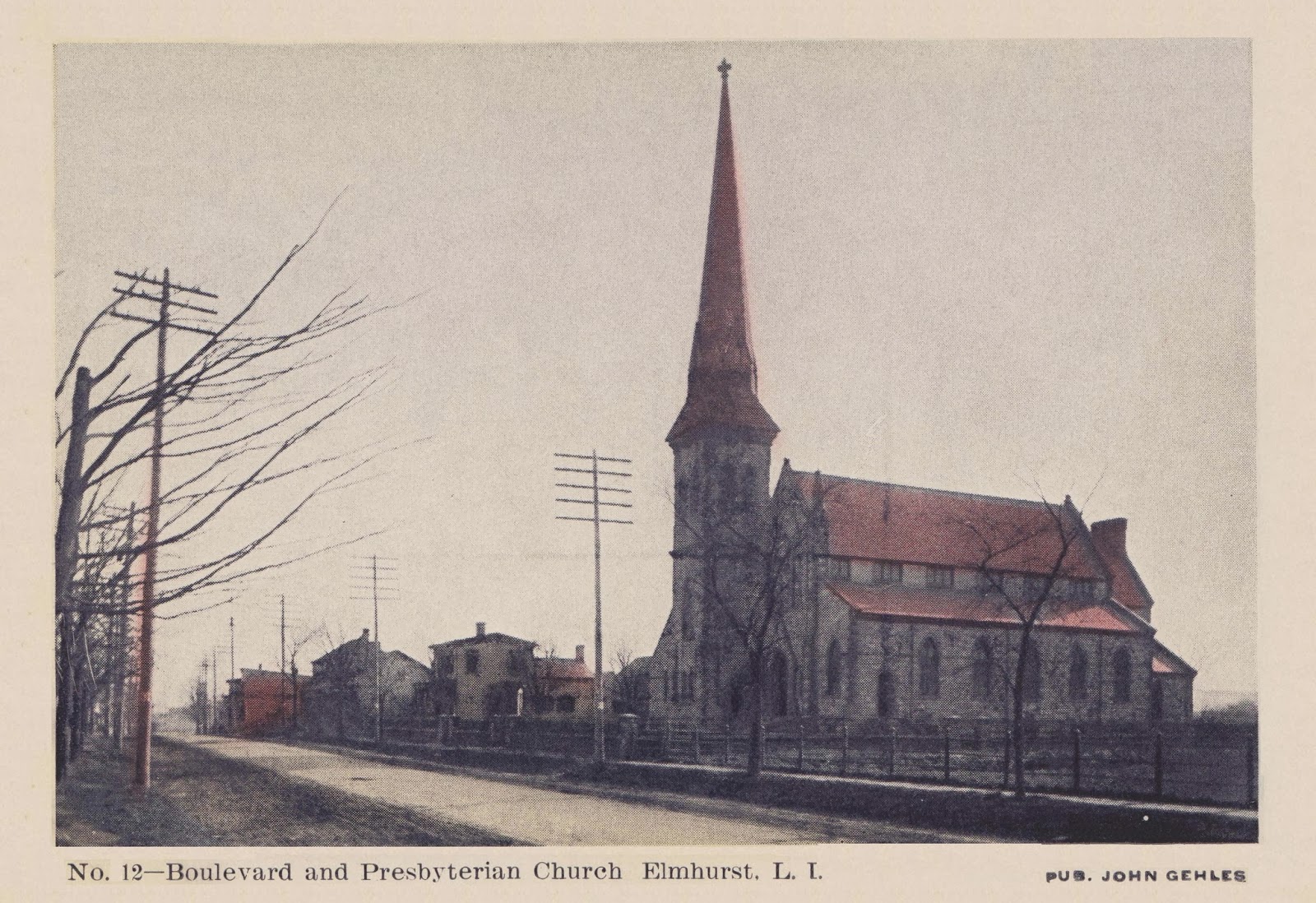
Classical Concert To Benefit Historic First Presbyterian Church of Newtown's Restoration


You are invited to a unique musical event, which will also contribute to a "high note" in historic preservation. On Sunday, January 19 at 1:30 PM, award-winning harpist Tomina Parvanova will be performing Classical works at the historic First Presbyterian Church of Newtown in Elmhurst. 

For a $10 admission, the proceeds will benefit the restoration of this historic church, which was recently designated State& National Register of Historic Places status.

The church was founded in 1652, and the present Gothic sanctuary was built in 1895, and features stained glass by Tiffany artists. ALL are welcome!

The church is located on Queens Blvd & 54th Ave in Elmhurst, Queens. The R & M trains (east end) stop in front, and the Q58, Q59, & Q60 buses are within a block.

About the First Presbyterian Church of Newtown: http://www.fpcn.org/history

Historic & recent photos: http://bit.ly/1dVPoWA

About Tomina Parvanova: http://www.tominaparvanova.com/#!biography/c1enr

Please consider attending this great musical and restoration event, and circulate this blog posting.


Photos courtesy of Chairman Michael Perlman of the Rego-Forest Preservation Council

Saturday, December 21, 2013

Stoa Jewelry To Close on December 31st - Mourning The Loss of A Neighborhood Institution

Rena Monogenis, co-owner of Stoa Jewelry
We are saddened to report that Stoa Jewelry at 71-60 Austin St, one of Forest Hills' last old-time mom & pop shops is closing after 45 years on December 31st. This is the story of Rena Monogenis and Marie Sinanian, which I had the privilege of writing last March: http://www.foresthillstimes.com/view/full_story/22084561/article-Personalization-spans-generations-at-Stoa-Jewelry


The heart of Forest Hills can be found along Austin Street, which was once dotted with both simple and upscale mom and pop shops, reminiscent of a small town. Today, much has changed with the rise of some large corporations, often occupying a few storefronts, but the business district retains its Tudor village and Colonial charm. Nestled between that charm is a gem, where multi-generational patrons come upon a recessed flagstone entryway, sided by tastefully decorated window displays under a rustic wooden sign which reads, “Stoa Jewelry.”  


Enter Stoa at 71-60 Austin Street, and whether you are a longtime or new patron, you will be greeted with a smile and the amiable demeanor of business owners Marie Sinanian (founder) and Rena Monogenis. They have been giving their heart to the community for nearly 45 years, by offering custom-produced jewelry, as well as art from local artists.

Making our way inside, the rustic charm continues with wood and glass wall and counter displays of custom-made jewelry, high ceilings bearing accent lights on artwork, a rugged plaster wall finish, and wood plank floors. Classical music adds to the gallery ambiance.

Customization is a dominant aspect of Stoa’s mission. “We design every type of jewelry that can be worn, from looks that are classic to way out there,” said Monogenis.  Jewelry is hand-crafted in sterling silver or gold, among other materials. Jewelry was originally produced in the back of the shop, but now the owners sketch the designs by hand and it is custom-made off premise by local and international artists. She stated, “If you want cufflinks and you have the design, we can execute the design, but if you want us to design it, we can from scratch.” 


 A notable custom-made design is a sterling silver barbell pendant, where the weight actually fluctuates. A sculptor from Germany designed a universe-inspired abstract sphere comprised of sterling silver rings with a single gold bead. It collapses and expands, and can be worn as a bracelet. Monogenis added, “If you wanted to create your own family crest, you would tell us what elements are very important to your family, and then we would design it using symbols.”


Customers often refer local artists to Stoa, and the owners fulfill their mission to the community by selling their work, which ranges from classical to abstract. Currently, paintings from 3 local artists are being offered. Earnings are shared between Stoa and the artist.

Sinanian emigrated from Athens, Greece with her family in 1962, and settled in Forest Hills. Monogenis originated from Manhattan, and at age 8 in 1950, made a move to Forest Hills. Both are Forest Hills residents to this day. In 1968, Sinanian began working for her brother-in-law, who once owned Lorilil Jewelers on Continental Avenue. After learning the business first-hand, she took the initiative in 1972 to open her own jewelry shop on Austin Street, known as “A Bit Outre.” Monogenis, then an employee of Chemical Bank, decided to change her career path not long after befriending Sinanian. She took some jewelry design classes at the 92nd street Y. Sharing a mutual vision, their friendship evolved into a business partnership, and on October 2, 1976, they welcomed their community to Stoa Jewelry.

It may be hard to grasp that the jewelry business was neither owner’s childhood dream, but now it is their niche. Monogenis who first envisioned being a clothing designer at an atelier at age 11, attributes part of their success to a balance between their work styles. “I work more from the heart, whereas Marie works more from the mind,” she stated. 

Stoa was originally situated somewhat west on Austin Street, in a portion of what is now Victoria’s Secret. Sinanian coined the business name due to the large recessed storefront’s configuration, which resembled a portico or arcade in Greek culture. Monogenis explained, “A stoa was an ancient structure that was long and narrow, had columns and a roof, and was the town center where markets and meetings took place and people would sit and think.”

When asked how she felt being one of the last Austin Street mom and pop shops, she responded, “I feel truly wonderful, and I must say that after all these years, we have been blessed with wonderful customers who have become friends.” She then reminisced about yesteryear’s well-known mom and pop shops in close proximity. They were Buster Brown Shoes, Homestead Gourmet Shop, Beau Brummel (clothing), Koch and Nord Delicacies, Horn & Hardart, Towne Shepherd (an influential hair salon), Thorn & Thistle (florist), Ina’s (millinery shop), and Madeline Begg, which she described as an exquisite dress shop owned by her neighbor.      

Throughout the years, Stoa’s clientele included notables such as Geraldine Ferraro, former professional tennis player Renée Richards, Dennis Hevesi, and judges. Within Stoa’s walls, countless memories are harbored relating to the relationship between the owners and patrons, on the basis of the character of the owners and that of which extends into their custom-made jewelry. This contributes to stories ranging from humorous to heart-warming. For example, a long-standing American craftswoman from Maine named Peggy Johnson, worked with Stoa to produce a sterling silver necklace with copper and stone accents, and dangling kitchen pots and utensils as a focal point. Monogenis explained, “A man came into our shop and purchased it for his wife. When he returned, he said the rest of his life won’t be the same, since he will never be able to give his wife another gift that she would enjoy as much.”

A heart-warming story followed. She explained, “We designed a necklace for a woman who is the mother of the bride, and based it on the dress she planned to wear at the wedding. She was thrilled, and thanked us with a photo of her outfit during the wedding.”

As for younger generations hoping to launch a jewelry and art business, Monogenis offered some pointers. “Follow your dream. If it is a true love, that will make your entire life a lot easier. Especially since we are in poor economic times, start small.” Referring to her experience, she added, “We could have expanded way back when, but we felt good with this size, which our customers helped accomplish. I don’t believe that success is measured strictly by money.”

On a Saturday afternoon, 10 year-old local patron Ian Fried and his mother engaged in conversation with Monogenis. He was impressed when he learned about Stoa’s custom-made mission. Some items reminded him about his recent interest in collecting antiques, but only time will tell if it will unfold into his niche. “It’s my first time here, and it’s a very artistic store,” he stated. His mother first shopped at Stoa in 1990, and now the younger generation is being introduced. Fried said, “I always pictured these pieces as old-fashioned items from the early to mid-industrial revolution, but now this has given me a whole new light on antiques and how they are made.”

Monogenis attests, “Customers over the years become the mamas, the papas, and an acquired family,” and added, “They know if they need a place to sit, rest, and socialize over coffee, they can come to us.”